Wednesday, 11 July 2018

Keväistä Tukholmaa 2: Historiska Museet ~~~ Spring trip to Stockholm 2: Historiska Museet

Tukholman toinen kohde -jahka suurkirkko oli ensin katsastettu- oli Historiska Museet. Tämähän oli itselleni varmaan neljäs kerta Historiskassa joten sitä ensimmäisen vierailun äimänä ihastelua ei oikein enää tavoittanut ja esineistäkin varsin hyvin tiesi mitä tuleman piti. Mutta aina se on vaan yhtä ihana museo ja erityisesti viikinkiajan näyttely herättää huokauksia kerta toisensa perään -ja ne keskiajan huonekalut, taas tuli nimittäin räpsittyä erinäisiä rakennekuvia. Ja muitakin kuvia. Paljon kuvia.

The second destinatin in Stockholm -right after Storkyrkan- was the Historiska Museet. This was far from being my first trip to Historiska (fourth visit, I guess), so the first impression and the awe was not quite there to grasp anymore and I pretty much knew what items to expect from the exhibitions. But Historiska is a wonderful museum and totally worth several visits time after time -I love especially the Viking age exhibition and the medieval furniture! I just had to take some photos of those too, structure-wise. And other photos. A lot of photos.

Viikinkiaika ~~~ The viking age

Viikinkinäyttelyhän on heti ensimmäisenä vastassa kun ovesta saapuu. Ja elävöittäjä-ansana heti ensimmäisten vastaantulevien esineiden joukossa on yksi näyttelyn julkkisesineistä, Mästermyrin viikinkiaikainen työkaluarkku Gotlannista -ja vieläkään en muuten ymmärrä miksi se on sijoitettu lattiatasoon, niin pieni esine (korkeus jotain 30 cm:n luokkaa). No, arkun rakenteen tarkasteluun sopivan kuvakulman hakeminen vähän tarkoitti sitä että sopivaa perspektiiviä hakiessa oli sitten pers-pektiiviä tarjolla muillekin... Seuralaisethan olivat tähän jo tottuneet, muista museovierailijoista en sitten niin tiedä.

The viking exhibition is what one first stumbles across when arriving to the museum. And as a trap for living history nuts, one of the "celebrity items" is among the first items one sees on the exhibition -the Mästermyr tool chest from Gotland and all its tools! And I still can't quite understand why it has been placed on the floor, such a small item (the height is something like 30 cm). But that's not really an obstacle when it comes to observing structural details, it just meant that I was on my hands and knees on the museum floor and pretty much crawling around the chest checking for joints and hinges and stuff. My companions have been well accustomed to that habit, I don't quite know about other visitors though...


Ja vaikka työkalut muun arkielämän esineistön ohella aina viehättävätkin, blingille on aina sijansa. Viime aikoina posament-punotut kuviot (onkohan näille ylipäätään olemassa suomenkielistä nimeä?) ovat kovin kiinnostaneet, vielä en ole päässyt testaamaan mutta varmaan jossain vaiheessa sitäkin. Sitä odotellessa.

And although I do fancy tools and other everyday objects, there is always a place for some bling. Lately I've been curious of these metal thread posament decorations. I haven't quite tested making them yet, though, but at some point I'm quite sure it'll come to that.
 

Birkasta haudasta Bj 581 löytyneen piippapäähineen hopeiset koristeet olivat olleet välillisesti taas tapetilla jokin aika sitten kun kävi ilmi, että niiden omistaja olikin komean soturihautauksen saanut nainen. Lakin pääteosa on käyttötarkoitukseltaan aivan selkeä sinänsä, mutta nuo pompulat ovat ihmetyttäneet, kaivauspiirroksen perusteella niiden sijainti oli löydettäessä niskassa mutta mitenkähän ne on kiinnitetty ja mihin osaan päähinettä?

These silver hat embellishments of Birka grave Bj 581 had some indirect publicity some time ago when it turned out that their owner was a woman who had received a warrior funeral along with weapons and horses and all. It's the hat I've been wondering -the placing of the conical part is fairly clear (at least one would expect it to be), but how about those mesh-y oblong bits? In the grave they were found at the back neck, but how had they been attached and where?


Esihistoria ~~~ Prehistory

Tässähän järjestys on vähän hassu, jos reittiä jatkaa viikinkiajasta niinkuin tavallaan luontevaa olisi, seuraavaan tilaan mentäessä otetaan takapakkia kivi- ja pronssikaudelle josta taloa luontaiseen kulkusuuntaan edelleen kiertäessä seuraavaksi vastassa on rautakauden loppupää josta pakitetaan taas varhaisempaa historiaa kohden. Hätäinen voisi siis päätellä että olen joka ikinen kerta Historiakassa käydessäni kiertänyt talon väärään suuntaan :D Erityisesti tavan ihmiselle helposti etäiseksi jääviä kivi- ja pronssikautta oli lähestytty hyvien kysymysten avulla. Miten ihminen käsitti ympäröivän maailman, miten taas yksilön ja yhteisöön suhde toisiinsa... Eikä näihin anneta valmiita vastauksia, esineiden perusteella voi tehdä jotain tulkintoja.

It's a bit funny when one first walks through the Viking age exhibition, then one is facing the stone age and bronze age, and after that one stumbles across the late iron age and then goes back in time all the way to the stone age again. It only occured to me a while ago that all these years I've been taking the museum tour in the wrong way around :D But the prehitory exhibitions are delightful, especially the stone age and bronze age which tend to be more distant and not-so-easy to approach. The museum has decided to ask the visitor some very good questions and let the visitor find the answers in the items on display instead of giving direct answers. How does a person percieve the world around him/her? How was a person and his/her community connected to one another? 

Vendel-aikaisen naisen koristeita ja tarvikkeita -siis yhden naisen. ~~~ Vendel age woman's bling and practical items -one woman's, that is.
Syömä- ja juoma-astioita roomalaisajalta ~~~ Eating and drinking the Roman iron age style

Ruotsin historia ~~~ History of Sweden

Ruotsin ollessa varsinaisesti Ruotsi eli keskiaikaa ja siitä eteenpäin löytyi museon toisesta kerroksesta, ja ilahduttavasti sielläkin oli esillä keskiajasta sekä arkielämän esineitä, yhteiskunnan yläluokan elämää että kirkollista esineistöä. Ja edelleen myös vahvasti esinetutkimus-suuntautuneena ilahdutti se, että esineitä oli esillä runsain määrin (ja varsinaiset kirkolliset olivat sitten vielä erikseen omana näyttelynään)! Hassusti satuttiin portaikosta tämänkin näyttelyn "väärään päähän" eli kuljimme näyttelyssä käytännössä ajassa taaksepäin aloittaen 1500-luvusta, käpytellen siitä keskiajan alkuun ja sitten käännöksen jälkeen uudestaan kohti renessanssia, mutta täälläkään ei oltu ensimmäistä kertaa eli näyttely oli kuitenkin tuttu ja ensivaikutelma jo saatu aikaa sitten. Myönnettävä sinänsä on, että renessanssi ja uudemmat eivät varsinaisesti ole ihan sitä ydin-kiinnostusaluettani joten ne osuudet tuli käveltyä läpi syventymättä kovin tarkasti yksityiskohtiin -olihan museota jäljellä vielä runsain määrin joten piti hieman säästellä. Tunnustetava tosin on että saatoin hiukan testailla 1700-luvun vaatteita kun siellä niitä esillä ja testattavana oli :D

Sweden while actually Sweden, ie. from the middle ages on- was exhibited in the second floor. Delightfully there were items from all over the society, from everyday life, from the rich and powerful and some church-related items too (although most of the church items were on separate exhibition a few rooms away). And what was especially nice was that there were a lot of artifacts on display! As we entered the exhibition we arrived in the "wrong end" of the hall, so basically in here too we walked back in time, starting from the 16th century and from there to the beginning of the middle ages, and then back again towards the renaissance. But as this wasn't the first time we saw this exhibition, I guess the first impression had already been made... I have to admit that as renaissance and newer times are not quite what I'm super interested in, I did not pay that much attention to those rooms - I was sort of saving my brain for rooms to come as there was plenty of museum still left at that point. But I also admit that I just had to try some of the 18th century garments on, as there were some recreated clothes specifically for that purpose :D

Kovin viehättävää muotokieltä keraamisissa astioissa. ~~~ Pretty pottery!
Kuva ei oikein anna ilmi sitä miten järkyttävän suuri tämä solki onkaan -halkaisija yli 19 cm. Motala, 1300-l. alku. ~~~ Without comparison it's hard to tell how huge this brooch actually is, more than 19 cm in diameter. Motala, early 14th century.
Puinen kilpi Döderhultista, Smålannista. Tarkoitettu muistoesineeksi, mutta rakenne vastaa käyttökilpeä. 1300-l. ~~~ Wooden shield from Döderhult, Småland. This is a memorial shield but constructed the same way as a shield meant for use. 14th century.
Visbyn taistelu ~~~~ The Battle of Visby

Visbyn taistelu 1361 sai pari vuotta sitten oman näyttelytilansa myös Historiskaan, sitä ennen se oli ollut hyvin edustettuna Gotlannin lääninmuseossa. Visbyn taistelun jälkeisten joukkohautojen materiaalihan on ihan ainutlaatuista, vainajat kun oli haudattu joukkohautoihin täysissä varusteissaan -tämähän ei ollut mitenkään normaalikäytäntö. Mutta ei ollut varsinaisesti hyvän mielen näyttely tämä (no, jos nimikin on "Medieval massacre" niin mitä voi odottaa), joskin hirveän hienosti tehty. Mielenkiintoisena yksityiskohtana taustalla pyöri Battle of Wisby -tapahtumasta kuvattu klippi taisteluun varustautumisesta ja taistelun kulusta.

The battle of Visby in 1361 received its own exhibition a few years ago in Historiska, before that it was exhibited in the county museum of Gotland. The material from post-battle mass graves is quite unique when it comes to medieval warfare, the dead were buried in all their gear which is far from the usual practices. Albeit impressive and very good exhibition, this was definitely not a nice place (well, if the exhibition is called "medieval massacre", what can one expect). But I think that's only proper. As an interesting detail, on the background there was a video clip filmed in the Battle of Wisby -event about preparing for a battle and the battle itself.


Keskiaikainen taide ~~~ Medieval art

Tunnelma oli lähestulkoon helpottunut kun Visbyn taistelun huoneen jälkeen vuorossa oli keskiaikaisen taiteen osasto -vaalea, avara ja valoisa (epäilemättä tahallinen kontrasti!). Keskiaikainen taide tarkoitti tässä tapauksessa ennen kaikkea kirkollista tai kirkkoihin liittyvää taidetta, ja sisälsi pyhimyspatsaiden ja alttarikaappien lisäksi myös melkoisen määrän huonekaluja -penkkejä ja arkkuja ennen kaikkea. Erityisesti tässä ilahdutti se, miten esineille oli annettu kunnolla tilaa ja niitä pääsi katsomaan monesta vinkkelistä, sivusta ja osin jopa takaakin (tämähän tarkoitti sitä että niistä sai myös kunnon kuvia!).

I have to say that I was slightly relieved when after the battle of Visby we entered the medieval art exhibition -it was light and spacious, I believe that's an intentional contrast! In this case medieval art meant objects from or linked to churches -there were statues of saints, altarpieces and most interestingly quite a lot of furniture, chests and seats to name a few. What I found most delightful was that most of these objects had a lot of space around them, and therefore one could easily see side views and even backsides -and that also meant that good photos could be taken!
 
Viklaun kirkon madonna 1100-luvulta. Tämän sisältä löydettiin reliikkipiilo vuonna 2012. ~~~ 12th century madonna from Viklau church. In 2012 conservation a hidden relic was found inside this statue.
Kungsåran kirkon penkki, 1100-1150 ~~~ Seat from Kungsåra church, 1100-1150
Gotlantilaisen Vallstenan kirkon penkki, 1250-1350 ~~~ Seat from Vallstena chursh, Gotland, 1250-1350
Arkku Voxtoripista, Smålandista, 1100-luku ~~~ Chest from Voxtorp, Småland, 12th century

Keskiajan äänimaailma ~~~ Medieval sounds

Täällä osassa näyttelyä en muistanut käyneenikään, joten mahdollista kai on että se oli kasattu edellisen käynnin jälkeen! Joka tapauksessa kovin mielenkiintoinen osio tämä tutustuminen keskiajan soittimiin -esillä oli kahdet keskiaikaiset urut (joista toisia kehuttiin maailman vanhimmiksi säilyneeksi) sekä kelloja. Mahdollista oli myös kuunnella näiden ja muidenkin keskiaikaisten soittimien ääntä kuulokkeista mukavasti sohvalla istuen (ja pieni istumatauko oli ylipäätään ihan kiva tässä vaiheessa).

I had no memory of visiting this exhibition before, so I guess it's possible that it had been assembled after our previous visit! Anyway a really interesting peek into the musical instruments -there were two sets of medieval organs on display, the older one was said to be worlds's oldest surviving organ, along with some bells. In this room it was also possible to listen to the sounds of these instruments and other medieval instruments while sitting comfortably in a sofa -a sitting break was quite welcome at this point. 
Urkukaappi, Sundren kirkko, 1370-l. ~~~ Organ from Sundre church, 1370s.

Historian tulkinnat ~~~ Interpreting history

History unfolds- a reflection -näyttely oli toiseksi viimeinen osa museota jossa tällä kertaa käytiin. Siellä esittelyssä oli nippu esineitä joita oli aikojen saatossa tulkittu eri tavoin. Käsitelyssä oli myös se, miten ylipäätään Ruotsin historiaa oli tulkittu ja miten (ja keiden) historiasta on kerrottu. Hyviä kysymyksiä siis! Esillä olevista esineistä en ole ihan varma miten ne kaikki liittyivät aiheeseen, onko esim. Marbyn keskiaikainen itämainen matto aiheuttanut enemmänkin keskustelua aikoinaan vai miten. Vendel-aikainen kypärä oli siinä mielessä helpompi, sehän on yksi niistä ikonisista historiallisista esineistä jotka varmasti aikoinaan edustivat suurta ja kunniakasta menneisyyttä...

History unfolds- a reflection -exhibition was the second last part of our visit. On display there were quite a few objects that had been intepreted in different ways depending on the time, and in general how history has been told (and whose history has been told). Excellent questions, I say! About the objects, I'm not sure how they were related to the theme, for example has the medieval Marby oriental mattress been causing debate? A helmet from the Vendel period is easier in that sense, it's definitely one of the iconic objects of Swedish history and no doubt has it been thought to represent the glorious past...
Turkkilainen matto Marbyn kirkosta, 1300-1420


Kultanäyttely ~~~ Gold room

No johan tässä infoähkyä podettiinkin mutta vielä oli museota jäjellä. Kellarissa oli aarrenäyttely, toisin sanoen kultaa, hopeaa ja muuta kiiltävää esihistoriasta keskiaikaan. Vastaanottokyky alkoi olla koetuksella, mutta kyllähän nättiä esineistöä katseli! Tosin sen verran on sanottava että tässä nämä nätit jäivät vähän jotenkin irrallisiksi, toki esineissä oli ajoitus ja löytöpaikka ja näin päin pois mutta.. En ihan osaa täsmentää, jotenkin konteksti oli vähän epäselvä. Mutta siis kovin ihania esineitä toki ja ihan varmasti näihin pystyisi keskittymään paremmin jos ei olisi juossut koko museota läpi tätä huonetta ennen.

I guess it's safe to say that as we entered the gold room, we were all suffering from information OD. But there were still sights to see, in the basement shiny and bling things from prehistory to medieval times. I had some difficulties in absorbing the information, but these kind of pretties were easy to look at. Although I think these splendid artifacts were left somehow left, like, separate, I mean of course the date and place were mentioned but somehow I felt they were just slightly off their context, hard to clarify... But none the less there were lots of beautiful artifacts and I bet it would've been easier to pay attention if one had not been through the whole museum before entering this room. 


Siinäpä sitten olikin ensimmäisen Tukholman-päivän museotarjonta, seuraavana päivänä suunta oli vielä Medeltidsmuseetiin!

And that was all there was for museums during our first day in Stockholm, on the next day we headed off to Medeltidsmuseet!


Friday, 22 June 2018

Keväistä Tukholmaa 1: Suurkirkko ~~~ Spring trip to Stockholm 1: Storkyrkan

Postaukset laahaavat nyt lievästi perässä, mutta parempi myöhään kuin ei ollenkaan, eikös? 

Kevään kunniaksi päädyttiin pienellä porukalla piipahtamaan Tukholmassa! Laivamatka kun perinteisesti Turku-Tukholma-välillä päätyy Tukholmassa siihen, että aikaa ennen yhtään minkään avautumista on runsain määrin ja koko kaupunkikin on silloin vielä kovin hiljainen, suoritettiin ennen ensimmäisen varsinaisen kohteen avautumista vähän kaupunkikatselmusta Vanhassakaupungissa. Tukholma on kyllä varsin viehättävä paikka!

It seems that my posts are lagging behind a bit, but better late than never, right?

For a quick spring trip we ended up in Stockholm with a small group of friends! As the ferry between Turku and Stockholm is in Stockholm way too early in the morning and absolutely nothing is open at that time -even the city itself seems to be somewhat asleep- we ended up walking around the Old town for a bit. Stockholm indeed is a charming city!


Ensimmäinen reissun varsinainen kohde oli Suurkirkko, heti kuninkaanlinnan vieressä. Kirkko on mainittu ensimmäisen kerran kirjallisissa lähteissä 1279 ja oli lajissaan keskiajalla koko vanhankaupungin ainoa. Varhaisimmasta, 1200-luvun rakennusvaiheesta on kirkossa nähtävissää enää varsin vähän, 1300-luvusta näkyvillä on komeita kattomaalauksia. Suurimmalti osalti ulkomuoto perustuu 1400-luvun täydennyksiin ja korjauksiin,  jonkin verran lisäyksiä myös myöhemmältä ajalta kun kirkkoa on "päivitetty" muodin mukaiseksi.

Our first target was the Storkyrkan (the great church), right next to the royal palace. The church is first mentioned in written sources in 1279 and during the middle ages it was the only church in the island that is currently known as the Old town. The traces of the oldest 13th century building phase are hardly visible anymore, from the 14th century there are handsome paintings in the ceiling. Mostly the looks are from the 15th century and also several additions and modifications have been carried out after that when the church has been "updated" to match the current fashions.

1300-luvun kattomaalaukset ~~~14th century paintings on ceiling
Kuva/photo aix.se. Erityisen kivat katon tiiliholvaukset, ilmeisesti 1400-luvun loppupuolelta. Otin kyllä itsekin kuvan ihan samasta paikasta, mutta se osoittautui lähemmässä tarkastelussa ikävän epätarkaksi :( ~~~ The interesting vaulting, apparently from the late 15th century. I did take a photo from the very same place, but in closer inspection it turned out to be not in focus :(

Tämän kirkon julkkishan on Pyhän Yrjänän ja lohikäärmeen patsas, jota itse asiassa tänne varsinaisesti tultiinkin katsomaan. Ja olihan se katsomisen arvoinen, ihan jo silkka koko yllätti. Paitsi että keskiaikaisessa kirkossa oli hyvinkin paikkansa pyhimyspatsaille (tämäkin toimittaa samalla relikvaarion virkaa), tämä patsas on valmistunut 1400-luvun lopulla Brunkebergin taistelun (1471) kunniaksi. Yksityiskohtana muuten jota ei välttämättä kuvista huomaa, tässä lohikäärme on kuvattu poikasten kera!

The most famous item in this church is the statue of St. George and the dragon. It was the main reason why we went there,  and it was definitely worth seeing- even its sheer size was impressive! Not only the statue is a statue of a saint -they of course have their places in medieval churches and this one also doubles as a reliquary- the statue commemorates the battle of Brunkeberg (1471). As a detail, the dragon here is portrayed with a few younglings, a detail mostly invisible in photos!

Prinsessalla komeaa brokadia yllä ~~~ The princess wears some impressive brocade!

Keskellä kirkkoa oli kuningatar Kristiinan esineistöä näytteillä, aina kruunajaisviittaa myöten (melkoinen laahus, noin niinkuin huomiona). Kristiinahan kruunattiin vuonna 1650 juuri tässä nimenomaisessa paikassa. Näyttely oli ilahduttava yllätys, en ollut yhtään varautunut. Tämä näyttely valitettavasti tosin loppui jo 15. toukokuuta...

In the middle of the church there was a small exhibition of items that belonged to queen Christina, starting from her coronation cloak (some train, I say!) And Christina was crowned in this very place in 1650. The exhibition was a delightful surprise, I had no idea it was there. Unfortunately the exhibition also ended in May 15th...


Keskiaikaista esineistöä muuten kirkossa oli sinänsä vähän, pyhän Yrjänän patsaan lisäksi löytyi komea (myös mitoiltaan) seitemänhaarainen kynttilänjalka.  1400-luvun lopulla Saksassa valmistetulle kynttilänjalalle löytyy kuulemma myös vastine Saksasta.

Besides the St. George and the dragon-statue, there were very little medieval items around. There was a handsome late 15th century chandelier, though, originally German. And it's been said that it also has a twin in Germany.


Muuta, uudempaa komeaa sitten olikin, kuten nämä 1600-luvun kuninkaallisten istuimet. Joku voisi väittää yltiöprameaksikin :D

But there was other, newer pretties, such as these royal 17th century pews. Someone could even call them overly pompous :D


Tästä sitten jatkettiin kohti Historiska Museet'ia, siitä seuraavassa postauksessa!

From here we went on with our sightseeing, off towards the Historiska Museet. More about that on the next post!


Thursday, 14 June 2018

Pinkki huppu ~~~~ A pink hood

Uutta napitettua huppua oli ollut ajatuksissa jo jonkin aikaa, ja kun toisesta prokektista jäi hyvä määrä leikkuujätettä, pitihän asiaa ruveta suunnittelemaan. Pinkki ei ole varsinaisesti se väri minkä kanssa olisin eniten kotonani, mutta Romance of Alexanderista (1340-l Flanderi) löytyi niin kiva inspiraatiokuva että sitä lähdettiin lähestymään. 

I've been thinking of a buttoned hood for quite some time now, and since another project left me a generous amount of cutting waste, I  just had to start planning that on a more detailed level. Pink isn't exactly the colour I'm most at home with, but since I found such a nice inspiration pic from the Romance of Alexander (1340s Flanders) I decided to aim for that.
Uusi pinkki huppu! ~~~ new pink hood!

Romance of Alexander, Ms. Bodleian 246, fol. 171r
Alkuperäinen kangas oli värjäämätöntä Medeltidsmoden luomuvillaa, toimikassidoksista, kude ja loimi hienokseltaan eri väristä. Pakastimessa puolestaan oli kerran keitetyt krappijuuren palat, nehän eivät yhdellä värjäyksellä luovuta kaikkia värejään joten ne käytettiin uudelleen ja kiva pinkkihän siitä tulikin. Värjäsin kankaan alunapuretuksella ja tulos oli yllättävänkin tasainen, mikä ei aina pienessä kattilassa ole ihan itsestäänselvyys.

The original fabric was undyed organic wool from Medeltidsmode. It was of twill weave, warp and weft slightly different colour. Also I had some once-boiled madder roots in my freezer, they are known not to yield all their colour in one boiling session so I re-boiled them - and the dye ended up as being quite a nice pink! I mordanted the fabric with alum and got an surprisingly even result, not something that can be taken for granted when dyeing in a small-ish kettle.

Värjäämätön kangas, tästä näkee oikean ja nurjan puolen sävyeron. Kissa-apu on tyytyväinen itseensä. ~~~Undyed fabric, one can well see the difference in colour on different sides of fabric. Kitty help is very pleased with himself.

Värjättävänä, alkaa näyttää jo punaiselta. ~~~ Dyeing in process, reddish already.
Nätti kesäpäivä,hyvä kuivattaa kangasta ulkona. ~~~ A pretty summer day, perfect for hanging the fabric out to dry.

Kaavana käytin suuntaa-antavasti Grönlannin Herjolfsnes 66:n kaavaa sillä erolla, että tästähän oli tulossa napitettava kun taas alkuperäinen oli edestä umpinainen, ja pidensin häntää hiukan. Käytin alkuperäisen mittoja niin pitkälle kun niitä oli mainittu. Huppu osoittautuikin yllättävän isoksi, se tulee varsin alas hartioille. Mahdollista on, että tämä on ollut miehen huppu sillä löydettäessä se oli käytetty käärinliinaksi mieheksi tulkitun luurangon jaloille (vaikka eihän se varsinaisesti välttämättä todista sen kummempaa hupun omistussuhteista) ja kuvituksissakin tämäntyyppisiä alemmas tulevia huppuja nähdään enemmän miehillä, naisten huput tuppaavat olemaan pienempiä.

I used the pattern of a norse Greenland find, Herjolfsnes 66, as a guideline. The difference was that I was about to make a buttoned hood where as the original was a closed one. Also I extended the tail somewhat. I used the measurements of the original hood wherever they were mentioned. The hood turned out to be surprisingly large, it extends quite far below shoulders. It's possible that the original Herjolfsnes 66 was a man's hood since it was found wrapped around the feet of a skeleton that was interpreted as being male. That's hardly a definite proof of ownership, though, but also in illustrations larger hoods like this are more commonly seen worn by men, women's hoods are smaller and more snug.
Alkuperäinen Herjolfsnes 66. Kuva sivulta Some clothing of the Middle Ages.


Alkuperäisen Herjolfsnes 66:n ompelu- ja viimeistelytekniikoista ei ollut Woven into the earth -kirjassa mainittu oikein mitään, esimerkiksi tämän hupun alareunaa ei ollut säilynyt, ja tilanne oli huononpuoleinen muissakin hupuissa. Sovelsin sitten hieman muiden Grönlannin huppujen tekniikoita niistä mistä tietoa oli saatavilla, huppu nr. 65:ssa (museonro D10596) pääntien reuna oli ommeltu takapistolla kiinni ja varmistettu kahdella "stab stitch"'-rivillä joten sillä mentiin tämänkin kanssa, sovelsin samaa myös alareunaan ja nappilistaan. Tuli muuten hyvä ja napakka reuna.

The sewing techniques of the original Herjolfsnes 66 were largely unmentioned in Woven into the earth, and for example the lower edge had not survived. The situation was almost as bad with other hoods as well. So I took what I had and applied other Herjolfsnes techniques to this hood. In hood nr. 65 (Museum nr. 10596) the face opening was sewn down with a whip stitch and secured with two rows of stab stitch, so that's what I did with my hood too, and treated the front and lower edges the same way. A nice and firm edge as a result!

Palat yhdessä mutta täysin viimeistelemättä ~~~ pieces joined but still totally unfinished.

Käsikirjoituksen kuva ei ole kovin selkeä mitä tulee nappeihin, joten päätin ratkaista nappimateriaalivalinnan sillä mikä on lähinnä eli hupun leikkuujätteellä ja kangasnapeilla. Tässä kohtaa otin apuun Lontoon löydöt, sieltähän tunnetaan 1300-luvun kerroksista useita isoja jäänteitä napitetuista hupuista. Koska tyypillinen keskiaikainen napitus on kovin tiheää, asensin napit paikoilleen peukalonleveyden välein. Nappien kokonaismääräksi tulikin sitten 15 kappaletta.

The illustration on the manuscript isn't that clear on the choice of button materials, so I took what was closest to me, the cutting waste and made fabric buttons out of that. At this point I decided to go for the London finds for a source, since large fragments of 14th century buttoned hoods have been found from London. Because the typical medieval way of buttoning garments is very dense and lots of buttons, I added buttons only a thumb's width apart. That resulted in 15 buttons altogether.

Napinaihioita ~~~ Buttons in the making

Pellavainen nappilista ~~~ Re-enforcing the buttonhole edge with a strip of linen fabric


Lähteet ~~~ Sources
Woven into the earth
Textiles and clothing from medieval excavations in London 1150-1450
Buried Norsemen in Herjolfsnes

Tuesday, 5 June 2018

Lasihelmiä, otto 2 ~~~ Glass beads, take 2

Koko komeus tässä! ~~~ My pretties from this course!
Taas oltiin lasihelmiä tekemässä, jo toisen kerran (ensimmäisen kerran postaus täällä)! Paikkana oli taas tuttu Pyhäjärviseudun kansalaisopisto ja opettajana jo viime kerralta tuttu Lea Schwantz. Tälläkään kertaa kurssi ei varsinaisesti keskittynyt historiallisiin helmiin, mutta itse ajattelin vähän viime kertaa enemmän panostaa asiaan -nyt kun aivan perusteet olivat jo hallussa päin. Eihän sitä yhden kurssin perusteella parhaalla tahdollakaan itseään kovin taitavaksi voinut sanoa, mutta pitipä koittaa muutamia historiallisen oloisia tekniikoita kun kerran tilaisuus oli. Joten tässä näitä omia tekeleitä ja niille historiallisia verrokkeja, noihin pyrittiin.

And again we headed off to make some glass beads, for the second time now (post about the first tries here)! Our teacher was the same as last time, the skilled Lea Schwantz. It also remained unchanged that the course did not focus on historical glass bead making techniques, but since I had already gotten a little glimpse on what the basics on glass bead making are, I decided to focus more on more historical-looking beads. Although I could by no means call mysef an expert after one course, and not even after this second one, but I decided to try my hand on making some historical-ish looking beads now that I had a chance. So here are the beads I made, and some actual historical examples -I was aiming for those, more or less.

Yksiväriset ~~~ Single coloured beads
Sinisiä yksivärisiä lasihelmiä viikinkiajalta Pöytyältä. ~~~~ Blue undecorated viking age beads from Pöytyä, SW Finland. Kuva/photo Finna.
No näitähän tuli tehtyä aika nippu jo viimeksi eikä ketään varmasti yllätä, että nämä olivat jo aikoinaan niitä yleisimpiä -yksinkertaisia tarvitaan, että monimutkaisemmat pääsisivät esille (vaikka moderni estetiikka ei välttämättä olekaan ihan yksi yhteen muinaisen kanssa), ja löytöjen valossa näyttää siltä että jopa koko helminauhan koostaminen yksivärisistä on aivan käypä ratkaisu. Muotoasioista muuten havaintona, että siinä missä normaalisti helmestä muotoilematta tulee palleroisen pyöreä, varsin monet etenkin Suomen rautakautiset helmet ovat vähän muotoiltuja ja litteitä, hieman sylinterimäisiä.

Well, I made quite a few of these last time too, and I assume no-one is really surprised to find that these were the most common type of beads even back in the Iron age. After all, one needs simple beads to make the complicated ones stand out more (although modern aestheetics and Iron age concept of what looks good are not necessarily one and the same), and when it comes to finds, it seems that it's a completely valid choice too to use only single-coloured beads for one's necklace or other string of beads. When it comes to the shape of beads, normally without any shaping the beads end up round-ish but quite a few Finnish iron age beads are slightly shaped, more flat, rather like cylinder-shaped.

Melonihelmet ~~~ Melon beads

Viikinkiaikainen ,melonihelmi Pöytyältä. ~~~ Viking age melon bead from Pöytyä, SW Finland. Kuva/photo Finna

Kermanvaalea lasi käyttäytyi varsin erikoisesti, vaikka se oli puikkona ja vielä sulatettunakin kermanvaalea, valmiina helmenä se oli kehittänyt ikänkuin punaista "ruostetta". Tätä olisi voinut käyttää hyödyksi jos olisi etukäteen tietänyt, mutta noin odottamattomana värinmuutoksena se aiheutti vähän päänvaivaa. Mutta näin siis tällä kertaa, ei voi materiaalin käytöstä näemmä täysin ennustaa. Muodon puolesta kuitenkin tuli aika tavalla sitä mitä piti. Nämä omat yksilöni ovat jopa vähän leveitä verrattuna historiallisiin melonihelmiin, mutta niitä tunnetaan melko tavalla eri leveyksisiä, myös Suomesta. Kuviointi tapahtuu tökkimällä uria pehmeään lasiin, omassa tapauksessani hyvinkin paljon ruuvimeisseliä muistuttavaa työkalua käyttäen. Tarkkahan siinä saa olla, lasi kun kovettuu hyvinkin nopeasti kun sen ottaa liekistä pois, joten urat on syytä saada kohdilleen nopeasti. Vaikka ainahan toki voi uudelleenlämmittää ja muotoilla uusiksi, mutta yhden kohdan korjaamiseen se ei oikein sovellu.

The cream coloured glass showed some curious behaviour, it was nice and solid offwhite in colour when in rod and even when heated, but once finished it seemed as if it had developed some kind of red "rust". This could've been exploited if one had been aware of it in the first place. Well, one cannot always fully predict on how material behaves... But when it comes to shapes, these ended up quite a lot like they were intended. These ones that I made are quite wide when one compares these to the actual historical examples, they come in several sizes starting from very narrow flower-like beads -these kinds have been found in Finland too as well as wider ones. The shaping takes place when the glass is still hot and soft, one pokes the soft glass with a metal tool which in my case looked quite a lot like a screwdriver. One needs some precision as glass hardens again quite fast-the shaping needs to be done quickly and accurately! Of course one can re-heat and reshape the bead, but that's not really a suitable method for fixing a single detail.

Pistekoristeet ~~~ Dot decorations
Ravattulan Ristimäen komeassa helminauhassa on myös pistekoristelu edustettuna. ~~~The handsome necklace from Ravattula Ristimäki also features a bead with dotted decoration. Kuva/photo Ristimäen blogi.

Tätä kuviointitapaa opiskeltiin jo viime kerralla, ja koska lopputulos on kiva ja kuviointitapa yksinkertainen, pitihän vastaavia tehdä tälläkin kertaa. Tosin edellä manattu kermanvaalea lasi teki tepposet tässäkin joten kaikki pistekuviot eivät näkyneet ihan niin kuin olisi ollut kiva... Historiallisessa mielessä pistekuvioihin -yksinä tai kaksinkertaisiin pisteisiin- törmää myös usein, eikä se kai ole mikään erityisempi ihme sillä se on varmaan yksinkertaisin mahdollinen kuviointitapa -ohuen ohuella lasipuikolla tökkäistään helmen pintaa ja riippuen siitä halutaanko pisteen olevan muun helmen tasalla vai koholla, sitä joko lämmitetään siitä kohtaa tai ei. Yksinkertaista ja mukavaa.

This type of decoration was familiar from the previous course. And because it is a simple method of decoration and I like the outcome, I just had to do beads like these again! Although the cream coloured glass caused some minor trouble in here too and on occasion the contrast isn't as big as I intended it to be... Historically speaking, dotted decoration is one of the most common ones, be they one dot or concentric dots. And that's no wonder since it's also one of the most simple forms of decorating a glass bead -one needs a thin glass rod (called a stringer), heats it, pokes gently the surface of a glass bead with it and depending on if one wants the dot to be pronounced or even with the rest of the surface, heats it again or not. Simple and fun!

Höyhenkuviot ~~~ Feather patterns
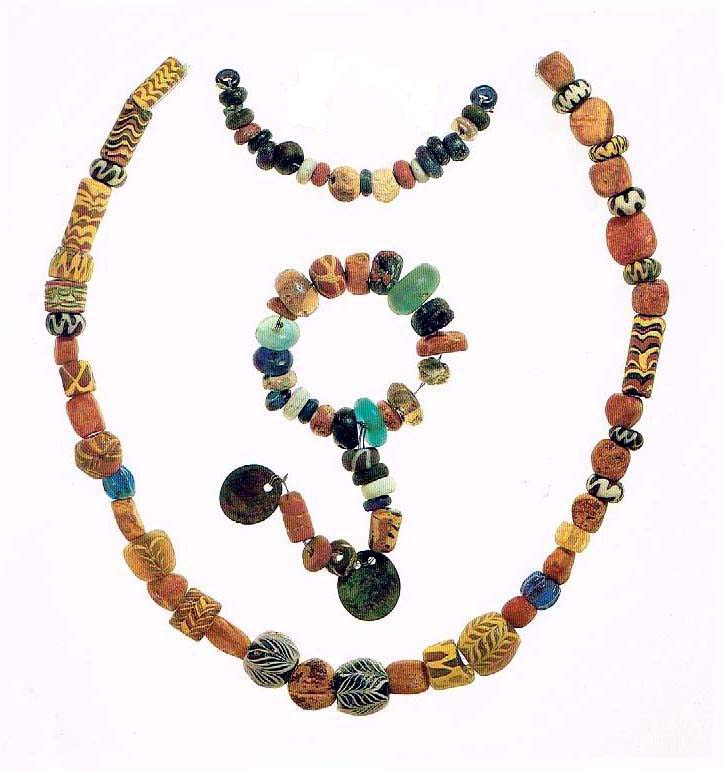
Saksilainen kaulanauha ja rannekoru 500-luvulta ~~~ Saxon necklace and bracelet, 6th century. Kuva/photo Hampshire archaeology

Tämä oli ihan uutta tällä kertaa! Opettaja näytti miten aikaansaadaan hieman höyhenmäistä kuviota, ja sehän oli mukavaa. Tämä kuviointityyli vaan on kovin harvinainen Suomen rautakaudella ja myös viikinkiajan Skandinaviassa (toisaalta taas jonkin verran aiemmin Englannissa niitä sitten taas tuntuu olleen varsin runsaasti). Pohjoisessa jopa siinä määrin harvinainen että jos tarkasti suomalaistyylistä omaa helminauhaani olisin nyt koostamassa, tällä tavalla kuvioituja helmiä mukaan pääsisi ehkä yksi tai jos kaikkein tyypillisintä haetaan, ei välttämättä ehkä sitäkään. (Sikäli hirmuisen harmi että tämä on ihana kuvio!) Edit: Kuulemma Saksan alueella tätä löytyy myös viikinkiajalta.

Kuvioinnin tekeminen olikin sitten yllättävän yksinkertaista vaikka prosessi olikin melko monivaiheinen. Pohjana oli pitkulainen, sylinterinmuotoinen helmi, joka saatiin aikaan tekemällä ensin kaksi tavallista helmeä aivan kiinni toisiinsa, sulattamalla niitä hiukan yhteen ja lopulta muotoilemalla grafiittilevyä vasten tasaiseksi pötköksi. Kuvionti aloitettiin vetämällä ohuella lasilangalla kontrastivärisiä raitoja helmen pintaan pitkittäissuuntaisesti ja sitten vetämällä ura niiden poikki metallitikulla. Tasoitus vielä liekin lämmössä, ehkä  ja kuvio olikin valmis! Omissa siis kuvio tuli yhdellä uranvedolla, mutta alla olevasta kuvasta voisi päätellä että eri suuntiin vetämällä saisi varsin nättiä jälkeä myös eikä pohjahelmen tarvitse olla pötkylä.

This was totally new! Our teacher showed how a feather shaped(ish) decoration is made, and that was indeed fun! This type of decoration is quite rare in iron age Finland and also in viking age Scandinavia (but in Saxon England it seems to have been  quite common). In the north it seems to have been so rare, that if I was constructing my own Finnish-style late iron age necklace atm, perhaps I would add one bead decorated like this but no more, if the aim was to create something that's most typical, perhaps even that one "feather" decorated bead would be too much. Which is slightly unfortunate, because I love this type of decoration (but the beads surely will find their uses, no doubt about that!). Edit: A friend told me that there are beads like this found in Viking age Germany.

Making of said decoration was a process with several stages, but all in all it was quite simple. A cylindrical bead was the base, it was created by making two "regular" beads very close to another and then shaping them by rolling them lightly on a graphite paddle. The actual decoration was formed by drawing contrast coloured lines with a thin glass rod lengthwise to the bead's surface, and then by using a metal pin drawing a line across those lines, horizontally. Some warming and perhaps little re-shaping and it's done! That's at least how it was done in my beads, but looking at the lower pic, one can spot that the base doesn't need to be cylindrical and although in my beads the metal pin lines were drawn only once, one can just as well draw several lines to different directions and get very pretty results. 

Sunday, 27 May 2018

Dublin IV: Trinity College & National Leprechaun Museum

Trinity Collegen kirjasto on koti usemmallekin varhaiselle irlantilaiselle käsikirjoitukselle, kuuluisimpana näistä Book of Kells. Tätähän yleisesti pidetään kelttiläisen taiteen varsinaisena kulmakivenä, joten pitihän sitä sitten mennä katsomaan kun nurkilla oltiin. Pelivetona ostettiin liput ennakkoon, ja tätä voi suositella ihan jokaiselle joka paikalla käy sillä vaikka lippuja myydään myös paikan päällä, jono lippukassalle oli odotuksiakin pidempi ja visiittipäivänä keli oli vielä harvinaisen huono. Ennakkolipun ostaneet marssivat sujuvasti jonon ohi ja näyttivät puhelimen ruutua sisälle mennessään :)

The Trinity College library is a home for several early Irish manuscripts, the Book of Kells being the most famous of them all. It is also considered as being one of the greatest masterpieces of Celtic art, so no question whether we should visit the library while in town. It was a brilliant move to buy the tickets in advance, and I can really recommend that to anyone about to drop by. Tickets are sold at the door too, but when we were around the queue was even longer than I expected it to be and weather was nothing short of terrible on the day of our visit. Well, we had our pre-purchased tickets and we happily marched past the queue and only showed our phones at the door :)


Itse varhaisten käsikirjoitusten näyttelyssä ei saanut kuvata, mutta tässä vähän tunnelmaa sieltä kuitenkin -jos jono oli melkoinen, oli väkeä ängennyt näyttelyyn sisällekin niin paljon että olo oli lähestulkoon tuskaisa. Ennen varsinaisia näyttelyn päätähtiä eli vanhoja käsikirjoituksia vuorossa oli näyttelysalin verran taustoittavia tekstejä koskien paitsi itse kirjoja, myös niiden tekijöitä ja tekovälineitä -varsin informatiivista ja kivasti toteutettu. Itse kirjat olivatkin seuraavassa huoneessa, vaakasuuntaisessa vitriinissä -epäilemättä kirjoille itselleen ihanteellinen ympäristö, mutta kun katselijoita oli viidessä rivissä ja hieman lyhyenläntä allekirjoittanut siellä kauimmaisena, havainnoksi jäi että siellä mahdollisesti jotain kirjoja vitriinissä oli. Ei toivoakaan että olisi pystynyt katsomaan useammalta puolelta kiertämällä vitriinin ympäri, joten ehkä lopulta parempi olikin että ostin museokaupasta näitä esillä olleita teoksia käsittelevän kirjan ja tarkastelin sitä sitten paremmissa olosuhteissa.

Taking photos was forbidden in the exhibition of the old manuscripts, so I have no photos of those. However, as one could expect, since there were a lot of people waiting to come in, the exhibition was crowded as well. Before the actual manuscripts there was a hall filled with information plaques about the manuscripts themselves, the monks who made the manuscripts and techniques and materials that were used in the process -quite informative and nicely written! The books themselves were on the next room, lying horizontally in a glass case. No doubt that was a good environment for the books, but because the small-ish room was so packed and I'm not the tallest person around, I barely got a glimpse and I can only confirm that there were some books around but I couldn't even start thinking of, for example, walking to the other side of the glass case and seeing the books from another angle. Bit of a shame, really, but from the museum shop I got myself a nice book about the manuscripts. I can familiarize myself to the manuscripts with that! 


Ilahduttavampi kokemus oli näyttelytilan yläkerrassa sijaitseva oppilaitoksen vanha kirjastohuone Long Room (vaikka väkeä sielläkin ymmärrettävästi riitti). 1700-luvun alussa rakennettu ja 1800-luvun puolivälissä  yläsuuntaan laajennettu kirjastohuone toi mieleen useammatkin elokuvat ja olisin kyllä sitä mieltä, että jos olisi ollut vähän rauhallisempaa, olisin voinut viihtyä tuolla vaikka miten pitkään!

Kirjastossa oli esillä myös 1400-luvulta peräisin oleva harppu, yksi vanhimmista säilyneistä lajiaan. Sitä kutsutaan myös Brian Borun harpuksi, mutta herran kanssa tällä ei kyllä liene mitään tekemistä. Tämähän on se soitin joka on irlantilaisessa eurokolikossakin...


The upstairs Long room library -the former university library- was unexpectedly more delightful experience. Although this one was crowded too, the big room made the feeling less claustrophobic.  The library was originally built in the early 18th century and expanded (upstairs!) in the mid-19th century. It reminded me of several films, too, and had it been more peaceful, I would've loved to stay there for -well, I don't know how long. But I love libraries :)

Also in the library there was the one of the oldest surviving Irish harps on display. It's been called the Brian Boru's harp, but in real it's several centuries younger than that. Originally from the 15th century, this very instrument is the one that's depicted in the Irish Euro-coins...


Illalla oli vuorossa vielä National Leprechaun Museum. Menninkäiset ja Irlantihan kuuluvat ihan erottamattomasti yhteen! Tämä menninkäismuseo osoittautui ihan eri tyyppiseksi laitokseksi kuin mikään tähän asti vierailtu, vierailu perustui likipitäen täysin varsin sujuvasti huulta heittävään oppaaseen. Ja sujuvasti puhuikin, tarinankerronta oli hallussa ja tekstiä riitti menninkäisistä historian saatossa, menninkäisten ja ihmisten kohtaamisista ja menninkäisten asuin- ja elinolosuhteista, noin muutamia mainitakseni. Tosiaan hupaisa vierailu oli tämä, ja ilmeisen suosittu paikka sillä tännekin jouduttiin hankkimaan ennakkoliput hyvissä ajoin, suosittelen samaa muillekin. Kuvaaminen oli hankalampaa, mutta ei tänne visuaalisen puolen takia mentykään. Ja museokaupassa oli huomattavan paljon ja varsin laadukasta tarjontaa tarinoita ja mytologiaa koskien. Ja jännästi lähti kirja sitten sieltäkin.

In the evening we headed off to the National Leprechaun Museum. No Ireland without leprechauns, right? :D And this was a museum of quite a different style than any museum I've visited before. It was based on not objects, but stories -and our guide was one gifted storyteller! She told us about the history of leprechauns in Ireland, encounters between humans and leprechauns and how and where leprechauns reside -to name only a few. So indeed this was a lovely visit and it indeed seems that this is one popular place, we had to book our tickets well in advance in here too and I recommend the same for anyone about to visit. Taking photos was a bit more difficult since mostly the place was quite dim, but it wasn't really the visual side that was attractive in here (although it accompanied well the storytelling!). Bonus points for the museum shop, it had quite a lot to offer (and good quality) when it comes to leprechaun stories, traditions and Irish mythologies. And (un)surprisingly a book followed me home!


Monday, 21 May 2018

Dublin III - Dublinia -museo ~~~ Dublinia museum


Ajoissa kun oltiin oltu liikkeellä, Kansallismuseon jälkeen aikaa oli vielä jonkin verran ja suuntana oli Christ Church Cathedralin vieressä (tai oikeastaan yhdyskäytävällä yhdistettynä) Dublinia-keskus. Keskus esitteli Dublinin historiaa viikinkiajalta ja keskiajalta, ylimmässä kerroksessa vielä näiden lisäksi arkeologien työtä näitä aikakausia tutkiessa (harvinaista sinänsä ja arvostan kovin!). Täytyy sanoa että kaksi museota yhdessä päivässä on yleensä liikaa joten en välttämättä ollut erityisen vastaanottavaisessa tilassa täällä (ja vertaaminen Irlannin kansallismuseoon on vähintäänkin epäreilu asetelma laitokselle kuin laitokselle) mutta en jotenkaan ollut ihan täysin vakuuttunut tämänkertaisesta kohteesta vaikka tuntuu että sinänsä Dublinia-keskuksessa ainesta olisi ollutkin.

Since we had started our day quite early, after the National museum we still had some time, and therefore we headed off to the Dublinia museum, situated right next to the Christ Church Cathedral. The Dublinia center exhibited the history of Dublin, its viking origins in the first floor and medieval Dublin on the second floor. The third floor was dedicated to archaeologists and other history professionals -quite rare and I do appreciate that! I muse say that two museums in one day is quite a lot and perhaps that is the reason why I wasn't really paying as much attention in Dublinia as I should've (and comparing really anything to the National museum of Ireland is an unfair comparison) but somehow I wasn't really that impressed with Dublinia although I feel it had the potential to do better than it did.

Viikinkiajasta siis aloitettiin. Museon luonne tuli hyvin esiin jo siinä, esillä oli sisätiloihin rakennettua ympäristöä ja luonnollisessa koossa paikallisia menneisyyden asukkaita kuvaavia nukkeja ja sisätiloihin rakennetuilla rakennusten osia. Rakennettuna oli myös katua äänineen (vähän mietitytti muutamien ääniefektien valinta) ja viikinkiaikaisen kotitalon sisätilakin. Esillä oli varsin paljon multimediaakin. Varsinaisia alkuperäisiä esineitä täällä ei juurikaan esitetty yläkerroksen muutamia lukuunottamatta joten ennallistuksilla mentiin. Aiheista käsiteltiin aika kattavasti Dublin viikinkikaupunkina, talot, elinkeinot ja sodankäynti ja ryöstelyt ja viikinkien ja Brian Borun johtamien irlantilaisten välillä käyty Clontarfin taistelu. Yleiskattaus siis.

But, we started with the viking age. The nature of the museum was well presented right from the start, there was rebuilt viking city scenery and lifesize human figures representing the city dwellers. Built to the museum there was a viking age street with house facades and the sounds of living (I did wonder slightly some of the audio effects...) and even the insides of a viking age house. Also there was quite a lot of multimedia representations. What the museum lacked was original historical objects, although the 3rd floor exhibition had some on display -mostly there were replicas. The exhibition told the audience about Dublin as a viking city, trades and professions, warfare and pillaging and finally the battle of Clontarf between the vikings and the Irish led by Brian Boru. So all in all quite thorough.
Viikinkiajan kirjoitetuista lähteistä muistutettiin, että aikalaislähteet eivät välttämättä ole aivan objektiivisia... ~~~ A reminder that the original viking age written sources are not necessarily that objective...
Toisessa kerroksessa oli vastassa keskiaika. Heti tullessa saatiin ihastella hienoa keskiaikaisen kaupungin pienoismallia, ja siitä eteenpäin jatkettiin taas luonnollisen kokoisten kaupungin asukkaiden parissa. Heti ensimmäisenä pienoismallin jälkeen vastaan tullut oma osastonsa oli omistettu keskiajan sairauksille ja rangaistuksille. Kieltämättä sinänsä ihan tässä osiossa esitetyt asiat pohjautuivat faktoihin, mutta jotenkin tästä jäi tunnelma, että näillä synkkyyksillä mässäiltiin. Nykyisin aika harvoin törmääkään tällä tavoin kauhistelevaan esitystapaan, ja tuntui että etenkin rangaistus-osion funktio jäi vähän auki ja asiasisältö eli rangaistukset rikoksista ilman sen kummempaa kontekstia.

In the second floor there was the medieval Dublin. The first thing we set our eyes on was a beautiful and quite sizable scale model of the city during the medieval era. After the miniature we arrived on a display dedicated to illnesses, crimes and punishments. Although the facts were straight AFAIK, nothing to complain there, I feel that this part of the exhibition was focusing on the gruesome details without giving them much context (I do remember that was a popular way of expression quite a while -like a decade or more- ago).. I would have loved to see some context added especially to the crimes and punishments -part.

Taudeista selvittyä vastassa oli markkinakatu kaikkine myytävineen ja äänineen. Markkinakatu esitteli kaupankäynnin kautta myös lääkintää ja mausteita ja ruokakulttuuria. Muutakin katutilaa oli rakennettu, rakennusten ulkopintoja ihan hirveän mukavan ja tunnelmallisen tuntuiseen kadunpätkään.

After the illnesses we walked to the medieval market with all its sounds and things that were on sale there. Linked to trade, it exhibited among other things spices, culinary culture and cures. Also built there was a medieval street with exterior walls of buildings, I found that quite nice and atmospheric.

Hieno pienoismalli keskiaikaisesta Dublinista. ~~~ A pretty scale model of medieval Dublin

Keskiajan markkinoilta -myynnissä myös syötävää ~~~ Medieval market had also foodstuff to sell

Kolmas kerros "History hunters" kertoi arkeologien ja muiden menneisyyden ammattilaisten työstä. Dublinian viereisen tontin kaivaukset olivat alkusysäyksenä koko kaupungin viikinki-innostukselle eivätkä ihan turhaan, löytynyt aineisto oli melko lailla ainutlaatuisen hyvin säilynyttä. Tämän museon kolmas kerros käsitteli myös sitä miten menneisyys nähdään nykyisin ja miten se näkyy populäärikulttuurissa. Kiva lisäys, ehdottomasti.

The third floor, "History hunters" was dedicated to archeologists and other history professionals. The excavations right next to the Dublinia building resulted in loads of viking age and medieval finds so well preserved that they're almost unique and were a start to a whole "viking craziness" thing in Dublin. The third floor also covered topics such as how the past is seen nowadays and how it affects popular culture. A nice add, I really think.
Luurangon mukaan tehty kasvoennallistus varhaiskeskiaikaisesta dublinilaisesta. ~~~ A facial reconstruction of an early medieval woman from Dublin, based on her skeleton.
Rakennukseen kuului vielä Pyhän arkkienkeli Mikaelin torni, 1600-luvulla rakennettu lisäys nykyisen Dublinian rakennukseen. Torniin oli melkoinen kiipeäminen, mutta näköalat korvasivat kyllä vaivan!

The last and newest part of the building was an 17th century addition, the St. Michael the Archangel's tower. A lot of climbing, but the scenery was nothing short of spectacular!
Pyhän Mikaelin torni - mahdollisesti parhaat näköalat kaupungin yli! ~~~ Perhaps the best wiev across the town!
Museokauppakin paikalla oli, mutta tällä kertaa meni säästämisen puolelle koska sieltä ei oikein mitään erityisen houkuttelevaa löytynyt (lähinnä jäi tunnelma krääsästä). Enpä nyt varsinaisesti ollut mitään sen erityisemmin vailla ja kirjabudjettikin oli ylitetty reippaasti kansallismuseossa, eli ehkä paremmpi näin :)

And there was also a museum shop, but I guess I saved some money there since I did not find anything that tempting there (mostly stuff for kids and tourist-y items). But considering that did my share of book acquiring in the National Museum only a few hours before, not finding anything especially nice wasn't really that bad :)