Showing posts with label 18th century 1700-luku. Show all posts

Friday, 30 July 2021

Vanha Rauma ja raatihuone ~~~ Old Rauma and Old town hall

Kesäloman alkamisen kunniaksi pitipä tehdä piipahdus Raumalle ja korjata aukko yleissivistyksessä - vierailla Vanhalla Raumalla! Raumahan on keskiaikainen kaupunki (säilyneen dokumentin mukaan kaupunkioikeudet myönnetty 17. toukokuuta vuonna 1442), ja sen Vanhana Raumana tunnettu osa noudattelee myös katulinjoiltaan ja tonttijaoltaan keskiaikaista kaupunkia. Keskiaikaa kaupungin pinnalta ei tosin enää juuri löydy, kaupungin rakennuskanta uudistui käytännössä kertaheitolla v. 1682 tulipalon jälkeen. Kirkkoa lukuunottamatta nykyinen Vanhan Rauman rakennuskanta on siis 1700-1800-luvuilta.

Itse satuimme paikalle kesken heinäkuisen Pitsiviikon, joka on Rauman varmaan kuuluisimpia tapahtumia. Tämä ei ollut mitenkään tietoinen päätös, eli tapahtuma ja yleinen hässäkkä kaupungissa tuli vähän yllätyksenä (parkkipaikan löytäminen oli tällä kertaa hieman hankalaa). Kaikenlaiseen ohjelmaan olisi voinut siis varata enemmänkin aikaa, jos olisi ymmärtänyt varautua. Kaupunkia kuitenkin näki erinomaisesti silti!

To kickstart my vacation I decided to drop by in Rauma and fix a gap in my "common knowledge" - by visiting Old Rauma! Rauma is a medieval town (town rights granted in 17th May 1442, the document still survives), and the town plan and streets still follow the medieval town plan. There's hardly any medieval above ground anymore, since a fire in 1682 made sure the town was modernized thoroughly. So, apart from the church, the buildings in Old Rauma date to 18th-19th century.  

Our visit happened by chance in the middle of the Lace week, which is possibly the best known yearly events in Rauma. This was not a deliberate desicion, so the event and the hustle and bustle in the town took us a bit by surprise (for example finding a parking lot was somewhat challenging). But the town was there, allright, and it was lovely, and there were all kinds of activities and events where one could take part and spend a whole lot of time, should one just have been prepared, schedule-wise.


Vanha Rauma UNESCO-kohteena ~~~ Old Rauma as UNESCO world heritage site 

Vanha Rauma otettiin UNESCO-maailmanperintökohteeksi 1991 ensimmäisenä suomalaisena kohteena, samaan aikaan Suomenlinnan linnoituksen kanssa. Vanhan Rauman status UNESCO-listalla perustuu siihen, että se on Pohjoismaiden laajimpia yhtenäisenä säilyneitä puukaupunkialueita. Ja onhan se laaja, 29 hehtaaria ja 600 rakennusta!

Old Rauma was accepted as a UNESCO world heritage site in 1991, as the first site in Finland along with Suomenlinna sea fortress. Old Rauma's status as a world heritage site is based on the fact that it is one of the largest and best preserved Nordic wooden town areas. And it is indeed large, 29 hectares and 600 buildings!


Rauman museo Raatihuoneella ~~~ Old Town hall museum

Rauman museo koostuu kahdesta kotimuseosta ja kaupungin raatihuoneesta. Aikataulurajoitteen vuoksi kotimuseot jäivät seuraavalle visiitille ja suuntasimme raatihuoneelle, jossa esiteltiin kaupungin historiaa. Tosin juuri tällä hetkellä meneillään on näyttelyuudistus, joten kaupungin historian esittely jäi vähän vähäiseksi... 1700-luvun lopun raatihuone tosin itsessäänkin on aivan sievä rakennus, ja pihalla on varsin viehättävä historiallisia hyöty- ja koristekasveja esittelevä puutarha.

Kaupungille mainetta tuonutta pitsiä ja sen tuotantoa Raumalla esiteltiin kokonaisen huoneen voimin, ja paikalla oli myös pitsinnyplääjä esittelemässä taitoaan. Yläkerrassa suurin osa näyttelytilasta oli varattu tällä kertaa taiteilija Kosti Koskisen (1905-1983) Rauma-aiheisille maalauksille ja syntyperäiselle raumalaiselle Koskiselle itselleen. Tämän lisäksi siellä oli pieni kirkkotaideosasto, mutta tällä kertaa ilman niitä herkkuja, joita odotin näkeväni.

Ihan suurella mielenkiinnolla odottelen tulevaa kaupungin historian näyttelyä jahka se aukeaa, onhan kaupungilla monipuolinen historia ja museon kokoelmissa mm. erittäin harvinaisia keskiaikaisia kirkkotekstiileitä (jonkin verran tietoa kuuluisimmasta täkänä-kudonnaisesta löytyy esim. tästä Suomen Käsityön museon julkaisusta).

The Rauma Museum consists of two home museums and the old town hall. Because we were on a schedule, we skipped the home museums (for this time) and headed off to the town hall, where there was an exhibition on the town history. Although the exhibition was quite limited this time, as they are currently planning on a new exhibition... The late 18th century town hall itself is a cute building, and in the courtyard there is a neatly kept garden of historical useful medicinal plants and decorative plants as well.

Rauma is famous for its bobbin lace tradition, and a whole room was dedicated to making, using and selling bobbin lace in Rauma - and also there was a lady doing a craft demonstration in bobbin lace making (I just have to admire that). In the second floor the exhibition consisted of artwork and personal history of artist Kosti Koistinen (1905-1983), native to Rauma.  Also there was a small church art exhibition, but not the pretties I hoped to see...

I'm really looking forward to the upcoming exhibition, as the town has an rich, multifaceted history and there are interesting items in the museum collections, for example super rare medieval church textiles (most famous of them being a large 15th century double weave textile, some pictures of it in a pdf by Finnish Crafts museum)

Rauman keskiaikaisesta kirkosta tulossa sitten erillinen postaus!

Rauma medieval church is covered in another, upcoming post!

Friday, 6 September 2019

Kevätreissu Berliiniin VII: Deutches Historisches Museum ~~~~ Spring trip to Berlin VII: Deutches Historisches Museum

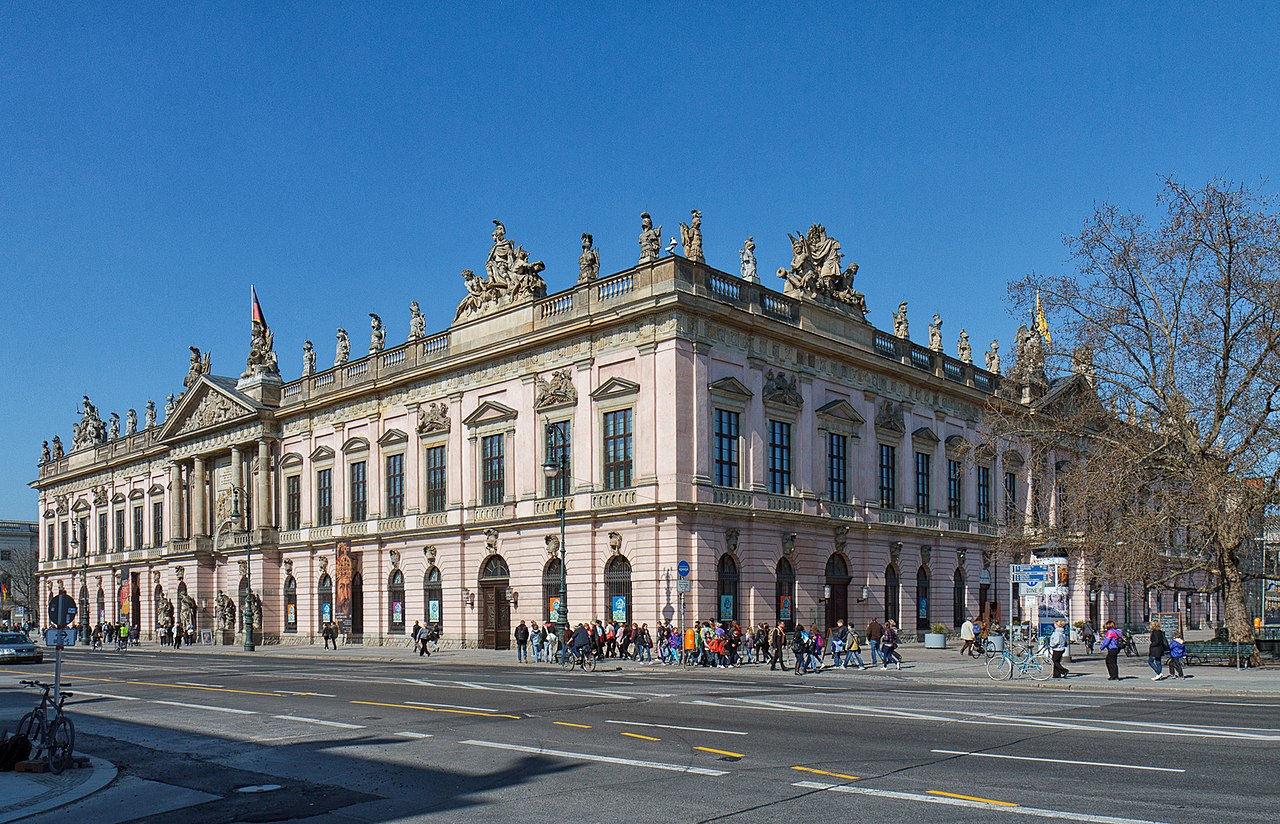
Ei ihan museosaarella muttei kovin kaukanakaan, Saksan historian museo (Deutches historisches museum) sijaitsi heti joen vastarannalla. Omien sanojensa mukaan Saksan historian museo tarjoaa katsauksen maan 1500 vuoden historiaan. Keskiajan museotarjonta oli ollut tähän asti vähän köykäistä, joten toive oli josko Saksan historian museo olisi  tarjonnut sitä lajia enemmän kuin museot joita oli tähän asti nähty. No, jonkin verran sitä olikin mutta monta vuosisataa sai museossa silti aika nopean käsittelyn... 

Not quite in the museum island but in its immediate surroundings, the Museum of German history (Deutches Historisches Museum) was located just across the river. According to the museum they provide a look to the 1500 years of the history of Germany. In the previous museums where we visited the medieval period was dealt with really quickly, so we were kind of hoping that this museum would be more generous in the presentation of medieval stuff. Well, there was some but considering how many centuries the medieval period covers, I still think it was quite briefly presented...

Museorakennus ~~~ Museum building, kuva/photo Wikipedia
Museo oli kahdessa kerroksessa, josta ylempi kerros esitteli ajanjaksoa 500-luvulta ensimmäiseen maailmansotaan. Pohjakerroksessa olisi ollut sitten uudempaa historiaa Weimarin tasavallasta 1990-luvulle. Tässä tapauksessa keskityttiin kakkoskerroksen tarjontaan, uudempi ei ollut niinkään kummankaan reissaajan ykkösprioriteeteissa (ja tiedossa oli vielä visiitti DDR-museoon myöhemmin, mutta siitä sitten enemmän omassa postauksessaan). Ja kyllähän pelkästään yhdessäkin kerroksessa aikaa sai menemään, aivan valtava rakennus kun oli kyseessä.

The museum was in two floors, the upper one covered the period from the 6th century to the first world war. Lower floor, then again, focused on newer history, from the Weimar republic to the 1990s. We focused on the upper floor and older history, since neither of us were so super interested in newer events (and we were going to see the DDR museum later, but more of that in another post). In this case in one floor there was quite a lot to see and it took quite some time, it indeed is a huge building. 

Kaarle Suuren patsas, 1100-lukua ~~~ Statue of Charlemagne, 12th century
Slaavilaisperäistä arkiesineistöä Spandausta 800-1100-luvuilta. ~~~ Slavic items from Spandau, 9th-11th centuries. Kuva/photo M. Pulla.
Harvinaisempi ihmispään mallinen akvamaniili 1270-luvulta. ~~~ A rare type of aquamanile in the shape of a human head, 1270s.  Kuva/photo M. Pulla
Akvamaniili Kölnistä 1300-luvulta. ~~ Aquamanile from Cologne, 14th century- Kuva/photo M. Pulla
Kölnin kaupungin säilytysarkku, 1300-luku ~~~ Storage chest belonging to the town of Cologne, 14th century
Kierrätystä noin v. 1300: rikkoutuneesta kolmijalkaruukusta siivilä. ~~~ 14th century recycling: Broken tripod pot turned to a sieve.
Seinävaate jossa kohtauksia neitsyt Marian elämästä, n. 1480 ~~~ Wall hanging with scenes of the life of virgin Mary, c. 1480

Keskiajan jälkeisiltä vuosisadoilta olikin sitten varsin reippaasti esineistöä esillä. 1500-luku painottui teemaltaan reformaatioon ja siitä kohtuullisen erottamattamattomaan valtakähinään.

After the medieval period the exhibition progressed somewhat century by century. 16th century part was focused on the important themes of the era, reformation and the power struggles that came with it.
Patriisipariskunnan muotokuvat, 1550-luku. ~~~ Portraits of a partician couple, 1550s
Liikuteltava käsiproteesi, Grüningenin linna, 1500-luku ~~~ Prosthetic arm with moving joints, Grüningen castle, 16th century
1630-luvun maalaus Mühlbergin taistelusta v. 1547 ~~~~ 1630s painting of the battele of Mühlberg in 1547

Siinä missä keskiajan ja vielä 1500-luvunkin esineistö oli varsin tukevasti saksalaista, tämän jälkeen osansa saivat myös yhä laajemmalle ulottuvat yhdeydet. Sota oli myös kohtuullisessa roolissa näissä yhteyksissä. Seinäpinta-alasta melkoisen osan ottivat valtavan suuret maalaukset.

Where the items in the medieval and 16th century parts of the exhibition were almost exclusively German of origin, after that it was apparent that Germany too got more widely connected with the rest of the world. Warfare was also a part of those connections... Walls in this part of the exhibition were covered with huge portraits.


Ruttolääkärin maski 1600-luvulta. Ei siis keskiaikaa nähnytkään. ~~~~ Plague doctor's mask, 17th century. Definitely not medieval! Kuva/photo M. Pulla
Sotasaaliiksi saatu turkkilainen teltta 1600-luvun lopulta. Nyt pahasti haalistunut, alkuperäinen teltan väri on ollut kirkas turkoosi vuoritettuna punaisella! ~~~~ Late 17th century Turkish tent, once a war booty. Nowadays the colour is faded, originally it was bright teal lined with red! Kuva/photo M. Pulla
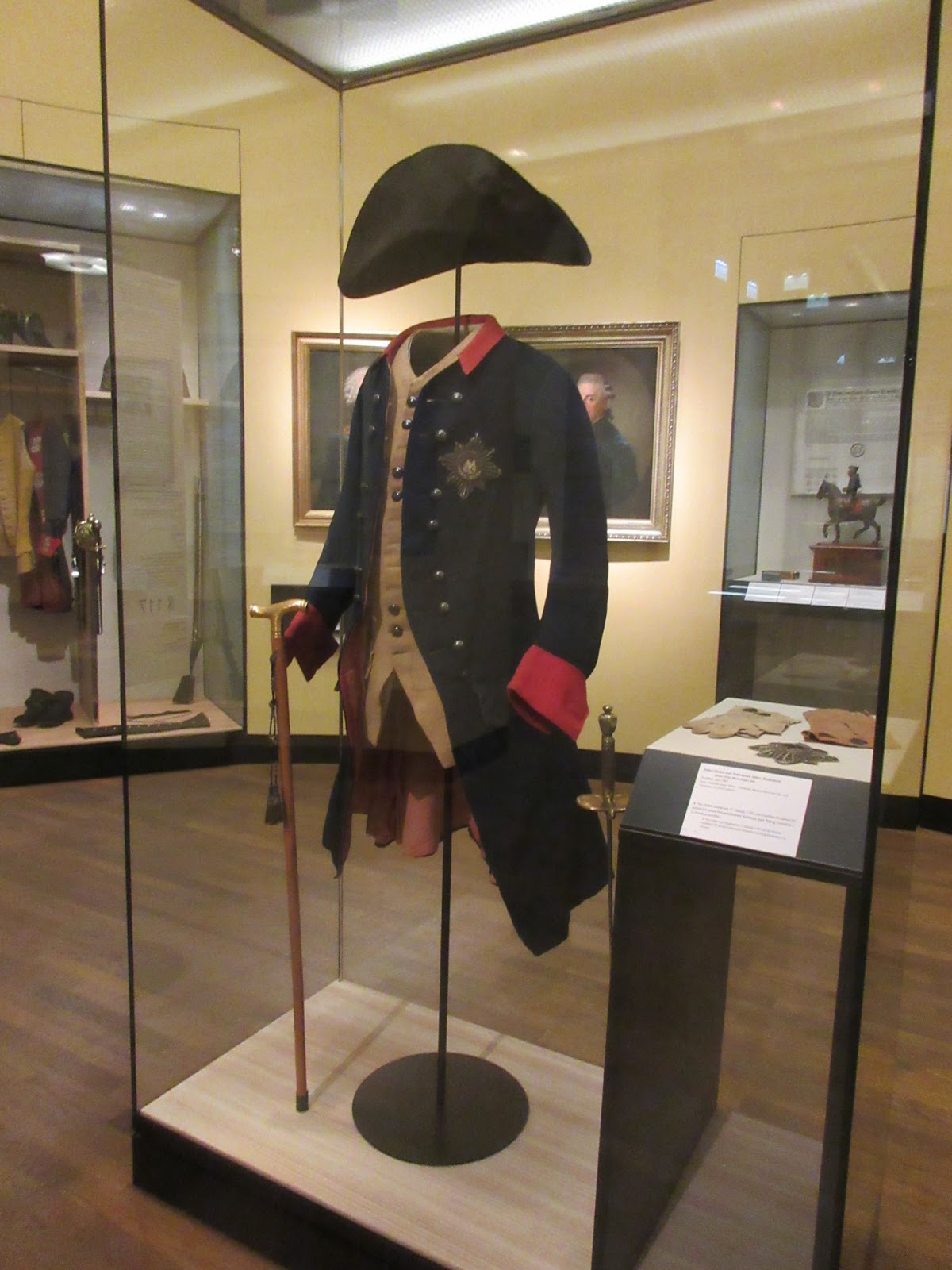
Preussin kuningas Fiedrich II:n univormu, 1786 ~~~ Unifom belonging to Preussian king Friedrich II, 1786
1800-luvun osastolla huomio kiinnittyi ensisijaisesti vaatteisiin ja tekstiileihin. Niitä olikin esillä runsain määrin!

In the 19th century exhibition there was a significant number of clothing and textiles on display. 
Kukkakirjottu puuvillamekko, 1795-1800 ~~~~ Cotton dress with flower embroidery, 1795-1800

Tekstiilimallikirja painokuvioista käsinkirjoitetuin kommentein, 1807 ~~~~ Textile samples book with handwritten comments, 1807
1800-luvun osastolla osansa sai myös teollistuminen, josta sitäkin oli tekstiilipuolen edustus. Siitä eteenpäin ylemmän näyttelykerroksen tarjonta olikin varsin sotilaallista.

Industrialization was a notable part of the 19th century exhibition, and textile industry was a big business and an important part. Apart from that, the latter part of the upper floor exhibition was quite military-themed. 
Langan kertauslaite ~~~ Device for plying yarn

Museon kotisivut
Museum homepage