Friday, 5 July 2019

Kevätreissu Berliiniin III: Altes Museum ~~~ Spring trip to Berlin III: Altes Museum

Berliinin museosaari (museuminsel) on itsessään jo UNESCO-kohde, kokonaisuus joka on rakennettu 1800-luvulla ja koostuu kaikkineen viidestä museosta. Niiden lisäksi on edellisessä postauksessa mainittu tuomiokirkko vaikkei sitä varsinaisesti lasketakaan museokokonaisuuteen, mutta sijaitseepa alueella kuitenkin. Innokkaat museokävijä-turistit olivat varsin tyytyväisiä siihen, että heti Berliinin rautatieasemalla oli saatavilla lippu, joka oikeutti paitsi käyttämään Berliinin joukkoliikennettä, myös pääsyyn Museosaaren museoihin.

Ensimmäinen alueelle rakennettu ja myös ensimmäinen vierailukohde alueella oli Vanha museo (Altes museum), rakenenttu 1839 ja jonka kokoelmat koostuvat muinaisen Kreikan ja Rooman esineistöstä. Ulkonäöstäkin olisi sen jo voinut päätellä...

The Berlin museum island (museuminsel) is by itself an UNESCO site, built in the 19th century and consisting of five museums altogether. In addition to that, also the Berlin cathedral is located in the same area but it isn't actually classified as belonging to the museum complex. Us enthusiastic museum-goers were quite happy to find that tickets for both Berlin public transport and Museum island museums were available already in the Berlin main railway station.

Altes Museum, the old museum, was the first museum to be built in the area -it was finished already in 1839. Its collections consist of ancient Greek and Roman items -one could perhaps guess that based on the looks of the building alone!


Ensimmäisestä kerroksesta aloitettiin ja vastassa oli muinainen Kreikka. esineitä oli esillä paljon, aika perinteiseen museotyyliin (arvostan sinänsä kyllä kovasti että näytteillä on runsaasti juttuja). Ehkä opastetulla kierroksella olisi saanut paikasta vielä enemmän irti.. Kaikkineen tilat olivat melkoisesta esinemäärästä (ja vahvasta painottumisesta patsaisiin) huolimatta melkoisen avarat ja valoisat. Tuli ihan sellainen olo että olisi voinut istua alas ja ihan vaan katsella, mutta eipä niin oikein ehtinyt tehdä kun valtavan kokoinen laitos oli kyseessä ja aikaa kuitenkin suhteellisen rajoitetusti.

Starting from the first floor, first we came across ancient Greece. A lot of items on display, very traditional museum style (I do appreciate the fact that a lot of items were exhibited). Perhaps it would've been more easy to approach with a guided tour -you never know. But all in all the atmosphere was really peaceful and the insides of the museum were light and spacious -not even numerous large statues made it feel crowded. I felt like it would be nice just to sit down and take good time to observe, but the museum was large and we were on a schedule before the museum closed for the day.


Tarjonta oli tosiaan painottunut varsin voimakkaasti patsaisiin ja muuhun kiveen, teemoiltaan hauta-asioita ja aika paljon myös mytologia-painotteista kuvamaailmaa. Ei kovin yllättävää, sinänsä kun Kreikasta ja Roomasta oli kyse...

The items on display were focused quite heavily on statues and stone carvings, and when it comes to the themes the focus was on grave decorations and mythology. Unsurprising, since it's ancient Greece and Rome we're talking about...
Filosofointia, musisointia ja yhdeksän muusaa. Hautakoriste n. 200 j.a.a. ~~~~ Philosophy, music and the nine muses. Sarcophacus side, 3th cent. CE.
Myyttinen metsästäjä Meleager koiransa kanssa. Roomalainen ajanlaskun alun tienoon versiointi kolmeasataa vuotta vanhemmasta kreikkalaisesta pronssipatsaasta. ~~~~ Mythiological hunter Meleager with his dog. 1st cent. CE version of a 4th cent. BC Greek statue.

Vähän arkisempaakin asetelmaa löytyi jumaluuksien ja merkkihenkilöiden lisäksi.

Along with the deities and remarkable people there were some depictions of everyday events.
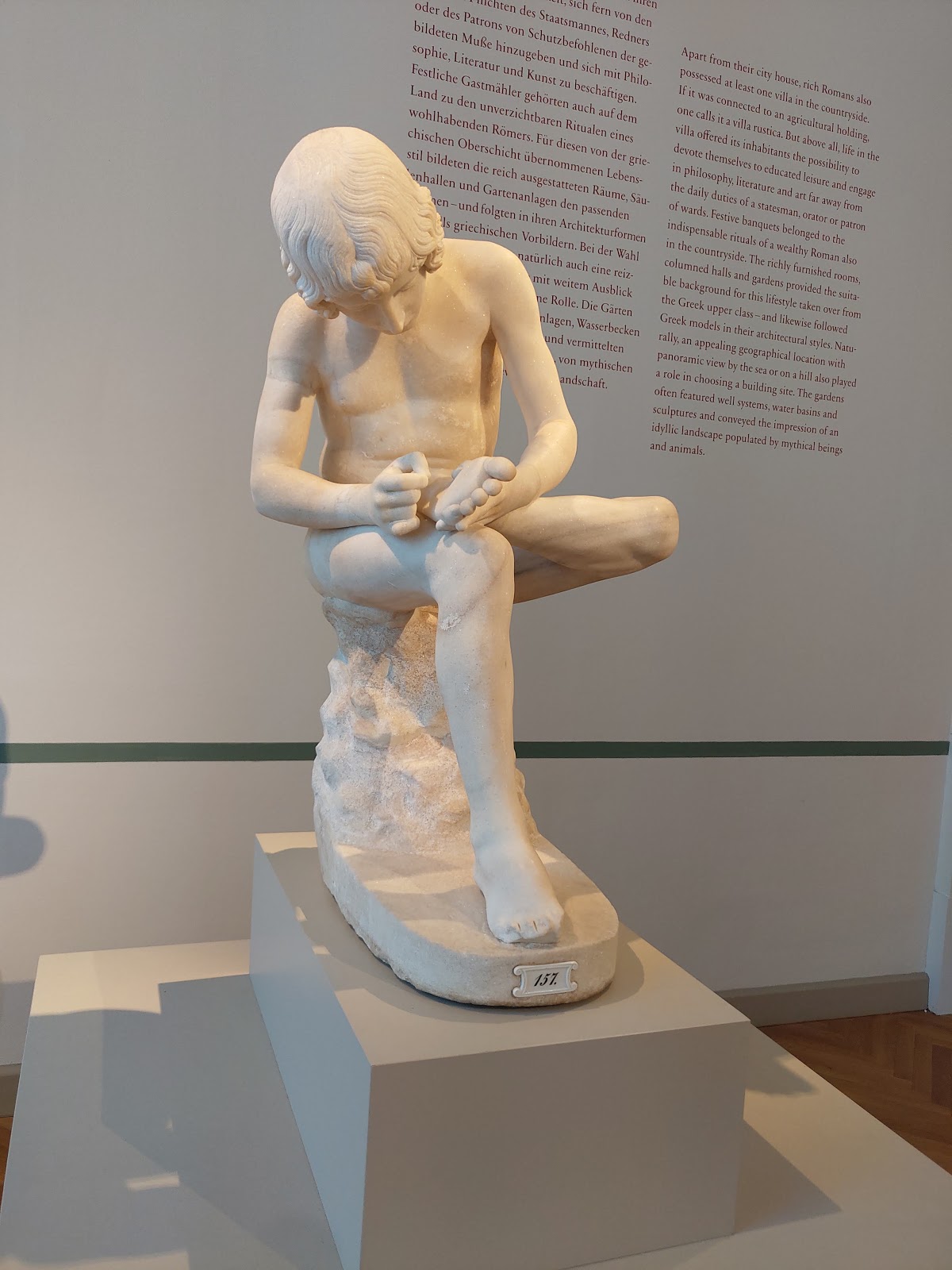
Tikku pojan jalkapohjassa, n. 150 j.a.a. ~~~ A boy with a sprinter in his foot, c. 150 CE.
Korva kutiaa. Sympaattisinta ehkä hetkeen <3 Lajityypiltäänkin aika harvinainen roomalainen koirapatsas, yleensä koirat kuvataan metsästämässä. ~~~~ Itchy ear. Propably the cutest thing in the museum <3 An untypical dog statue, mostly dogs were depicted in hunting scenes.

Roomalaisaikaan oli otettu mukaan myös kuuluisat egyptiläiset hautapotretit. Statuksen merkiksi muotokuvaan kuvatut oli esitetty täysin roomalaistyylisissä vaatteissa ja asusteissa. Muotokuviin oli ihan kekseliäästi yhdistetty korujen esittely -vierekkäin siis potretti ja saman tyylin korusto. Monenlaista korvakorua ja kaulaketjua olikin.

Roman era part of teh museum also featured the famous Egyptian funerary portraits. For to display status, the people portrayed were depicted in very roman-style clothing and accessories. Along with the portraits there was jewellery displayed, combining the illustrations with actual roman-era jewellery. Several types of necklaces and earrings, indeed!


Toki se pakollinen eroottisen antiikin taiteen osasto löytyi täältäkin. Häveliäästi omassa huoneessaan, mutta tekstejä tässä tilassa oli huomattavasti enemmän kuin muualla museossa. Teksteissä avattiin vähän tarkemmin kuvitusten ja esineiden taustaa ja mitä niillä viestittiin -vaikka tekstit olivat myös ihan avoimia siitä, että sataprosenttisen varmaa tulkintaa ei näistä voi tehdä vaan vaihtoehtoja on useita.

And of course the famous Greek and Roman erotic art was featured. Modestly they were placed in their own room, and in this room there was a lot more text providing some context to the art -what was it that they were depicting and different interpretations. Also they did not hide the fact that the interpretations varied and no 100% certain explanation can be made as therer are several options.

Hedelmällisyysteemaisen juhlan kulkue vai prostituoitu? Näitä tulkintoja tarjottiin, n. 470 e.a.a. ~~~~ Fertility-themed festivities procession or a prostitute? Different interpretations of this decorated jar, c. 470 BC,
Suojelusta kaikenlaista pahaa vastaan. Ajanlaskun ensimmäiseltä vuosisadalta 200-luvulle j.a.a. ~~~Protection against all kinds of evil things. 1st-3rd cent. CE.
Roomalaisten merkkihenkilöiden rintakuvissa selvästi parasta on yksityiskohtaiset kuvaukset hiustyyleistä -täälläkin täytyi hiukan taas kierrellä patsaiden taakse että sai kunnon käsityksen kampauksista. Ja tämän lajin tarjontaahan täällä Vanhassa museossa oli.  

When it comes to the busts of Roman remarkable persons, I find the detailed depictions of hair styles most interesting -and in here too I had to sneek behind the busts to take a peek of the hairdos! And as there was a lot of busts, also there was a lot of different hair arrangements.
Keisarinna Faustina (patsas 161-170 j.a.a). Viitta ja mekko todellakin eri lajin marmoria, mahtava efekti. ~~~ Empress Faustina (bust 161-170 CE). The cloak and dress indeed are made of different marbles!

Kierroksen viimeinen huone oli jotensakin näyttelynsä puolesta keskeneräisen näköinen, esim. osa vitriineistä oli tyhjiä ja tekstejäkin oli esineille vain osittain. Mutta ehkä varsinaisia esineitä mielenkiintoisempi -tilassa oli nostettu esille museon alkuperäisiä näyttelyvitriineitä. Välitön "tahdon myös" -reaktio! 

The last room of the tour seemed like the display was slightly unfinished by the looks of it -for example some of the glass cases were empty and the text plaques were only partially present. But perhaps more interesting than the items themselves, this room had some of the original 19th centuiry display cabinets. Immediate "I wants" -reaction :)

Rotundasta olisi päässyt museokauppaan, vaan laitos oli menossa kiinni joten se jäi tarkastamatta. Rotunda itsessään oli kyllä vaikuttava.

From the rotunda there was the access to the museum shop, but since the museum was about to close, I did not check that one out. The rotunda was impressive, though.


Siinä ensimmäisen päivän museotarjonta, seuraavana päivänä (hieman yllättäen) ei palattukaan museosaarelle vaan otettiin ekskursio paikalliseen elävän historian kylään. Siitä seuraavassa postauksessa!

That was all for the museums for our fist day in Berlin. Next day we skipped the museum island and headed off to the local living history village. More of that in the next post!

Wednesday, 5 June 2019

Kevätreissu Berliiniin II: Berliinin tuomiokirkko ~~~ Spring trip to Berlin II: Berlin cathedral

Ensimmäinen Berliinin-kohde oli museosaaren tuomiokirkko. Huolimatta kovasti historiallisesta ulkonäöstään Berliinin tuomiokirkko on vasta hiukan toistasataa vuotta vanha, rakennettu 1800-1900-vaihteen kumminkin puolin valmistuen 1905. Samalla paikalla tosin on erinäisiäkin kirkkoja ollut jo keskiajalta lähtien, mutta tämä uusin tarvittiin siksi että vanha ei keisarin mielestä ollut tarpeeksi komea pääkaupungin pääkirkoksi.

Kirkko otti pahasti vauriota toisessa maailmansodassa, ja sen korjaamisen aloittaminen viivästyi niin että valmista korjaustyöstä tuli vasta 1990-luvun alussa -siinä välissä ehdittiin jo miettiä mitä rakennukselle ylipäätään tehtäisiin, olisiko se syytä purkaa kokonaan. Korjattavaa rakennuksessa riittää, työt olivat käynnissä vierailuhetkelläkin.

Our first target in Berlin was the museum island and the cathedral. Although Berlin cathedral has a very historical look to it, it is only a little more than a hundred years old, built in the turn of 19th-20th century and finished in 1905. Churches - several of them- have been standing in the very same location since the medieval period, but this new one was definitely needed (acoording to the emperor) because the previous one was not large and fancy enough for the capital's main church. 

The church was bady damaged in the second world war, and the restoration works were delayed so much that they were finished eventually only in the 1990s -before that there was a great debate on what to do with the damaged building, should it be pulled down completely.  And the restoration works still continue, some repairs were still going on during our visit.
Kuva/photo M. Pulla

Koska komeaa oli lähdetty tekemään niin komeaa tuli -koristeita ei kirkosta ainakaan puuttunut. Inspiraatiota oli ilmeisesti haettu barokista ja sen lisäksi ehkä antiikistakin?

And because fancy was needed, so fancy was built -there is no lack of decoration in the church, to say the least! It looks as if the architect was inspired by baroque and antique styles?

Kuva/photo M. Pulla
Kuva/photo M. Pulla

Ylätasanteella oli pieni kirkon historian museo. Melko paljon siellä keskityttiin siihen, miten tämä nykymuotoinen tuomiokirkko rakennettiin ja mitä muita suunnitelmia kirkon ulkomuodoksi oli -varsin mahtipontisia kun olivat muutkin suunnitelmat.

On the second floor there was a small museum concerning the history of the church. It focused largely on how this current church was built and what other plans were made by architects -the other plans were quite pompous too!


Kovan kipuamisen jälkeen pääsi myös näköalatasanteelle katon reunamille! Sieltä oli varsin messevät näkymät yli Berliinin, moneen suuntaan. Ilahduttavasti tuli huomattua, että siellä pidetään myös mehiläispesiä!

After climbing a lot of stairs, one could step on a vantage point, almost on the rooftop! Quite splendid scenery over Berlin, and I was super delighted to spot that they also had some beehives on the roof. 


Katon reunalta kipitettiin portaita alas niin alas kuin tässä rakennuksessa pääsee, Hohenzollern-kryptaan. Kryptassa viettivät lepoaan hallitsijat perheineen. Hautoja kryptassa oli vuodelta 1499 alkaen, viimeinen vainaja oli haudattu tänne 1915. Ettei vierailu kryptassa olisi jäänyt vain hautamuistomerkkien ihmettelyksi, multimediaa oli otettu mukaan ja sitä kautta mm. nostettu esille Saksan historiasta tiettyjä tänne haudattuja yksilöitä ja kuninkaallisia hautaustapoja. Kryptakin vaurioitui jonkin verran toisessa maailmansodassa kirkon pommituksissa, ja hautamuistomerkkejä ja arkkuja kunnostetaan osin edelleen.

From the rooftop to the basement, our next target was as down as one could decend in this building -the Hohenzollern-crypt. In the crypt several rulers with their families had been laid to rest. First deceased had died in 1499 and the last burial in the crypt had been made in 1915. Some modern technology was added to make the visit something more than eyeing on coffins and monuments -multimedia presentations introduced the visitors for example to some individuals that had been buried in here and royal burial customs. Also the crypt had been damaged in second world war bombings, and some grave monuments are still being repaired.


Tuomiokirkon kotisivut
Cathedral homepage

Friday, 31 May 2019

Kevätreissu Berliiniin I: Malmöhusin linna, Ruotsi ~~~ Spring trip to Berlin I: Malmöhus castle, Sweden

Kevätreissu suuntautui tällä kertaa Berliinin! Matka tehtiin junaillen, joten lähtöpisteestä ei putkahdettu suoraan määränpäähän vaan vietimme muutaman tunnin verran välipysähdystä Malmössä lounaan merkeissä -ja eihän se olisi pysähdys eikä mikään jos siihen ei museota mahduttaisi! Kyseessä oli ensimmäinen kerta kun varsinaisesti tuli Malmössä käytyä (Tanskaan mennessä tosin kulkenut muutamia kertoja läpi mutta sitä ei ehkä lasketa) ja olipa suorastaan yllättävän sievä vanha keskusta kaupungissa! Se ei tosin ollut varsinainen kohde, vaan piipahduksen varsinainen määränpää oli Malmöhusin linna.

Linna oli alkujaan rakennettu 1429 tanskalaiskuninkaan Erik Pommerilaisen toimesta. Nykymuoto rakennukselle on pitkälti 1500-luvulta peräisin. Rakennusaikaan ja vielä pitkään sen jälkeenkin Skånen alue kuului Tanskalle. 


This year our spring trip destination was Berlin! We travelled using train as means of transportation, so it was not a straightforward travelling from point A to point B but instead we had a few hours pit stop in Malmö, southern Sweden. We had well time to grab lunch in there, and no stop is complete without a museum visit if I have anything to say to it :D This was actually my first real visit to Malmö, I have driven a few times through it when going to Denmark but I guess that doesn't really count. And I was quite surprised, the old town was really pretty! The old town, however, was not our real destination, instead we headed off to the Malmöhus castle.

The castle was originally built in 1429 by Danish king Eric of  Pomerania. The modern-day appearance of the castle is largely 16th century when large renovations were made. When the castle was built Malmö town and the whole Scania were a part of Denmark.


Pyöreässä tykkitornissa esiteltiin Malmöhusin linnan roolia 1600-luvun lopun Ruotsin ja Tanskan välisessä sodassa. Tämän sodan seurauksena Skåne päätyi lopulta Ruotsin osaksi vuonna 1658.

In the round cannon tower there was an exhibition about the 17th century war between Sweden and Denmark and the role of Malmöhus in that war. As a result of this war Scania eventually ended up as a part of Sweden in 1658.

Kuva/photo M. Pulla


Asuintiloissa oli esillä lukuisia 1600-luvun huonekaluja ja muuta esineistöä, seinätekstiileitä ja maalauksia myöten.

In the living quaters several 17th century pieces of furniture were on display, along with other items such as wal hangings and paintings.


Malmöhusin linna oli -kuten varsin monet linnat- toiminut historiansa varrella myös vankilana, vuosina 1828-1909. Alakerrassa esiteltiin linnan historian tätäkin puolta.

The Malmöhus castle was -among many other old castles- transformed into a prison in the 19th century. Prisoners were housed in Malmöhus between 1828-1909. The exhibition in the castle basement showed that part of the castle's history.

Vankeja 1800-luvun lopulta. ~~~ Late 19th century prisoners of Malmöhus.

Linnassa oli tilapäisenä näyttelynä puvustuksia Ingmar Bergmanin elokuvista. Näyttely oli jaettu elokuvittain, mukana tietysti myös kuuluisimmat Fannya ja Alexanderia myöten. Mielenkiintoista nähdä ylipäätään elokuvavaatteita näin läheltä, paljon yksityiskohtia joita ei niin ruudulta huomaakaan.

As a temporary exhibition, there was a display of the costumes featured in Ingmar Bergman's movies. The exhibition was organized by films, and of course the most famous were featured too, including Fanny and Alexander. All in all, I like seeing movie clothes up close, there often are many details that go totally unnoticed in the screen.
Fanny ja Alexander -elokuvasta (1982) ~~~ Fanny and Alexander -movie (1982)
Kesäyön hymyilyä -elokuvasta (1955) ~~~ Smiles of a summer night (1955)

Ei aivan pelkkää historiaa, museokompleksi olisi sisältänyt lukuisia muitakin kohteita joista ehdittiin piipahtaa ainoastaan akvaariossa. Eksoottisien ja värikkäiden eväkkäiden lisäksi oli myös kotoisampia kaloja ja mukavan luonnonsuojelullinen näkökulma.

Not just history, the museum complex would've featured several other museums too, but we only had time to drop by in the aquarium. Along with the exotic and colourful fishes there were a lot of domestic ones too, with a nice protect the environment -approach to it.


Välipysähdyksellä ehti siis lounastamaan ja katsomaan linnan hyvinkin, sitten matka jatkui junalla eteenpäin. Eräänlainen historiakokemus sekin, vaunut olivat aika kovalla todennäköisyydellä vanhempia kuin tämä reissaaja itse oli :) Aamulla herättiinkin sitten Berliinistä, siitä sitten myöhemmin.

So, during one pit stop we had time to grab lunch and see large parts of the castle, and then we were on our way with a train. A kind of history experience by itself, the train was quite likely older than this traveller was :) In the morning we woke up in Berlin, but that is for another post.


Friday, 10 May 2019

Pöytätapoja 1400-luvulta ~~~ 15th century table manners

Keskiajan pöytätavoista liikkuu monenlaista viihdemaailman levittämää käsitystä -lähinnä siihen suuntaan että pöytätapoja ei ollut. Kuitenkin keskiaikaisten käytösoppaiden (joista aikoinaan proseminaarinikin tein) kautta on varsin selvä asia että hillittyyn ja hallitttuun käytökseen kannustettiin keskiajalla vahvasti. Ihan pöytätapoihin ja muihin yltiökäytännöllisiin seikkoihin saakka nämä muut käytösoppaat eivät ole ulottuneet, mutta sain käsiini hiljattain uusintapainoksen -sekä näköispainos että kieleltään modernisoitu versio 1400-luvun lopun lapsille osoitetun pöytätapaoppaasta.

 Hollywood has done good job in spreading the idea of medieval table manners -or rather, that there were none. None the less medieval books of conduct (which were also the subject of my bachelor's thesis) make it clear that self-contained and controlled behaviour was strongly preferred. Those books of conduct do not really comment on table manners or other overly-practical details, but recently I got my hands on a facsimile and modernized translation of a late 15th century booklet aimed for children, concerning table manners.

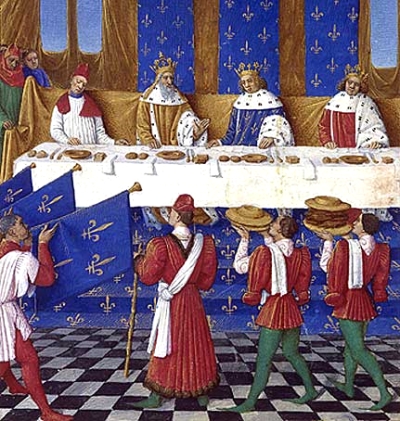
Berryn herttua pitopöydässä. ~~~Duke of Berry at feast table. Tres riches heures du Duc de Berry, c. 1410
Englantilaisen William Caxtonin Stans puer ad mensam/Table manners for children -kirjanen on painettu vuonna 1476. Kyseessähän on varsin pieni lirpake, pöytätapaopastus koostuu kaikkineen viidestä sivusta (muu osuus kirjasta on muita hyvään elämään opettavaisia ja uskonnollisia tekstejä). Teksti itsessään ei liene aivan täysin Caxtonin omaa tuotosta sillä jo kirjan ensimmäinen lausekin viittaa 1200-luvun vastaavaan latinankieliseen käytösopastukseen, mutta englanninkielisiä käännöksiä siitä tehtiin siis 1400-luvulla.

Printed by William Caxton, Stans puer ad mensam/Table manners for children -booklet was first published in 1476. It is an absolutely tiny leaflet, the table manners part consists of only five pages (the rest of the booklet has other texts, mostly religious or texts that instruct on how to live a good life). The table manners guidance itself is a part of a long tradition and not totally composed by Caxton himself, even the opening sentence refers to a 13th century Latin instruction from which a few different English translations were made in the 15th century.
Pieni ote näköispainos-osuudesta. Kohtuullisesti ymmärrettävää vaikkei vanhoihin käsialoihin olekaan erityisesti perehtynyt. ~~~A small  part of the facsimile. Quite understandanble, even if one is not that accustomed in reading old fonts.
Teksti on tarkoitettu nuorille aatelispojille jotka olivat oppimassa (ja myös verkostoitumassa!) toisessa aatelistaloudessa palvelijana. Tämä mainitaan heti aluksi, ja siihen palataan myös muutaman kerran. Alkuperäinen (ja myös tämä nykyenglannille käännetty versio) olivat runomuotoisia, ehkä muistamisen helpottamisen takia? Riimit tekstissä joka tapauksessa tuntuvat olevan tärkeämäpiä kuin sisällön loogisuus, teksti pomppii varsin railakkaasti aiheesta toiseen.

The text itself is aimed for young noble boys who were serving as pages in other noble households. This is mentioned right at the beginning of the text and every now and then later in the instruction, too. The original (and also this modern-English version) are in poetic verse, perhaps to make it easier to remember? The rhymes, anyhow, seem to be more important than the logical arrangement of the content, to say the least -the poem jumps from one subject to another quite randomly...

1800-luvun piirros hovipojasta. Tämä nuorimies ei olisi saanut kiitosta... ~~~ 19th century drawing of a page boy. This young man would not have received praising...
Mutta aiheeseen, tässä siis kootut vinkit siihen, miten edustaa hyvätapaisesti 1400-luvun lopun ihanteiden mukaan!

But back to the subject -here are the best tips for behaving according to the late 15th century ideals!

Yleinen olemus
  • Muista ryhti! Älä nojaa pylväisiin.
  • Älä anna ympäristön hälinän häiritä, älä pyöri vaan keskity.
  • Kävele rauhallisesti ja anna muutenkin arvokas vaikutelma. Myös kovaäänistä naurua kannattaa välttää.
  • Ole hereillä sen suhteen jos isäntäsi kaipaa palvelua; jos kaipaa, toimi nopeasti.

Overall appearance
  •  Keep your posture! Don't lean on posts.
  • Do not let the hustle and bustle in the hall disturb you, stay still and focused.
  • Walk  calmly and remember to keep up a dignified appearance. Also avoid loud laughter.
  • Be alert in case your master needs your services; if he needs you, act quickly. 
Hienostuneita pitovieraita, huonosti pukeutunut heitetään pihalle.~~ Dignified guests at feast, badly dressed guest is being thrown out. Ms. Ludwig XV 9, fol. 88v (1469)

Yleisesti ruokapöydässä
  • Istu sinne minne sinut on paikoitettu, älä yritä valita mieluisinta paikkaa.
  • Nenän kaivaminen ei ole suotavaa. 

Keskustelu ruokapöydässä
  • Jos sinulle puhutaan, katso puhujaa kasvoihin.  
  • Myös keskustelussa kannattaa muistaa maltillinen äänentaso, ei huutamista ruokapöydässä.
  • Toisen keskeyttäminen on epäkohteliasta.
  • Keskustellessa pidä käsillä elehtiminen mahdollisimman vähissä.

At the dining table
  • Sit where you have been placed, don't try to pick a nicer place.
  • Don't pick your nose.

Conversation when dining
  •  When you are spoken to, look at the speaker in the face.
  • Remember to keep your voice down when speaking, too, no yelling at the table.
  • Interrupting another person is impolite.
  • Keep your hands still when speaking, don't wave your hands. 
1400-luvun lopun saksalainen lasipikari ~~~Late 15th century German glass beaker, Corning museum of glass.

Syöminen
  • Muista ruuan jakaminen, älä ahnehdi itsellesi kaikkea.
  • Älä puhu ruoka suussa!
  • Ota lusikkaan vain sen verran ruokaa kun siihen mahtuu, ympäriinsä läikyttäminen ei ole ok.
  • Keittolautasen pyyhkimistä leivällä pitäisi välttää.  
  • Herrasmiehet ottavat suolaa veitsen kärjellä.

Juominen
  • Kohtuullisuus alkoholijuomien kanssa!
  • Juoma-astiaan ei sovi puhaltaa.

Eating
  • Remember to share the food, don't be greedy.
  • Don't talk with your mouth full.
  • Avoid overflowing spoonfuls, don't spill food around.
  • Don't wipe your soup bowl with bread.
  • Gentlemen take salt with the tip of their knives. 
  
Drinking
  • Moderation with alcoholic drinks!
  • Do not blow on your cup.
Lautasliinoja arvokkaiden ruokailijoiden pöydässä. ~~~ Napkins in front of important guests. Grandes chroniques de France (Ms. français 6465), 1460.
Hygienia
  • Kädet on oltava pestyinä kun aletaan syömään. Erityisesti kynnenaluset on pidettävä puhtaana.
  • Pyyhi kasvot ruuan rasvasta.
  • Suu pitää pyyhkiä ennen kun juo puhtaasta juoma-astiasta.
  • Likaisin käsin ei anneta juoma-astiaa eteenpäin.
  • Lautasliinaakaan ei sovi liata puhtaan huolimattomuuden takia...
  • ...Äläkä varsinkaan sottaa paitaasi tiputtamalla siihen kastiketta tai keittoa.
 
Ruokailuvälineet
  • Pyyhi lusikkasi puhtaaksi.
  • Veistä ei sovi käyttää hampaiden puhdistamiseen. 
  • Veitsen kanssa ei leikitä.

Hygiene
  • Your hands have to be washed when you come to dinner. Especially keep your nails clean.
  • Wipe the food grease  from your face.
  •  Wipe your mouth before drinking from a clean cup.
  • Don't pass a cup forward with dirty hands.
  • Not even a napkin should be stained because of carelesness...
  • ... And especially avoid spilling soup or sauce on your shirt. 

Eating utensils
  • Wipe your spoon clean.
  • Don't pick your teeth with a knife.
  • Knife is not for playing, either. 

..Niin, vaikuttaa siltä että aika vähän mikään on muuttunut. Aika käypäisää ohjeistusta tähänkin päivään. Näillä siis kevään juhliin!

...Yes, it seems that very little has changed. Fairly fitting instructions even today. So, with these one is ready for the sprintime festivities!

Wednesday, 8 May 2019

Museum Gustavianum, Uppsala

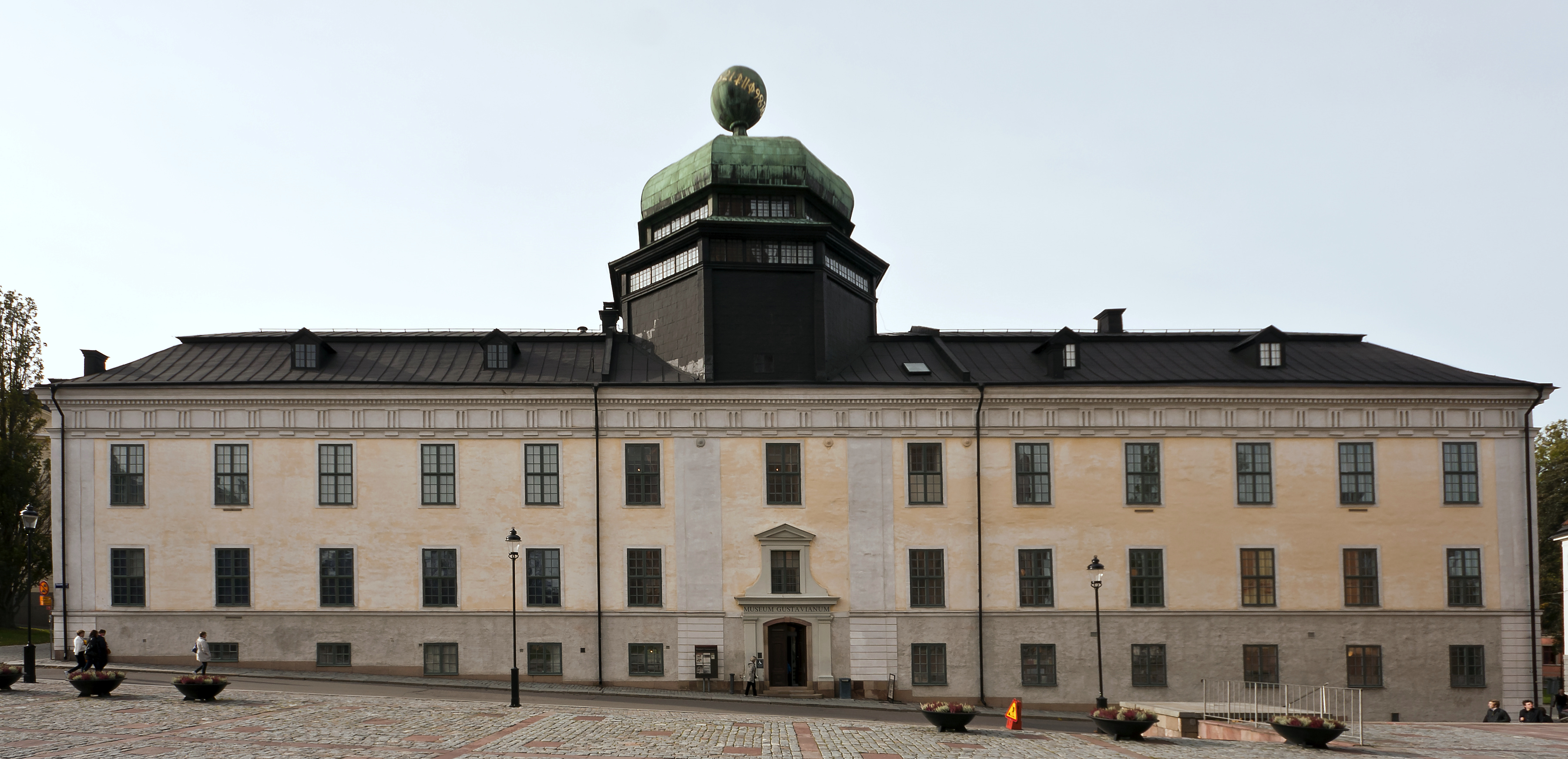
Uppsalan yliopiston museo Gustavianum sijaitsee ihan tuomiokirkkoa vastapäätä. Yhden katon alle on koottu varsin mittava kokoelma kaikenlaista, ruotsalaisesta rautakaudesta muinaiseen Egyptiin ja yliopiston omaan tieteenteon historiaan. Museo sijaitsee rakennuksessa joka on rakennettu yliopistokäyttöön jo 1600-luvun alkupuolella -yliopisto itsessään on perustetu 1477.


The Uppsala university museum Gustavianum is located right in front of the Uppsala Cathedral. Quite a few different exhibitions are being housed under one roof,  from the Swedish iron age to ancient Egypt and the history of the university itself. The museum is located in a building that was originally built for the university in the early 17th century -the university itself was founded in 1477. 


Kuva/photo Wikipedia
Valsgärden kalmisto
Kansainvaellusajasta viikinkiaikaan (n. 400-1000 jaa) käytössä ollut kuuluisa Valsgärden kalmisto sijaitsee ihan Uppsalan vierellä, 7 km pohjoiseen. Paikan päällä ei, harmi kyllä, tällä kertaa käyty, mutta kalmiston hautalöytöjä päästiin näkemään Gustavianumin näyttelyssä jonne oli koottu kuuluisimpia esimerkkejä. Valsgärde on kuuluisin laivahautauksistaan, mutta alueella on myös kamarihautoja, polttohautauksia ja arkkuhautauksiakin. Alueelle tyypillistä tuntuu olevan yläluokkaisuus, hauta-antimet ovat melkoisen kalliit ja runsaat. Mukana hautauksissa oli myös eläinten tarvikkeita (Valsgärdeläisiä koiran tarvikkeita tulikin esiteltyä postauksessa Seurakoiran varusteita keskiaikaisittain) ja ruuanlaittoon liittyvää välineistöä, mutta kuuluisimmat esineet ovat melko varmasti vendelaikaiset kypärät. Tekstiilisuuntautuneet toki olivat kovasti innoissaan säilyneistä metallilankakirjonnoista...

Valsgärde burial ground
The famous Valsgärde burial ground was in use from the Migration period to the Viking age (c. 400-1000 CE). It is located very close to Uppsala, only 7 km north. We unfortunately did not have a chance to visit the site itself, but luckily some of the most famous finds were displayed in the Gustavianum. Valsgärde burial ground is most famous for its boat burials, but in the area there are also chamber graves, cremation burials and even coffin burials. The common feature for the area is that the grave goods are plenty and they are expensive. Among the grave goods there are equipment for different animals (some of the Valsgärde dog gear were covered earlier in a post Companion doggy gear the medieval way) and cooking-related items, but definitely the most famous part of Valsgärde grave goods are the Vendel period helmets. And of course for the textile oriented the silver thread embroideries were on display...
 
Hopealankakirjontaa! ~~~ Silver thread embroidery!
Heppablingiä ~~~ Bling for horses!

Juomablingiä. ~~~ Bling for drinking

Lasilattian alla yksityiskohtainen piirros laivahaudasta esineineen. ~~~ Under the glass floor a detailed drawing of a boat burial
Kuva/photo M. Pulla

Anatominen teatteri
Anatominen teatteri on lääketieteen opiskelijoita varten rakennettu opetustila jossa opiskelijoiden oli mahdollista seurata opetustarkoituksessa tehtäviä ruumiinavauksia. Anatominen teatteri oli rakennettu 1662, mutta sitä ilmeisesti käytettiin varsin vähän alkuperäiseen tarkoitukseensa. Nykyisin nähtävä anatominen teatteri tosin on osin uudelleenrakennettu alkuperäisistä Olof Rudbeckin piirustuksista 1950-luvulla, mutta mahtavan historiallinen tunne siitä kyllä välittyy. Tämä salihan on toiminut myös erinomaisen Anno 1790 -sarjan yhden kohtauksen tapahtumapaikkana!

Anatomical theatre
An anatomical threatre is a hall built for students of medicine as a place where it was possible for the students to observe teaching-purpose dissections. The anatomical theatre was built in 1662, but apparently it was used for its original purpose quite seldom. The anatomical theatre we see nowadays is partly a reconstrucion made using the original Olof Rudbeck's plans in the 1950s, but it sure manages to deliver a wonderfully historical feeling. And this hall is also featured in the wonderful Anno 1790 -series, one scene takes place there!


kuva/photo M. Pulla
Egypti ja Välimeri
Muinaisegyptiläistä materiaalia on yliopiston kokoelmissa ollut tekstilähteiden mukaan jo 1600-luvulla! Nykyinen näyttely kattaa pitkän aikajanan, esihistoriasta kristillistymiseen saakka. Paitsi perinteisiä wau-esineitä (mm. kokonainen komeasti koristeltu muumioarkku), esillä oli myös kivasti arkipäivää, huonekaluja ja käyttöesineitä. Ilahduttavasti myös tekstiilisuuntautuneet oli huomioitu, kokonainen koptilainen koristeltu paita oli esillä (mutta siitä valitettavasti sai todella huonosti kuvia heijastuksien takia). Osan kokoelmasta muodostavat nubialaiset esineet, joita ruotsalaiset arkeologit muiden pohjoismaisten kollegojen ohella olivat pelastamassa Assuanin padon alta. 

Egypt and the Mediterranean
Text sources state that ancient Egyptian items have been a part of the university's collections since the 17th century! The exhibition that we see now covers a large period of time, from prehistory until early christian times. There of course are several wow-items on display (for example a lavishly decorated mummy coffin) but also everyday life was nicely featured with some furniture and utensils. And as a treat for the textile oriented, a whole coptic decorated shirt was on display, but it was awful to photograph because of reflections. Part of the collections consisted of Nubian items which were obtained when a Swedish group of archaeologists (among their Nordic colleagues) took part in the research that was carried out before the Aswan dam was built.


Yliopiston tutkimuksen historia
Tämä osuus museosta jouduttiin käymään läpi vähän nopeammin kuin mitä näyttely olisi ansainnut (museo oli menossa kiinni!), joten joiltain osin meni ohi mitä kaikkea historian mittaan Uppsalan yliopiston toimintaan onkaan kuulunut. Näytteillä oli varsin mielenkiintoista materiaalia koko yliopiston olemassaolon ajalta. Näyttely kuitenkin esitteli paitsi kovasti mielenkiintoisia tieteellisiä välineitä, myös sitä miten yliopistossa tutkimusta ja opetusta tehtiin menneisyydessä ja miten koko tieteeseen suhtauduttiin.

History of research in the university
Unfortunately with this exhibition we were in a bit of a rush (the museum was about to close!) so we had to explore this exhibition hall with less time that it would've really deserved. But to cut it short, this hall is all about science and all that's been going on in the university of Uppsala. All kinds on interesting items were on display, from the whole university's timespan. The items include really cool scientific instruments, but also this hall tells the story of how university-level teaching has been regarded and how tha whole concept of science has been regarded.
 

Kuva/photo M. Pulla