Thursday, 26 January 2017

Tehtiin sitten intarsia! ~~~ So we made an intarsia!


Jos joku on vielä tiedolta onnistunut välttymään, teimme porukalla 1400-luvun villaintarsian ennallistuksen Kansallismuseoon!  Mahtava projekti kaikkineen, joten pakkohan siitä on hehkuttaa omaltakin osaltani kaikelle kansalle :)

If someone has missed it, I had the joy of taking part in a group which reconstructed an 15th century wool intarsia textile to the National Museum of Finland! It was an awesome project, so I just have to share the full story of it to all of mankind :)


Maskun tekstiilin historia ja intarsiatyöt Suomessa ja muualla
The history of the Masku textile and intarsia textiles in Finland and elsewhere

Intarsiassa on siis kyse Varsinais-Suomesta Maskun kirkon kellotapulista löytyneestä tekstiilistä, joka vuonna 1871 löysi tiensä Helsinkiin museoviranomaisille. Tekstiiliä on epäilty alttarivaatteeksi, morsiuskatokseksi ja monenlaiseksi muuksikin, tuorein päätelmä on että kyseessä olisi paarivaate -ja tämä kuulostaa paljon järkevämmältä tekstiilin rakenteen huomioon ottaen, sillä rakenne ei juuri roikottamista salli. Nykyinen kokokin sopisikin hyvin arkun päälle (palaset ovat noin 69 x 69 cm kokoisia, koko ehjin ruuduin siis noin 138 x 276 cm). Aivan alkujaan se on ollut vielä suurempi, nykyisen kahdeksan sijaan paneeleita on ollut ainakin 12 ja korkeus on ollut siis noin 207 cm (yhdessä vanhassa kuvassa näkyy muutaman sentin verran nykyisin puuttuvia kolmannen rivin paneelinosia). Alkujaan tämä intarsiatekstiili on voinut olla myös yksityisessä omistuksessa varakkaalla kotitaloudella, ehkä kartanolla tai linnalla. Myöhemmin se olisi sieltä päätynyt kirkon omistukseen, mahdollisesti perintönä sillä arvoesineiden lahjoittaminen kirkolle esim. testamentissa oli yleinen tapa. Mutta tästähän ei voi olla varma.

So, the textile in question has been found in the bell tower of Masku church, SW Finland. Museum officials in Helsinki received it in 1871. It has been suspected that the textile is an antependium (altar cloth), bridal canopy or many other things,  the newest conclusion is that it seems to be a pall (to cover a coffin during the funerals). This sounds plausible, because the structure of the textile isn't really that good for anything save lying flat. The present size too is good for covering a coffin (the panels are approx. 69 x 69 cm in size, so the size for the coverlet assuming the panels were intact is 138 x 276 cm). Originally it had been larger and instead of the present day two panel rows and eight panels, it had once had at least three rows and twelve panels, and a height of approximately 207 cm (there is one old pic that shows the now missing panel remains, not more than a few centimeters). Originally this textile might have been privately owned by a wealthy household, a manor or a castle. Later it ended up in a church, perhaps because it was bequeathed to the church in a will which was a common practice -but this we can't know for certain.

On epäilty, että tekstiili voisi olla Naantalin birgittalaisnunnien työtä ja näin voidaan arvioida myös intarsian oletettu valmistumisaika, noin v. 1440, samoihin aikoihin jolloin luostari perustettiin -ja luostarin ensimmäinen sijoituspaikkahan oli Maskussa, jossa se toimi vain muutaman vuoden ennen muuttoa Naantaliin. Maantieteellisestihän Naantalin luostarin sijainti osuu varsin hyvin yksiin toisten Suomesta löytyneiden intarsiatöiden kanssa -pienempiä intarsiafragmentteja ilmeisesti kahdesta eri tekstiilistä tunnetaan myös toisaalta Varsinais-Suomesta, Sauvon kirkosta, mutta nämä ovat paljon Maskun tekstiiliä huonokuntoisempia. Yhteyksiä Ruotsiin alleviivaavat myös Maskun intarsian tekstit, kuvakehiä kiertävät kaksi eri tekstiä, latinankielinen Ave Maria -rukouksen alkuosa ja ruotsinkielinen avunpyyntö Jeesukselle. Tekstiilin teksteistä on voinut myös pätellä asioita sen tekijöistä. Osa on selvästi ollut lukutaitoisia, tekstit ovat säntillisesti oikein, osassa teksteistä taas kirjaimet ovat väärin päin ja muutenkin vinksallaan...

It has been suspected that the Masku intarsia has been made by the nuns in the Naantali bridgettine convent. This assumption is also helpful in dating the textile, c. 1440, which was shortly after the convent was established. At first the convent was situated in Masku, but it was only a few years until it moved to Naantali. Geographically speaking the location of the Naantali convent lines up with the other intarsia textile find from Finland, there are some fragments of perhaps two different intarsia textiles from Sauvo church, SW Finland. They're quite fragmented and in small pieces, though. Connections to Sweden are also underlined by the texts in the Masku intarsia. There are two different texts encircling the animal motifs, prayer Ave Maria written in Latin, and a request for Jesus' help in Swedish. The texts in the intarsia also tell something about the people who made it -some have clearly been literate, the text is perfectly written, while some perhaps have been illiterate and the letters are partially a bit wonky and even upside down...

Intarsiaennallistuksen työryhmän ruotsalaiset jäsenet mainitsivat että olisi pieniä viitteitä siihen, että myös ruotsalaisilla intarsiatöillä olisi jonkinlainen yhteys birgittalaisluostareihin, vaikka vanhimmat säilyneistä ruotsalaisintarsioista ovatkin birgittalaisjärjestöä vanhempia. Ruotsin puolelta intarsiatöitä tunnetaankin useita (itselleni vastaan on tullut ainakin 6 eri työtä), ne ovat lähinnä kirkoista ja linnoista peräisin. Ajoituksellisesti ruotsalaiset työt menevät 1300-luvulta ehkä jopa 1600-luvulle. Mielenkiintoista on, että tällaiset villaintarsiat tuntuvat olevan voittopuolisesti skandinaavinen ilmiö, vaikka muualtakin tunnetaan keskiaikaisia intarsiatöitä (Saksasta, Ranskasta ja Espanjasta) mutta tällaisia isoja peitteitä ilmeisesti ei (ja taas saa korjata jos jollain on muuta tietoa!). Aasian puolella Kirgisiassa on myös komea huopaintarsiaperinne, mutta se lienee eri peruja.

The Swedish members of the textile reconstruction group mentioned that there are some hints that the Swedish intarsia textiles might have connections to the bridgettine monasteries too, although the oldest Swedish intarsia textiles are older than the bridgettine order. In Sweden several intarsia works are known (at least 6 that I know of), mostly from churches and castles. They date from the 14th all the way to the 17th century. What is interesting in these intarsia textiles, that they seem to be a mostly Scandinavian phenomenon. Although some medieval intarsias are known in the central and southern Europe too (Germany, France and Spain), apparently they're not large coverlets like these Swedish and Finnish ones (please correct me if you know better!). Also in Asia there's a lovely felt intarsia tradition in Kyrgyztan, but I doubt it shares the same roots as the European tradition.


Alkuperäisen aarnikotkan varpaat ~~~ The toes of the original griffin
Intarsiaryhmä tutkii alkuperäistä tekstiiliä ~~~ The intarsia group examines the original textile
Ennallistus
The reconstruction

Ajatushan lähti siitä kun Ruotsissa tehtiin ensin vastaavanlainen ennallistusprojekti. Ennallistuksen kohteina siellä olivat Dalhemin ja Skepptunan intarsiat (esim. Historical textiles -blogissa To recreate two inlaid woolen coverlets). Tämä ennallistus herätti intoa jatkaa ennallistusten tekoa ja levittää yhteistyötä lahden tällekin puolelle, etenkin kun tiedossa oli että Suomessakin on vastaavanlainen  hieno tekstiili.

The thought of making this reconstruction started out when a similar project was carried out in Sweden. The Dalhem and Skepptuna coverlets were reconstructed (see for example the blog Historical textiles and the post To recreate two inlaid woolen coverlets). After that, it was hinted that the Masku textile should be recreated too and the nice co-operation between museums and living history nuts should happen in Finland as well.

Toimeen ryhtyivät Elina Sojonen ja Mervi Pasanen. Asiaa tosin vähän hidasti ensialkuun se, että Maskun tekstiilistä ei tahtonut löytyä tarkempia lähteitä, eikä sen olinpaikkakaan ollut aluksi kovin selvä. Lopulta se paikallistettiin Kansallismuseoon, jossa sitä päästiin myöhemmin tutkimaankin. Työryhmää ruvettiin kasaamaan Neulakko-blogin ilmoituksella ja lopulta innokkaita olikin enemmän kuin ryhmään oltiin ajateltukaan. Joka palalle annettiin kaksi ihmistä, toinen ulkoreunalle ja toinen sisäkehälle, ja yhteensä se tarkoitti sitten kuuttatoista ihmistä -mainio määrä! Ryhmään saatiin myös tavallaan seitsemästoista jäsen tekstiiliarkeologi Krista Vajannosta, ja hänen työnsä kautta tekstiilistä saatiin paljon uutta tietoa.

Elina Sojonen and Mervi Pasanen accepted the challenge. At first there were some tiny difficulties, though, there seemed to be very few literary sources concerning the Masku textile and even the whereabouts of the textile was somewhat unclear. Finally the exact location of the textile was pinpointed to the storage rooms of the National Museum, where it was later also examined. The reconstruction group was gathered together when an announcement in Neulakko blog appeared, calling out for enthusiastic crafters -and it turned out that there were more volunteers than was expected! Each on the eight panels of the intarsia were divided between two people, other one for the outer rim, other for the inner circle. So that meant sixteen people altogether, and in a way we had our seventeenth member as textile archaeologist Krista Vajanto volunteered to take textile samples and run some tests. Because of her work we received tons of new information about the textile, its construction and even its origins.

Kankaat hankittiin valkoisina. Mervi Pasanen värjäsi ne kasviväreillä, sininen indigolla ja vihreä yhdistelmällä indigoa ja resedaa. Kankaiden hankinnassa oli mielenkiintoista se, että projektiin tarvittiin sekä toimikasta että palttinaa, kumpaakin useampaa lajia, ja sopivilla tiheyksillä niitä ei ollutkaan ihan joka kaupasta saatavilla -sopivia löytyi sitten lopulta Virosta ja Ruotsista.

Fabrics for the reconstruction were bought undyed and were later plant dyed by Mervi Pasanen. Blue was dyed with indigo, green with a mixture of indigo and reseda. Both twill and plain weave fabrics were needed, several sorts of both, and it required some detective work to find fabrics with suitable thread counts. Finally good fabrics were found from Estonia and Sweden.
Kankaat värjättyinä juuri ennen leikkuuta. ~~~ The dyed fabrics right before they were cut.

Itselleni osui arvonnassa vasemman ylänurkan vihreä aarnikotka sinisellä pohjalla. Koska projektilla piti olla kutsumanimi, aarnikotka nimettiin loogisesti Aarneksi. Ensimmäinen työryhmän tapaaminen, jossa työryhmä tutustui alkuperäiseen tekstiiliin, pidettiin syyskuussa Kansallismuseossa. Ensimmäiseen tapaamiseen en itse Islannin-reissuni takia päässyt, mutta heti seuraavassa tapaamisessa olin jo mukana ja silloin päästiinkin jo ennallistusta aloittamaan valmiiden kankaiden kanssa, ja projekti jatkui kotioloissa. Syyskuisesta ensikohtaamisesta eteenpäin tapaamisia oli kerran kuussa, viimeinen yhteistapaaminen ja palasten yhdistäminen tapahtui joulukuussa. Omia tähän työhön kuluneita tuntejani en laskenut mutta jokunen ryhmän jäsen niin teki. Niiden avulla laskettiin, että työ vei kaikkineen noin 1600 tuntia (hiukan reilu 2 kk, jos työskentelyä olisi 24 h vuorokaudessa)

The part of intarsia that was handed out for me was the green griffin in the top left panel. And because the project needed to have a name, the griffin was named as Aarne (griffin = aarnikotka in Finnish, while Aarne is a man's name). The reconstruction group gathered together for the first time in September in the National Museum and got to see the original coverlet, but I couldn't attend since I was in Iceland then. However, I was present in all of the the follownig meetings -in October we started the actual work with readily-dyed fabrics and continued the work in our own homes. The group met once a month, and the final gathering was in December when the panels were joined. I didn't calculate the hours I spent sewing this, but some members of the intarsia crew did. Based on those calculations the sewing took about 1600 hours (which would be a little more than two months, working 24/7).

Hommaan tuli pieni mutka matkaan kun Vajannon näytteistä ja analyyseistä alkuperäisen tekstiilin testituloksia alettiin saamaan pian toisen tapaamisen jälkeen. Hienoksi yllätykseksi ompelussa oltinkin käytetty silkkilankaa oletetun pellavan sijaan ja saumoja peittävä nahka, jota oli oletettu kultanahaksi ruotsalaisten esikuvien mukaan, olikin testituloksien vahvistuksella vailla kultahippustakaan ja siis täysin hopeapäällysteinen. Muitakin yllätyksiä alkuperäinen intarsia tarjosi ja toinenkin pellavaksi luultu osa työtä osoittautui muuksi materiaaliksi. Pienet tilkut riikinkukon pyrstössä olivatkin pellavan sijaan puuvillaa -niitä ei Suomessa montaa noin vanhaa ole!

 We experienced some unexpected changes in the project because of the test results by Krista Vajanto shortly after our second meeting. How cool was that - the sewing thread had always been considered as linen but nope, it was silk. And an even more significant discovery appearance-wise, the leather strips that had been considered as being gilded (as is the case with the Swedish intarsia works) had no trace of gold in them, they were certainly silver. Also small patches of textile fabric in the peacock's tail turned out to be cotton instead of linen -and that's news, medieval cotton finds are very rare in Finland.

Tekniikka 
Technique 

Lyhyt kuvareportaasi siitä miten tein oman intarsianpätkäni!
A short report on how I made my own piece of intarsia!
1. Intarsian ensimmäinen vaihe: kankaat päällekäin, kuviot piirrettynä kankaaseen paperimallin mukaan ja kankaat harsittuna toisiinsa kuvion kumminkin puolin, palasten täysi samanlaisuus on tärkeää. Kuvassa työ leikkuuvalmiina.

1. The first phase: The fabrics have been laid on top of each other, the cutting lines have been drawn using a paper cutout as an aid. The fabrics have been basted on both sides of the cutting lines to prevent any movement of the fabric, because it's important that the pieces are totally identical.


2. Osat leikattuina ja vaihdettuna keskenään, toisessa kuvassa jo yhteen harsittuina.

2. The parts have been cut and green and blue parts have been swapped. The parts have been basted together.

3. Saumojen peittäminen nahalla, itse tein nahan ompelun harsinpistojen päälle ja purin lopulta vasta harsinlangat. Applikaatiokappaleet täytyi harsia myös kiinni. Tässä kuvassa näkyvä harsintametodi muuten ei ollut näytännöllisin mahdollinen, ei oikein pitänyt kappaleita yhdessä niin hyvin kuin olisi voinut...

3. Covering the seams with leather. I sewed the leather on top of the basting stitches and only after that unravelled the basting. Also the applique pieces were sewn in at this point. By the way, the basting method visible in this photo is not the most practical one, it didn't keep the fabric pieces together as well as it should have done.
 

4. Ulkoreunat reunustettu, sisäkuvioiden asettaminen aloitettu. Olikin tarkkaa työtä, mallailin koristeiden oikeita paikkoja voipaperille läpipiirretyn apukappaleen avulla...

4. The outlines have been covered with leather, the decorations in the center have been started. Placing the decorations the right way took some patience -and paper version drawn to a see-through paper...  

5. Sisäkehä yhdistetty ulkoreunaansa, ulkoreuna yhdistetty muihin ruutuihin eli VALMIS!

5. The inner circle has been joined with the rim, the panel has been joined with other panels -that means it's READY!

Ja olihan noita assistentteja toki.
And of course I was well assisted.

 Mallikuva toimii tarvittaessa myös tatamina. ~~~ The lifesize image of the griffin doubles as a tatami.
Omahyväinen pikkukissa. Nostin takapuoleni työn ääreltä vain pieneksi hetkeksi... ~~~ Very smug little kitty. I was away from my work for only the tiniest while...


Luettavaa ja lähteitä
Reading and sources

Projektin tekijöiden kirjoituksia 
Writings by the reconstruction team members

Hibernaatiopesäke - Maskun intarsia oli muutakin kuin ompeluprojekti

Hibernaatiopesäke - Täällä tehdään historiaa

Historical textiles: Masku villaintarsia

Textile time travels: Oh deer!


Lehdissä tästä projektista
Newspaper articles concerning this project

Aamuset: Harrastajaryhmä teki kopion Maskun kirkon kellotapulista talteen otetusta tekstiilistä

Etelä-Suomen Sanomat: Ansioituneet harrastajat tekivät Kansallismuseolle suuren palveluksen - tältä upea keskiajan tekstiili näytti uutena

Etelä-Suomen Sanomat: Aarnikotkan ja riikinkukon salaisuudet: arkeologi löysi keskiajan tekstiilistä pienen sensaation ja paljon muutakin


Intarsiasta yleisesti 
Of medieval intarsia in general

Riitta Pylkkänen: The use and traditions of mediaeval rugs and coverlets in Finland, 1974

C.A. Nordman: Naantalin nunnien käsitöitä (Muistojulkaisu Naantalin 500-vuotisjuhlaan elokuun 23 päivänä 1943)

Historical textiles: To recreate two inlaid woolen coverlets

AROS, Medeltiden i Uppsala: Intarsiabroderi 

Textile time travels: Intarsia embroidery (pdf)


Monday, 16 January 2017

Kalannahkaa teeparkissa, kokeilu 1 ~~~ Fish skin tanned in tea, experiment n:o 1

Tämä projektihan oli ollut tekeillä jo pitkään, suunnteiltu ainakin pari vuotta ennen kun suunnitteluasteesta edettiin minnekään konkreettiseen. Tässä hommassa käytettiin Sustainable living project'in ohjeita vähän niitä soveltaen.

Kalannahan parkinnan historia keskiaikaisessa "länsimaisessa" kulttuurissa on vähän hämärän  peitossa, lähteitä ei juuri ole ja vaikuttaa siltä että sitä ei olisi mitenkään hirveästi käytettykään (isompien nahkojen kanssa on tainnut päästä helpommalla -ja jos jollakulla on jonkinlaista tietoa asiasta niin otan vastaan mieluusti!). Saamelaisten (kts esim. Elävä Perintö) piiristä taas kalannahan käyttö on tutumpi asia, ja näinollen myös epäilemättä ollut tavallaan Euroopan keskiaikaisessa kulttuuripiirissä mukana.

This project had been on a planning stage for quite a while, at least a couple of years before anything other that planning was actually made. I used the instructions from Sustainable living project, with some alterations.

Fish skin tanning in the context of  medieval European culture seems to be bit of an unknown subject, there are very little sources and it seems, that the technique has been used very little (perhaps using larger skins was easier -and if anyone has any information concerning this subject, I'll be really glad to hear!) The Sámi, then again, have traditionally been using fish skins too, and therefore the technique might've been in a way known in the European medieval cultural context.

Disclaimerina sanottakoon, että teehän ei oikeasti ole mitenkään historiallinen parkinta-aine, erityisestikään Suomessa, mutta koska tee nyt hommassa toimii ja sitä nyt tulee kotonakin laitettua lähestulkoon päivittäin, lehtiäkin oli päässyt kertymään. Samaten kun tätä nyt pääsi testaamaan, operaatio on myöhemmin helppo toistaa historiallisemmin esimerkiksi kuusenkuoresta tehdyllä parkkiliemellä (ja ei, minulla ei ollut valmiina oikein minkäänlaisia suunnitelmia noita siikoja varten, joten tästä ihan luvan kanssa tuli mitä tuli...).

As a disclaimer, I've got to say that tea tanning isn't really a historical tanning method, especially in Finland, but since it works and I do brew tea at home in an almost daily basis, the source of tea leaves was therefore abundant, I decided to give it a try. If this experiment would be successful, it could also be fairly easily repeated with more historically-accurate tanning agents -say, for example, spruce bark (and I had absolutely no plans for these skins beforehand, so no real pressure to come up with anything actually usable!) 

Materiaalit

2 siian nahkaa
157 g kertaalleen käytettyjä teenlehtiä
5 l kiehuvaa vettä
Ruokaöljyä

Materials 

2 whitesifh skins
157 g tea leaves, brewed already once
5 l boiling water
Canola oil
Nahat tuoreeltaan, vasta-rapsuteltuina. ~~~ Freshly scraped skins.

Eli ensinhän tehtiin sitten tee -lehdet ämpärin pohjalle, vesi päälle. Jotta siitä tulisi kunnolla tuhtia, annoin olla reilun 10 minuuttia ennen lehtien pois siilaamista.

So, first I made the tea. Tea leaves were placed to the bottom of a bucket, boiling water was poured on top of them. In order to have some nice and strong tea, it was left to sit for some 10 minutes before it was filtered.

Ensimmäinen liotusliemi tehtiin suhteella 1:5 eli 5 dl vastahaudutettua teetä,  2,5 l lämmintä kraanavettä. Laitoin kalat ämpäriin uimaan päivittäin käännellen, viikko uima-aikaa. Lisäsin tarmuuden vuoksi tämän viikon aikana teetä lisää pari kertaa, yhteensä n. 2 dl, koska liemi näytti tosi vaalealta mutta en sitten tiedä olisiko se oikeasti ollut tarpeen. Liotusämpäri sai olla kaikessa rauhassa sisätiloissa. Lopun liemen laitoin talteen viileään, parvekkeelle (0-5 astetta). Toisena iltana kun katselin nahkojen kuulumisia, oli jo ihan selvä että olivat jo ottaneet väriä! Viidentenä liotuspäivänä lämpötila parvekkeella painui pakkaselle ja seuraavaa viikkoa varten jemmattu teeliemi jäätyi, joten se piti ottaa sisälle sulamaan...

The first tea bath was made with the ratio on 1:5, so 5 dl freshly brewed tea, 2,5 l warm tap water. I placed the skins to the light tea bath for a week and checked their condition daily and stirred the bath. Also I added some fresh tea during that week, some 2 dl altogether, because the bath looked sort of weak -I don't know if it really would've been necessary, though. The fish bucket was safe and sound indoors, in my bathroom, while the remaining tea was placed to wait in the balcony (0-5 degrees Celsius). On the second day it was already evident that the skins had caught some colour! On the fifth day of the process the temperature in the balcony dropped below zero, so the remaining tea that was stored off to wait for the upcoming week had to be brought inside to melt..

Viikon jälkeen, selvästi väriä on jo! ~~~ After one week. The colour is indeed nice!

Viikon jälkeen otin nahat laimennetusta liemestä, rapsutin pienet ensimmäisestä putsaamisesta nahkaan jääneet lihan ylijäämät pois (nahat olivat edelleen melko ohuita ja heikonpuoleisia, joten tämä piti tehdä aika varovasti) ja siirsin nahat täysvahvuiseen liemeen. Tämä olikin sen verran tymäkkää tavaraa, että jo kahden päivän jälkeen nahat olivat aika parkitun tuntuisia, paljon paksumpia ja vahvempia, mutta viikon annoin liemessä olla silti -ja vain paranivat liotessaan.

After one week I took the skins off the diluted tea, scraped off the flesh remains left from the first cleaning (the skins were still quite thin and they seemed weak-ish, so this had to be done quite carefully) and transferred the skins to the un-diluted tea bath. The difference was obvious, already after two days the skins were a lot thicker and stronger, as if they were actually tanned. They were left to swim for one whole week, though.
Kaksi viikkoa teelientä ja huuhtelu -siinä nyt kuivuskelevat.

Viikon jälkeen nahat otettiin pois liemestä ja huuhdeltiin haaleassa vedessä (kirkkaaseen veteen saakka, väriä ei lähtenyt paljoakaan) ja sen jälkeen ripustettiin kuivumaan. Päämäärä oli että saisivat kuivua kunnes ovat nahkeita, mutta kuivuivat, penteleet, eri tahtia eri kohdista joten paikka paikoin olivat osin nahkeaa kuivempia ja osin taas kosteampia kun tuli rasvaamisen aika (ja näiden kuivahtaneiden kohtien rasvaaminen olikin sitten jännää, kun eivät tahtoneet ottaa rasvaa vastaan ja olivat myös kuitistuneet kuivuessaan joten jouduin soveltamaan ja heittämään nahat uudelleen päiväksi veteen). Rasvana käytin rypsiöjyä (sitä oli kotona kaapissa valmiina), mutta historiallisempi vaihtoehto tietysti olisi esimerkiksi eläinperäinen rasva.

After one week in the full-strength tea I took the skins off and rinsed them in lukewarm water until it was clear (not that much excess tannins, the rinsing was over and done with quite fast), and hung out to dry for a while. The goal was that they were to dry until they were only slightly damp, but the mean buggers dried in a different speed in different places -so that meant that eventually in places they were too dry to accept oiling and also shrunken, and in places they were still too wet. So I quickly decided to throw them to water for a day and start this stage all over again. For oiling the skin I used canola oil (because I had it in my fridge, a more historically correct alternative would¨ve been for instance animal fat), I rubbed the oil into both sides of the skin.
  
Nahkoja piti venytellä kuivuessaan ja rasvaamisen jälkeen, mutta epäilisin että taisi tulla venyteltyä liikaa, sillä toinen nahka otti ja repesi, toinen pysyi aivan ehjänä mutta jäi paikka paikoin ohueksi ja, no, venytetyn näköiseksi. Nahan notkeudesta tuli kyllä varsin hyvä kun nahkoja rullasi käsissä sekä pysty- että leveyssuuntaan hyvin kovakouraisesti ja erityisesti muisti nypeltää reunoja, mutta tosiaan tuo ohuus vähän nyt arveluttaa (osin saattaisi olla myös kalalajista kiinni?). Kokeilun piikkiin siis, seuraavan kerran ajattelin kokeilla kyllä isommalla nahalla (lohi, ehkä?) jotta siitä saisi edes noppapussin.

It was written in the tutorial, that one should stretch the skins after oiling, while they're drying.  I suspect that I stretched them a bit too much, because the other skin was torn apart and while the other one remained in one piece, it was left quite thin and, well, stretched-looking. It ended up quite flexible, though, I rolled it in my hands both width-wise and lenfth-wise direction quite harshly and paid extra attention to the edges. But I'm a bit concerned about the thinness of the skin, perhaps it's also the fish species? Well, this one was after all a test, next time I might try with a larger fish, perhaps a salmon, and aim for an actual object -perhaps a dice pouch, even! 


Thursday, 15 December 2016

Keskiaikaisia joululauluja ~~~ Medieval christmas carols

Nyt kun mitään kunnollista postattavaa ei tekeleistä oikein vielä ole (vaikka työn alla olisi vaikka mitä, mutta kaikki varsin levällään vielä) eikä ihan hirveästi muutakaan jännää ole oikein muullakaan rintamalla, näin tulevan joulun kunniaksi laitetaanpa musiikkipostaus! Keskiaikaisia joululauluja kun on säilynyt yllättävänkin paljon, tässä viihdykkeeksi muutama eli seitsemän suosikkilaulua taustoineen.

Now that there's really not that much yet to post crafts-wise (although I'm working on several projects but they're all very unfinished atm) and not really that much happening elsewhere either except for upcoming christmas, let's post some music! There are surprisingly many surviving medieval christmas carols around, and here are a few (or, actually, seven) of them for your delight, along with some information on them.

Coventry carol (tämä versio instrumentaalia). Tämähän on todella mielenkiintoinen tapaus, peräisin englantilaisen Coventryn kaupungin leikkaajien ja räätälien organisoimasta mysteerinäytelmästä (Shearmen and Tailors Pageant). Coventryn mysteerinäytelmästä on tietoja jo 1300-luvun lopulta, mutta varsinainen sisältö kirjoitettiin ylös 1534. Tämä nimenomainen mysteerinäytelmä kertasi Uuden testamentin kertomat Jeesuksen syntymän ajan tapahtumat, ja tämä laulun on näytelmästä kohdasta, jossa Herodes on antanut käskyn poikalasten tappamisesta -tämä taustatieto on melkoisen oleellinen lyriikoiden ymmärtämisen takia.

Coventry carol (this is an instrumental version). This one indeed is a curious case, it's from a mystery play from English city of Coventry, organized by the shearmen and tailors of the town. There are some notes concerning the mystery play already from the late 14th century, but the actual content (along with this song) was written down in 1534. The mystery play was about the events around the birth of Jesus and his early childhood, and this song is from the part of the play where Herod has ordered the command to kill all the baby boys - the background information is somewhat vital when it comes to understanding the lyrics.


Personent Hodie. Suomalaisittain ihan mielenkiintoinen sikäli, että tämä on peräisin suomalaisvoimin kootusta Piae Cantiones -kokoelmasta, julkaistu 1582. Samoihin kansiin oli kerätty 74 Turun katedraalikoulussa käytettyä latinankielistä laulua, jotka ovat aika vahvasti katolilaisvaikutteisia ja osa aivan varmasti peräisinkin aikaisemmalta katoliselta ajalta vaikka reformaatio olikin kirjan kokoamisaikaan täydessä käynnissä. Personent Hodie lukeutuu näihin Piae Cantiones'ia vanhempiin, melodia löytyy käytännössä samanlaisena (ja sanoissakin on yhtäläisyyksiä mutta ei ilmeisesti kuitenkaan jouluteemaa) baijerilaisesta käsikirjoituksesta v. 1360.

Personent Hodie. Interesting in especially Finnish point of view, because this one is from a songbook Piae Cantiones collected by a Finn, from Finland. Printed in 1582, it hosted altogether 74 songs in Latin that had been sung in the cathedral school of Turku. The songs are fairly heavily catholic-influenced and several of them are securely dated to earlier centuries, even though reformation was in full throttle during the time when Piae Cantiones was written. Personent Hodie is one of those older songs, the melody has been found from a Bavarian manuscript from 1360 and even the lyrics share some common features, but it's not apparently christmas-themed.


Gaudete. Tämäkin Piae Cantiones'ista. Kokoelmassa on näiden kahden lisäksi vielä 22 muutakin jouluteemaisia lauluja, jos niitä haluaa haeskella niin lista nimistä löytyy esimerkiksi The hymns and carols of christmas -sivulta.

Gaudete. This one too is from Piae Cantiones. The collection has, along with these two songs, 22 other christmas-themed songs. Should one want to check them out, the song names are listed, for example, in the site The hymns and carols of christmas.


In dulci jubilo. Tämäkin sinänsä löytyy Piae Cantiones'ista, mutta on alkuperältään reippaasti vanhempi -laulun teksti on ensimmäistä kertaa kirjoitettu ylös Saksassa 1328 ja melodiakin n. v. 1400 (Leipzig university codex 1305, ei ilm. digitoitu). Alkuperäinen teksti on hassu yhdistelmä vanhaa saksaa ja latinaa, mutta tätä ei tähän hätään videomuodossa löytynyt, joten alla oleva Medieval babes'in versio on englannin ja latinan yhdistelmä. Kuriositeettina muuten, ruotsalaisen Lundin tuomiokirkon astronominen kello soittaa tätä melodiaa kahdesti päivässä!

In dulci jubilo. This one too is featured in Piae Cantiones, but its origins are much older than that -the lyrics have been first written down in Germany in 1328, and even the melody is from c. 1400 (Leipzig University Codex 1305, not apparently digitized). The original text is a funny combination of old German and Latin, but I couldn't find a video with those languages. So there, this Medieval babes version below is a mix on English and Latin. By the way, the melody is also played twice a day by the astronomical clock in the Swedish Lund cathedral!


The Boar's head carol. Johan tässä on herkkää kirkollista musiikkia kuunneltu ihan riittävästi hetken tarpeiksi, joten väliin pätkä jolla ei ole niin mitään tekemistä kirkollisen kanssa, vaan joka liittyy lähinnä joulusyöminkeihin. Boar's head carol'in alkuperän on sanottu olevan 1400-luvulla, ensimmäinen ylös kirjoitettu versio on vuodelta 1521 Christmasse carolles newely enprinted -kokoelmasta. Laulussa mainittu tapa tarjota karjun päätä jouluateriaksi periytyy ehkä jo viikinkiajalta Skandinaviasta ja sitä kautta oli otettu tavaksi myös Brittein saarille, muinainen pakana-aikainen tapa oli vain ympätty kristilliseen ympäristöön mukaan pyhän Tapanin juhlallisuuksiin.

The boar's head carol. We've had our share of ecclesiastical music for a while, haven't we? So, for a change, here's a song that has pretty much no connection to religion, but is more about Christmas festivities and feasting! The boar's head carol has been said to originate from the 15th century, but the first version that has been written down is from 1521 in a songbook called Christmasse carolles newely enprinted. The habit of bringing a boar's head to the table for Christmas may be even from the viking age Scandinavia, and from there it had just been cut and pasted to the feast of St. Stephen.


Quem pastores laudavere. Takaisin hartaiden laulujen pariin! Ensimmäistä kertaa Quem pastores laudavere esiintyy v. 1460 Hohenfurtin luostarin kokoamassa Hohenfurter Liederbuch-kirjassa ja sen jälkeen useammassa muussakin kokoelmassa.

Quem pastores laudavere. Back to the pious songs! For the first time, Quem pastores laudavere has been written down in the 1460 songbook Hohenfurter Liederbuch, written (unsurprisingly) in the Hohenfurt monastery. After that, it appears in several other collections as well.


As I lay on yoolis night. Toinen enemmän maallisen puoleinen joululaulu Englannista. Tämän synty ajoitetaan ilmeisesti 1300-luvun alkupuolelle, mutta kirjoitettu versio löytyy 1400-luvun alun (?) Thomas Turke-nimisen miehen Winchester Collegea varten kokoamasta laulukirjasta. 18 laulua kaikkineen, Cambridge Additional MS 5493 on kirjan tunnus, mutta tätä ei ilmeisesti ja harmittavasti  ole digitoitu. Laulun tarina kuitenkin on selvä, laulun kertoja näkee jouluyönä unta odotellessaan näyn Mariasta, joka yrittää laulaen saada Jeesus-lasta nukkumaan.

As I lay on yoolis night. The second English song of a more secular type in this list. This is said to date from the early 14th century, but a written version is from the early 15th cent. songbook for Winchester College, collected by a man named Thomas Turke. 18 songs altogether, Cambridge Additional MS 5493 is the official name of the manuscript, but it seems it has not been digitized, bit of a shame. The story in the song is clear, however, the narrator in the song is having bit of a problem in falling asleep and s/he sees a vision where virgin Mary is trying to get baby Jesus to fall asleep by singing.


Friday, 2 December 2016

Ristimäen tekstiileistä ensimmäisen kerran julkisesti ~~~ The Ristimäki textiles, first time in public

Keskiviikkona 30.11. oli ensimmäinen varsinainen julkinen luento Kaarinan Ravattulan Ristimäen tekstiileistä, nimellä "Hihansuusta säärisiteisiin, tekstiililöytöjä Ravattulan Ristimäen ruumishaudoista". Kun kerran esitelmä pidettiin sopivan lähelläkin täällä Turussa yliopiston Geotalossa, tottahan toki sinne piti innolla osallistua! Jaana Riikonen, jolla oli hyvä kokemus jo Ristimäestä vain vajaan kolme kilometriä Aurajoen alajuoksulle päin sijaitsevan Kaarinan Kirkkomäen hieman varhaisempien tekstiilien tutkimisesta, oli tutkinut tekstiileitä ja pitämässä nyt tätäkin luentoa (joten nämä tässä tekstissä esitetyt faktat ovat ihan peräisin  häneltä). Ja olipa kyllä tupa täynnä kuulijoita! Disclaimerina vielä, saatoin sekoittaa jotain asioita täpinöissäni eli mahdolliset mokat ovat ihan omaa käsialaani -mutta korjaan mieluusti jos joku niistä huomauttaa!

Wednesday November 30th was the day of the first public presentation about the Ravattula Ristimäki textiles. It went by the name of "From a sleeve cuff to leg wraps, textile finds from Ravattula Ristimäki inhumation graves". Of course I had to attend, even more so since the place was super near, in University of Turku's Geotalo. The presentation (and therefore all the facts in this text) were given by Jaana Riikonen, who already was well experienced in researching late iron age textiles of a nearby slightly older burial ground Kaarina Kirkkomäki (somewhat 3 km downstream the river Aurajoki). And the room was very crowded with enthusiastic audience! As a disclaimer, I might've gotten a few facts mixed up being so thrilled, so if there are any bloopers, they're definitely of my own making. And I'll be glad to correct the errors, please let me know should you find any.
 
Tupa täynnä.  ~~~ A full house.
Ravattulan Ristimäkihän on tällä haavaa vanhin suomalainen tunnettu kirkonpaikka, ja kuten kirkon alueeseen kuuluu, kirkkoa ympäröi aidalla muusta maastosta erotettu hautausmaa. Tällä luennollakin esitellyt tekstiilit olivat siis kaikki haudoista, joihin vainajat oli laitettu hautausmaan kristillisestä luonteesta huolimatta ykköset päällä rautakautiseen tyyliin, joskin ilman sen suurempia hauta-antimia (pieniä poikkeuksia tästä on). Ristimäen kirkko pystytettiin 1100-luvun lopulla ja jäi pois käytöstä noin v. 1220, joka ajallisesti osuu aika tavalla yhteen Suomen virallisen seurakunnallisen järjestäytymisen ja myös piispankirkon siirron Nousiaisista lähimaastoon Koroisille (Ristimäestä 3 km alajuoksulle) kanssa.

Ravattula Ristimäki is by far the oldest church site in Finland, and as is typical to churches, it also has a churchyard with graves, surrounded by a fence. So, all of the textiles mentioned in this presentation were from graves -the deceased were buried in the iron age style with their very best clothes but without grave goods (save a few exceptions). The church was built in the late 12th century and fell out of use approximately in the 1220s. This is also the time when the parishes were officially organized in Finland, and also the time when the Finnish bishop's seat moved from Nousiainen to only 3 km downstream from Ristimäki, to Koroinen.

Ristimäen mäennyppäre. ~~~The tiny hill of Ristimäki. Kuva/photo ravattula.fi

Mutta niihin tekstiileihin! Suurinta pöhinää oli selvästikin aiheuttanut naisenhaudasta nro 2/2015, pronssisen kupurasoljen päältä löytynyt pellavamekon päärmätty hihansuu (kädet ristitty rinnan yli). 16 lankaa/cm tiheänä eli todella hienona pellavakankaana Riikonen epäili sitä tuontikankaaksi, ja joka tapauksessa tässä haudassa se on ollut hyvin esillä sillä sen päällä ei ilmeisesti ole ollut pitkähihaista villamekkoa, vain vaippahame. Päärme oli todella pieni, vain 2-3,5 mm leveä eli hyvää pellavaa ei ole haluttu ollenkaan pistää hukkaan. Muualtakin Ristimäeltä kerrottiin löytyneen pellavaa, jopa vielä hienompaa kuin hauta 2/2015:ssa (20 lankaa/cm). Vaippahameista Ristimäellä muuten paljastui mielenkiintoinen seikka, useammassa vaippahameessa on ollut sauma etukeskellä. Mitähän tämä mahtaa tarkoittaa, kudontateknisesti tai vaatteen pitämisen kannalta?

But, the textiles! The talk of the town has been female grave n:o 2/2015, and its fragment of a linen sleeve and even the finished sleeve cuff, preserved on the top of a bronze brooch (the lady had her arms crossed over her chest). The fabric was very fine, 16 threads/cm, and Jaana Riikonen suspected the fabric might've be imported. Anyway, the linen dress had been well visible, there apparently were no woolen long-sleeved dress on the top of it, only the peplos dress. The hemming on the linen dress was tiny, only 2-3,5 mm, so no wasting of perfectly good linen. This wasn't the only linen fragment found in Ristimäki, one fragment was even finer than grave 2/2015:s (20 threads/cm). As for the peplos dresses, an interesting feature occured among the finds -several of them had a vertical seam on the center front. What might that mean when it comes to weaving or wearing? 


Hauta 2/2015:n lisäksi hauta nro 8/2015 oli hyvin paljon esillä. Kyseessä oli myös naisenhauta, ja vaippahameen lisäksi jäänteitä oli päähineestä (samantyyppinen joka on Maskun muinaispukuun ennallistettu, kts. kuva alla). Spiraalit livat säilyttäneet murtotoimikas-sidoksista kangasta, hyvin tyypillistä siis tälle alueelle. Samassa haudassa oli vyötäröllä veitsentupen seutuvilla jäänteitä myös raidallisista neulakinnaslapasista, väreinä näin silmämääräisesti punainen ja vaalea (valkoinen?) sekä esiliinan ristikkonauhaa. Lautanauhoja Ristimäestä on löytynyt useampiakin, lautanauhaekspertti Maikki Karisto oli todennut niistä saatavan ihan kuvioitakin esille! Muita nauhojakin Ristimäestä  on, naistenpuvun esiliinan vyönauhoista ristikkonauhaa (alla kuvassa ennallistus) ja jo alueen koekuopituksessa löytynyttä pirtanauhaa -tai ehkä oikeammin niisinauhaa. Viimeksi mainittu on lajissaan Suomen vanhin löytynyt!

As well as grave n:o 2/2015, grave n:o 8/215 was also discussed. Grave n:o 8/2015 is also a woman's grave, and it featured not only remains of a peplos dress, but also remains of headwear in broken twill, very typical for the area (similar in type to the one that has been recreated for the Masku dress, see the pic below). In the waist area under a knife sheath there were remains of striped nalbinding mittens in reddish and light colour (white?), and a finger woven braid, originally from the apron. There are several tablet woven bands from Ristimäki, and according to a tablet weaving expert Maikki Karisto, some of them are clearly patterned. Other kinds of braids have also been found in Ristimäki, finger woven braids that have been used as apron ties, and among the very first finds from the area there was a fragment of a rigid heddle woven band -the earliest of its kind in Finland.
Ristikkonauhaa seminaarissa seinällä roikkumassa. ~~~ Finger woven band on display at the presentation.
Vaikka pronssispiraaleita Ristimäessä olikin runsain määrin, pronssi oli alueella säilynyt verrattain huonosti eikä tekstiilien säilyneisyyskään ollut ihan sitä mitä se olisi parhaimmillaan voinut olla. Muuten Ristimäen tekstiilien sanottiin muistuttavan hyvin paljon Maskun Humikkalan kalmiston samanaikaisia tekstiileitä -ja ihmekös tuo sinänsä, välimatkaa näillä paikoilla on vain noin 20 km. Vakka-Suomeen päin mentäessä Eurassa on jo havaittavissa erilaista tyyliä, kun taas puolestaan Perniön Yliskylän jo 1900-luvun alussa tutkittu kalmisto on taas tyylillisesti hyvinkin lähellä Ristimäkeä. Perniön tunnelmiin Ristimäen linkitti myös vielä kunnollista tutkimustaan odottava spiraalikoristeinen huntua kiinnittänyt päänauha, hyvin samanlainen kuin Yliskylän kalmistosta löytynyt ja Perniön (valkoiseen) muinaispukuun ennallistettu. Riikonen kertoi vielä, että nämä kaksi päänauhaa eivät olleet ollenkaan ainutkertaisia, oletettavasti hyvinkin samanlaisia on vielä lähiseudulta Liedon Ristinpellosta (3 km yläjuoksulle Ristimäestä) ja Piikkiön Huttalanmäeltäkin (10 km kaakkoon Ristimäeltä).

Although there are plenty of bronze spiral decorations in Ristimäki, the bronze decorations haven't been preserved that well, and therefore the state of preservation in textiles isn't exactly what it could be at its best. Otherwise, Ristimäki has been said to resemble quite a lot textile-wise the Masku Humikkala burial ground -and no wonder, since the two sites are of the same age and only somewhat 20 km apart in distance. For example in Eura region, some 90 km north, there are slight differences in fashion. Then again, Perniö Yliskylä burial ground (some 60 km west), which was excavated already in the early 20th century, has been said to be very much alike to Ristimäki when it comes to textiles. Also as a link to the Perniö direction, there has been found (but not quite thoroughly researched yet) a bronze spiral decorated band for the veil, similar in appearance as is the one recreated for the revised Perniö dress. Riikonen mentioned that these two veilbands are not unique at all, at least two others like them have been found nearby, in Lieto Ristinpelto (3 km upstream from Ristimäki) and Piikkiö Huttalanmäki (10 km southwest from Ristimäki).

Perniön valkoinen puku keskellä oikealla (sininen esiliina, valkoinen vaippahame), myös hunnun nauha näkyvillä oikealla paikallaan. ~~~ The revised Perniö dress on center right (blue apron, white peplos), also the veil band well visible in its right place. Kuva/ photo Heinola-seura.

Maskun muinaispuku. Ristimäen löydöt viittaavat hyvin samanlaiseen. Kuva Heinolan kalevalaiset naiset. ~~~ The Masku dress. The Ristimäki finds seem to hint to a similar appearance.

Suomen Muinaistutkimuksen tuki edusti myös paikalla kannatustuotteineen. Kaupan oli siis Ristimäen kaivausten tukituotteita kirjoista t-paitoihin ja piparimuotteihin, ja pitihän sitä hyvään tarkoitukseen sijoittaa- ja tokihan sillä sai myös rahalle laadukasta vastinetta! Mukaan tarttui aivan vasta painosta tullut arkeologinen värityskirja, kaverille spiraaliseminaarista hankkimatta jäänyt näyttelyopaskirja ja talouden toiselle paitoja käyttävälle osapuolelle Ristimäen virallinen Muinaisjäännös -t-paita. Ristimäen tukituotteita voi muuten katsella myös Ristimäen omilta sivuilta!

Suomen muinaistutkimuksen tuki (Support for the archaeological research in Finland) was there too with the official Ristimäki fundraising products. There were all kinds of products from t-shirts to gingerbread moulds and books, and once again I got a little something for me (and got good value for the money, too!). Freshly printed, there was the adult colouring book about the archaeology and archaeological finds in Finland, for my friend I got a book about the Estonian bronze spiral decorations which she missed in the seminar a month ago, and an "Ancient monument, protected by law" t-shirt for the other shirt-wearing member of my household. By the way, the Ristimäki fundraising products are also shown on the Ristimäki site's webpage!


Monday, 7 November 2016

Spiraaleja, säärisiteitä ja seminaaria ~~~ Spirals, leg wraps and a seminar

No niin, nyt kun kameraongelmat on selätetty ja kuvia saa taas jaettua, pääsee jakamaan seminaariviikonlopun jälkeen spiraalien ilosanomaa! Tämä täpinä johtuu siis siitä, että 29.-30.10.2016 järjestettiin Liedon Vanhalinnalla muinaistekstiiliseminaari Kulkusia ja pronssispiraaleja Itämeren rannoilta. Spiraaleista onkin seminaarin jälkeen tullut muinaisvaateinnostuneiden kesken vaahdottua niin paljon, että taitaa olla aika selvä mitä ensi kesänä tullaan näkemään ja paljon -olisikohan jopa niin, että Suomen elävöitysrintamalla havahduttaisiin laajemminkin Itämeren itäpuolen muinaisvaatteiden hienouteen...

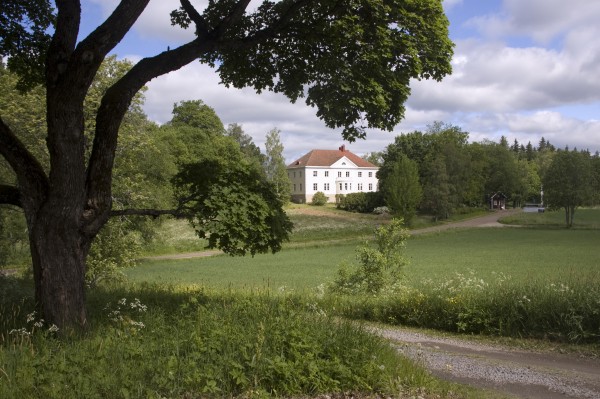
Now that my camera problems are in order and I get to upload photos once again, it's about time to share the excitement that was Spirals and bells from the coasts of the Baltic sea -ancient textiles seminar! It was arranged in 29th-30th October 2016 in Vanhalinna, Lieto, in a manor right next to an iron age hillfort. The spirals have definitely been discussed so much by the ancient textiles enthusiasts after the seminar, that I'm fairly sure I know what'll be the trendy choice of wear next summer :) 

Vanhalinna kesäaikaan. Nyt ei näyttänyt ihan tuolta, mutta siis paikkahan on ihana silti. Kuva museot.fi. ~~~ Vanhalinna at summertime. Now it didn't exactly look like this, but yes, it's absolutely beautiful none the less. Photo museot.fi.

Seminaarista siis, alkusanat sanoi Pirkko-Liisa Lehtosalo-Hilander, suomalaisen tekstiiliarkeologian edelläkävijä. Oli melkoinen fangirl moment istua samassa pöydässä muunkin seminaarin ajan, mutta hävetti toisaalta aivan vietävästi kun flunssaa pukkasi päälle ja seminaarin omana sivuohjelmanani oli näin reipasta aivastelua ja niistämistä - taudin tila ei varmastikaan jäänyt muille läsnäolijoillekaan  epäselväksi vaikka miten diskreetti yritti olla... Muuten, pahoittelen että tässä alussa varsinaisia seminaarikuvia on aika vähän, mutta esitelmänpitäjien powerpointeissa oli aika tavalla kopiosuoja-materiaalia, joten kaivelin sitten verkosta samasta aiheesta ja linkittelin ettei ihan jää kuvaosuus pimentoon sentään. Kuvalähde mainittu kyllä.


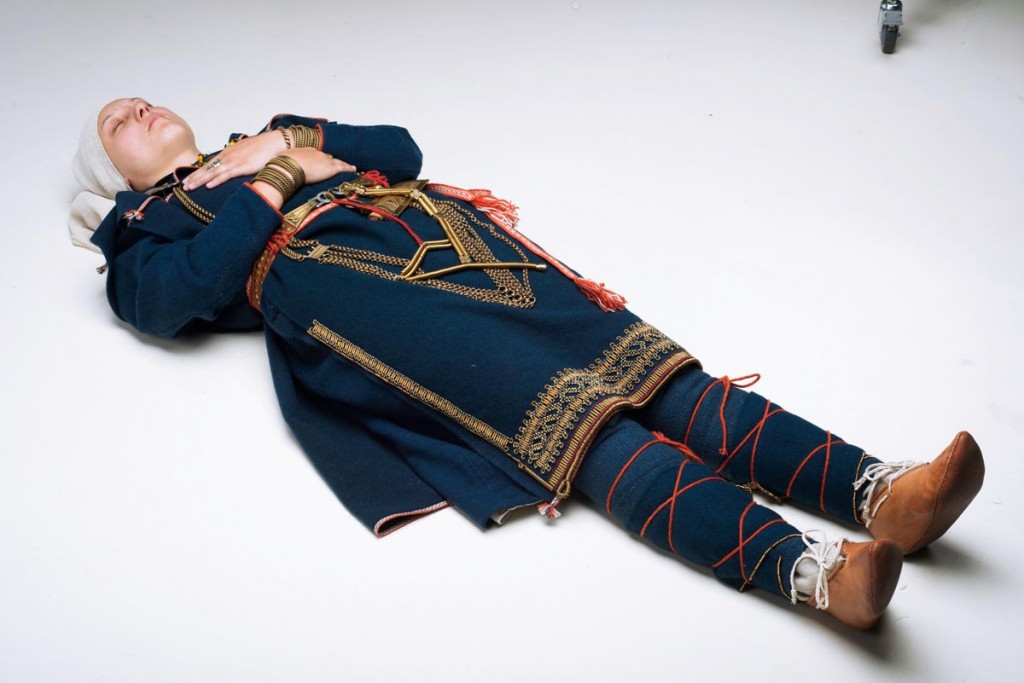
Alkusanojen jälkeen päästiin vauhtiin ja varsinaisiin luentoihin, ensimmäinen luento käsitteli Viron ensimmäistä varsinaista muinaispukurekonstruktiota, aivan vasta tehty. Riina Rammon (Tarton yliopisto) esittelemä vaatekokonaisuus perustui Kukrusen kalmiston (1100-1200-l.) talvella 2009-2010 tutkittuun  hautaan nro 6, jossa makasi noin 40-50-vuotias naisvainaja. Pronssikoristeita naisen vaatteissa oli yllin kyllin, joten tekstiiliäkin oli säilynyt varsin komeasti. Luento-powerpointtien lisäksi vaatekokonaisuutta voi muuten katsoa Viron kansallismuseon blogissa!

As for the seminar, the opening words were spoken by Pirkko-Liisa Lehtosalo-Hilander, the grand old lady of Finnish textile archaeology, most famous for the Luistari excavations. It was certainly a fangirl moment to get to sit on the same table and chat casually with her (never met her before) -and at the same time I was most embarrassed by the fact that I had quite a flu going on then, and although I tried to be really discreet about it, I assume the whole table got to "enjoy" my almost-constant sneezing. Not awkward, not for the slightest bit... Oh, and I'm sorry for the lack of actual seminar photos in the beginning of the post, the slideshows contained so much copyrighted material that I thought it's safer to search the web for photos of the same subject and link them. Credits  are properly given to the respective owners.

After the opening words it was time for the actual lectures. The first one was about the very first actual scientifically-made dress reconstruction in Estonia, a brand new one, by Riina Rammo (University of Tartu). It was based on the Kukruse burial ground (12th-13th cent.) grave no. 6 that was excavated during the winter 2009-2010. The deceased was a woman of 40-50 years. There was quite a lot of bronze decorations, and the bronze had caused the textiles to survive nicely too. The dress can also be seen in the blog of the National museum of Estonia.

Kukrusen puku Kansallismueon blogin kuvauksissa ~~~ The Kukruse dress in the National museum photoshoot

Seuraavassa luennossa tutustuttiin Ave Matsinin (Tarton yliopisto) johdolla Kaakkois-Viron tekstiileihin ja Siksälän kalmiston viittoihin -ja niissä olikin sitten ihmetelemistä, kun yhdessä haudassa saattoi olla yhdellä ihmisellä useita hyvinkin erilaisia koristeellisia viittoja mukanaan. Viittojen lisäksi kalmistossa oli muitakin mielenkiintoisia erityispiirteitä, hautaustavat esimerkiksi olivat säilyneet satoja vuosia hyvin samanlaisina 1200-luvun alusta 1400-luvulle (ja hautauksia oli kalmistossa tätä ennen ja tämän jälkeenkin). Täälläkin tekstiilit olivat kovin hienosti säilyneitä, ja niissä erottui paljaalla silmälläkin upeita lautanauhoja ja kudontakuvioita. Siksälän kalmiston materiaalista on muuten verkossa kokonaisia todella herkullisia kirjoja joita kannattaa kurkata vaikka vironkieli ei taipuisikaan, Siksälä Kalme 1 ja Siksälä Kalme 2.

The next lecture was by Ave Matsin (University of Tartu) and about the South-Eastern Estonian textiles and especially the cloaks of Siksala burial ground.  The Siksala cloaks were indeed something to admire, a deceased might have had several very different types of ornate cloaks in the grave. There are also some other peculiarities to the Siksala graveyard too, for example the burial customs had remained almost unchanged for centuries, from the early 13th to the 15th century -and the burial ground had burials dating both before and after those dates too. In Siksala the textiles were also very well preserved, and the patterns in the tablet woven bands and weaving patterns in the fabric are still visible to the naked eye. There are, by the way, some lovely books about the Siksala burial ground freely available online, Siksälä Kalme 1 and Siksälä Kalme 2.

Viitan ennallistus Siksälästä, tekijä Ave Matsin. Kuva Mervi Pasanen. ~~~ Shawl reconstruction from Siksala, by Ave Matsin. Photo Mervi Pasanen.
Sen jälkeen olikin lounastauko, jonka aikana todistetiin useampiakin eeppisiä kuvasessioita viereisen Vanhalinnan linnavuoren laella! Tauo jälkeen palattiin taas ruotuun, ja Jaana Ratas vei yleisön virolaisten pronssispiraalien pariin. Spiraalikoristeluperinne jatkui Virossa huomattavan pitkään, 1800-luvulle asti, joten materiaali on sikälikin erilaista kuin Suomen rautakautinen hautalöytöaineisto. Virolaiset spiraalit ovat muuten todella paljon pienempiä kuin suomalaiset vastaavat, ja kuviot kovin monimutkaisia eli ikuisuuskysymys onkin, miten ne on tehty. Jaana Ratas esitteli oikein pätevän tekniikan jossa kuviot tehtiin tuohen päälle! Tätä pääsi kokeilemaan seuraavana päivänä työpajoissa vielä käytännössä, oli kuulemma tarkkaa puuhaa.

After that we had a lunch break, and during the break we witnessed some really epic photoshoots on the top of the Vanhalinna hillfort! After that it was time for lectures again, Jaana Ratas taught us a method of creating bronze spiral decorations the Estonian way. The tradition of bronze spiral decorations in Estonia continued far longer than it did in Finland, all the way until the 19th century, so the source material is somewhat different than in Finland where the material is from iron age graves. The Estonian spirals, by the way, are a lot smaller than the Finnish spirals! The method of creating the decorations the iron age way has been somewhat open to debate, however. Jaana Ratas introduced a plausible technique, where the spirals are constructed on a piece of birch bark! This technique was also taught in a workshop on the next day, they said it indeed required some precision!

Spiraalikoriste tekovaiheessa, nättiä ja pientä! Kuva Mervi Pasanen. ~~~ Spiral decoration almost finished, so cute and tiny! Photo Mervi Pasanen.
Neljäs esitelmä tälle päivälle oli aiheensa puolesta poikkeus tähänastiselle ohjelmalle, ja Viron ihanuuksista lähdettiin etelään Latvian Kuurinmaan tekstiiliherkkuihin. Irita Zeiere (Latvijas Vestures Musejs) kertoi 1200-1300-luvun Kuurinmaalaisten naisenpukujen ennallistuksista. Ance:n kalmiston tutkimukset 1990-luvulla olivat antaneet riittävästi materiaalia jotta ennallistus oli mahdollinen, ja tästä siis tehtiin ensimmäinen ennallistus. Toinen ennallistus perustui Laukmeizan kalmiston jo 1929 tutkittuihin löytöihin. Ja ilmeisesti uusia vaate-ennallistuksia on vielä tulossa, 2000-luvulla kaivettiin Lejaskorgissa ja ennallistamiskelpoista materiaalia saatiin talteen...

The fourth lecture fr the day was an exception for the Estonian pretties discussed so far -we headed south and for the 13th-14th cent. Curonian textiles and their reconstructions in Latvia by Irita Zeiere (Latvijas Vestures Musejs). The excavations in Ance burial ground yielded in so much textiles material that it was possible to reconstruct a whole set of clothing, and hence the first Latvian dress reconstruction was made. The second dress reconstruction was based on the material from Laukmeiza burial ground excavated already in 1929. And apparently new reconstructions are on their way, in the 2000s Lejaskorg excavations have brought to light new material...

Yksi vaate-ennallistuksista Latvian kansallismuseossa, tilapäisessä näyttelyssä "Matkalla Latvian kansaksi" (Ceļā uz latviešu tautu). One of the dress reconstructions in the Latvian museum of history, exhibition "On the way to the Latvian nation".

Viidenteen aiheeseen olikin sitten tullut jo hienokseltaan tutustuttua, paikalla oli Krista Vajanto kertomassa väitöskirjansa aiheesta eli väreistä ja värjäysmetodeista Suomen rautakaudella.  Nopeasti yhteenvetäen Vajanto oli siis testauttanut parikymmentä rautakautista suomalaista tekstiiliä väriaineiden suhteen ja verrannut tuloksia kokeiluihin, tulokset olivat mielenkiintoisia! Näytteet viittasivat kovasti siihen, että käytössä oli kolme värjäysmenetelmää -puretetettuna värjääminen, kyyppivärjäys ja fermentoidut tanniinit, jotka antoivat punaisia sävyjä. Erityisesti tanniinit olivat sikälikin mielenkiintoisia, että ne paitsi värjäsivät, myös tekivät langan vetolujuudesta parempaa. Tulosten perusteella myös esitettiin, että rautakauden halutuin väri olisikin ollut musta -ei luonnonmusta vaan värjätty, joka vaati useita värjäyskertoja erilaisilla väriaineilla (muttei rautaa, joka haurastuttaa lankaa). Väitöskirja (englanninkielinen) on luettavissa kokonaisuudessaan Helsingin yliopiston sivuilta!

As for the fift lecture, the subject had been slightly touched by this blog already. Krista Vajanto spoke about her doctoral thesis concerning dyes and dyeing methods during the Finnish iron age. To sum it up, Vajanto had tested some twenty iron age textile samples for dye remains and compared  them to samples she dyed herself -and the results were indeed interesting! The samples hinted on that three methods of dyeing were in use -mordant dyeing, vat dyeing and fermented tannins, which give reddish colour. Especially the tannins were interesting, because not only they dyed the yarn, they also strengthened it. The results also showed that the most wanted and appreciated colour during the late iron age would've been black -not natural black that comes directly from a sheep but dyed black which requires several different dyes and repetitions (but no iron, which is bad for the yarn). The doctoral thesis (in english) is available at the Helsinki University website.

Napajäkälävärjättyä villaa Mycopigments-blogissa. Vajannon näytekappaleet olivat aivan yhtä ärmäköitä! ~~~ Umbilicaria dyed wool in Mycopigments -blog. The dye samples by Vajanto were equally bright!
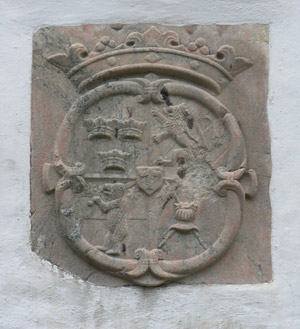
Kuudes esitelmä osuikin maantieteelliseti todella lähelle, sillä Heini Kirjavainen kertoi siinä Turun linnan kupeesta 1939 tutkimuksissa löytyneestä karhunmuotoisesta pienehköstä (kork. 16 cm) tekstiilimerkistä. Hienoja materiaaleja ja yksityiskohtaista pientä kirjontaa -tämä viittasi arvokkaaseen alkuperään. Karhun muoto merkissä myös oli herättänyt kysymystä, ja lopputuloksena esitettiinkin, että tällä merkillä olisi yhteys Juhana herttuaan (asui Turussa 1556-63). Hänen vaakunassaan esiintyy samoin tavoin aseteltu karhu, ja Juhana herttuakaudellaan tuli myös kutsutuksi "Suomen karhu"-nimellä, Ursus Finlandicus. Yhteyteen viittasi myös se, että materiaalien radiohiiliajoitukset osuivat hyvin renessanssin ajanjaksolle. Mahdollisesti merkki onkin ollut aikoinaan kiinni lipussa.

The sixth lecture was geocraphically really close, as Heini Kirjavainen told us about a bear-shaped textile small-ish (height 16 cm) badge found right by the Turku castle during the 1939 excavations. Fancy materials and tiny embroidery -the badge seemed to have a history worth noticing. The bear shape itself had raised some questions, too, and seemed to lead to a theory that the badge had a connection to duke John (residing in Turku 1556-63). His heraldic shield does feature a bear, and duke John was also occasionally referred to as the Bear of Finland, Ursus Finlandicus. Also the radiocarbon dates of the textiles point nicely to the renaissance era. Perhaps the badge was a part of a flag?

Juhana Herttuan vaakuna Turun linnan portilla. Tekstiilimerkin kanssa identtinen karhu alavasemmalla! Kuva Sagalundin museo. ~~~ Duke John's heraldic shield at the gate of Turku castle. An identical bear on the bottom left! Photo Sagalund museum.

Seitsemäs, toiseksi viimeinen päivän luento käsitteli Maikki Kariston tutkimaa Maskun Humikkalan haudan 31 (n. 1000-luvulta) lautanauhaa ja sen tutkimusta. Nauha oli herättänyt mielenkiintoa jo 1960-luvulla, jolloin Viivi Merisalo oli kutonut siitä version nauhakirjaansa, myöhemmin myös Seija Sarkki ja Egon Hansen olivat versioineet sitä. Osa nauhan kudontatekniikoista oli jäänyt vielä tuntemattomiksi, joten versioinnit olivatkin sikälikin puutteellisia -puolikaskierron "löytyminen" suomalaisissa nauhoissa edesauttoi tätäkin tutkimusta ja lopulta oikean lautamäärän löydyttyä ja alkuperäisen nauhan digikuvien ja useiden kokeilujen avulla kuvio alkoi valottua oikeanlaisena -työ vaan ei ole vielä lopussa vaan jatkuu edelleen nauhan fragmenttien lisätutkimuksella.

The seventh and the second last lecture of the day concentrated on tablet weaving and the problemns of recreating one single band. Textiles conservator and an experienced tablet weaver Maikki Karisto spoke about the tablet woven band in Masku Humikkala 31 -grave (11th cent.). The band had awoken some interest already in the 1960s, when Viivi Merisalo created a version of the band for her narrow wares book. Later Seija Sarkki and Egon Hansen tried to solve the puzzle, but as some of the techniques used in this band were unknown at the time, the reconstructions have their flaws. With the help of high resolution digital photos, discovering the half-turn was one step forward in the research of this band, and finding the right number of tablets also helped in creating the right look. The band still isn't totally solved, there are some fragments that haven't been thoroughly researched!

Humikkalan nauhan versiointi Adventures in historical tablet weaving -blogissa ~~~ The Humikkala band version in the Adventures in historical tablet weaving blog.
Päivän viimeinen luento käsitteli vähän varjoon jäänyttä aihetta, suomalaista rautakautista miehenpukua, jonka olivat koonneet Helena Honka-Hallila ja Hannele Köngäs. Miesten haudoista tekstiilijäänteitä on tupannut olemaan huomattavasti vähemmän kuin naistenhaudoista, joten tätä vaatekokonaisuutta varten löytöjä oli haettu useasta kalmistosta ympäri Varsinais-Suomea. Pääinspiraatio takkiin oli suomalaisittain ja Baltian suuntaankin katsoen ainutlaatuinen Maskun Humikkalan haudan 21 pronssikulkusnapit -komeat 11 kulkusta napinvirkaa toimittamassa rinnustassa! Kulkusnappeja tunnetaan kyllä Suomesta toinenkin löytö (Raision Ihalasta hauta XXIV) sekä Baltiasta, muttei missään läheskään yhtä montaa, myös Skandinaviaan päin katsellessa metallinappeja esiintyy kyllä, mutta kulkusia ei sielläkään tunneta. Koska vaatteiden varsinaista leikkausta ei pystytä kovin tarkkaan monestikaan sanomaan, itse malleissa joutui soveltamaan löytöjä muualta maailmasta. Tästä nyt nähdystä kokonaisuudesta puuttui vielä viitta, joka siis kuului tähän kokonaisuuteen. Itseäni kyllä yllätti miten tämä takki sai koko kokonaisuuden vaikuttamaan pintapuolisesti paljon myöhäisemmältä! On kyllä sanottava, että hienoa pioneerityötä tämä, ja oli mainiota nähdä tämä ensimmäisten joukossa!

The last presetation of the day was dealing with a very interesting topic that has so far been sort of left in the shade -late iron age men's clothing in Finland! Helena Honka-Hallila and Hannele Köngäs had been through the finds of South-western Finland and came up with an intepretation (men's graves often have next to zero textile remains, so focusing on one spescific grave was not an option). The main inspiration for this outfit was from Masku Humikkala grave 21 and its fancy bronze bell buttons, all 11 of them in a nice row! Bell buttons are known in one other find in Finland (Raisio Ihala grave XXIV) and the Baltic lands, but in no known grave there are this many. And there indeed are metal button in Scandinavian context, but no bells as buttons, so this is kind of unique! Since the cut of the Finnish iron age garments is mostly impossible to tell, finds from other parts of the world had been utilized. This set of clothing was still lacking a cloak -for now, it actally should be and will be included. I was sort of surprised, since the jacket made the whole outfit look superficially like it's younger by some centuries! All in all, I just have to say that this is wonderful pioneering work, and I'm really glad I got to see this slightly before it was officially introduced to the public in newspapers.


Seuraavana päivänä oli sitten vuorossa työpajoja ja työnäytöksiä! Varsinaisia työpajoja pidettiin spiraaleista, suomalaisista rautakautisista lautanauhoista ja neulakintaasta. Työnäytöksiä oli lisäksi pystypuilla kudonnasta, kehräämisestä ja villan kampaamisesta, Krista Vajannon värjäyskansiot katsottavana ja keskusteltavana, ja kankaan lopetuslautanauhan tekokin esiteltiin. Lisäksi näytillä oli mahtavia spiraaliesiliinoja ja -viittoja sekä valmiita suomalaisten rautakautisten löytöjen mukaan kudottuja nauhoja.

On the next day we had workshops and demonstrations on different sorts of crafts. The actual workshops were on bronze spirals, Finnish iron age tablet woven bands and nalbinding. Demonstrations, then again were numerous, weaving with an upright loom, spinning and combing wool, and making a tablet woven finish for a fabric. Krista Vajanto's dyeind samples were put to display and she eagerly told us about the dyeing processes. Also on display were the man's clothes we saw yesterday and the weaving samples. We also had a chance to admire up close several spiral-decorated aprons and shawls and readily-made tablet woven bands based on the Finnish late iron age finds.
Pöytä väärällään lautanauhaa, Mervi Pasanen kutoi. ~~~ Table filled with tablet woven pretties, woven by Mervi Pasanen.
Nerokas pystypuumalli, oikeastaan siis lähestulkoon teltanrunko! ~~~ A brilliant way to construct the upright loom, it' s basically a tent frame!
Spiraali-ihanuutta, Perniön muinaispuvun viitta. Tekijänä Orvokki Rosberg. ~~~ Spiral bling at its prettiest, the Perniö dress' shawl by Orvokki Rosberg.

Ja tulihan seminaarista sitten tuliaisiakin. Olisi varmaan ihan hyvä paikka alkaa nyt opetella viroa...
And some books happened. Now, I suppose, could be a good time to learn estonian...


Wednesday, 2 November 2016

Viikinkejä ja veneitä Virossa ~~~ Boats and vikings in Estonia

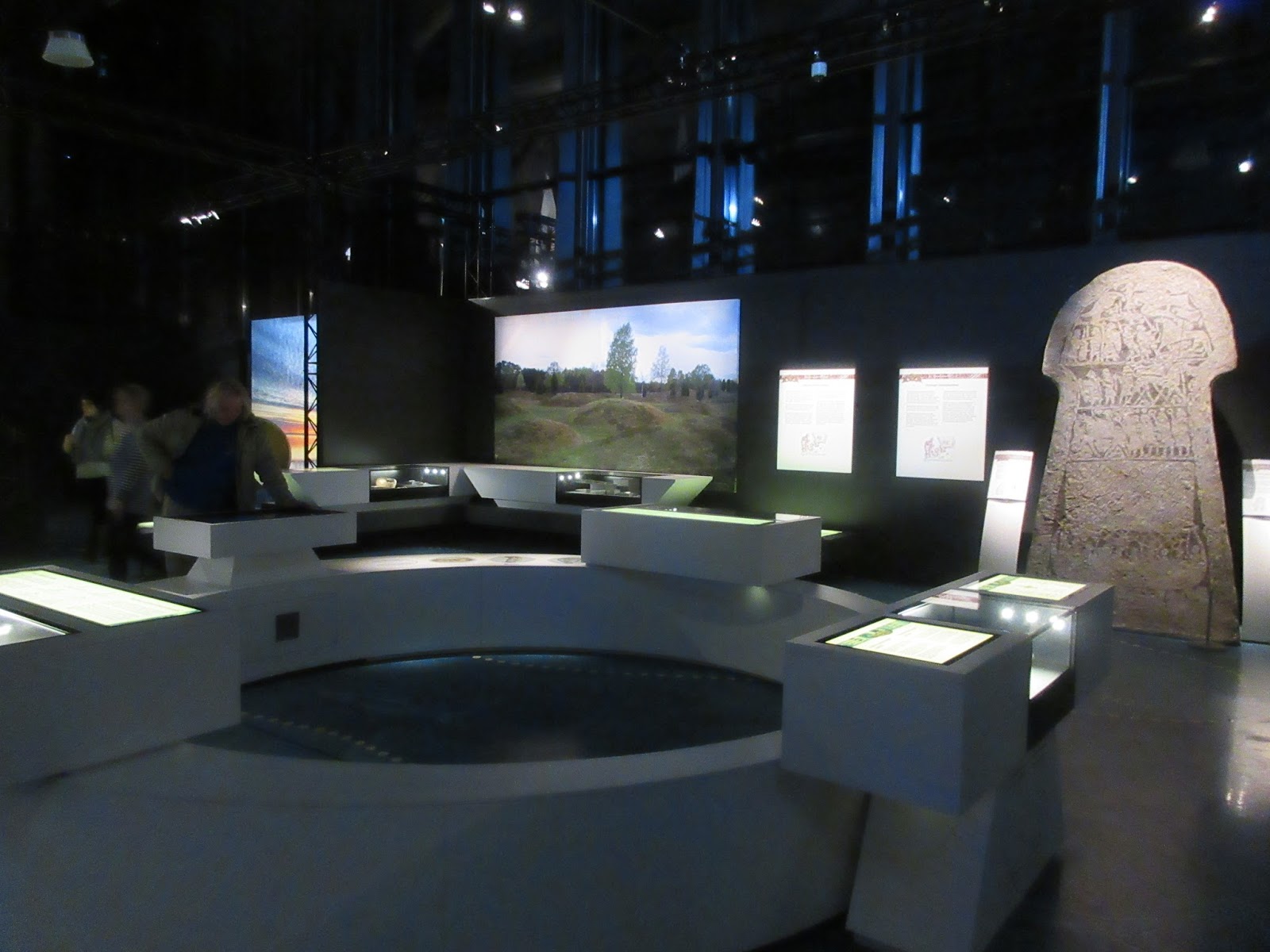
Tulipa käytyä taas pikapiipahduksella Virossa, suuntana oli tällä kertaa Lennusadamin Viikingit: Todellisuus tarujen takana -näyttely. En itse asiassa ollut käynyt Lennusadamissa ylipäätään, joten aikaa meni melkoisesti myös meri- ja laiva-aiheisen perusnäyttelyn läpikäymiseen -ja olipa sielläkin melkoisesti hienoa katsottavaa. Veneitä oli Viron vanhimman säilyneen laivanhylyn (Maasilinn-laiva Saarenmaalta, n. 1550) ja yksipuisen haapion kautta laiturissa kiinni olevaan 1900-luvun alun  jäänmurtajaan Suur-Töll:iin (jolle harmittavasti ei aika tällä käynnillä riittänyt, mutta joskus toiste sitten!). Melkoisen vaikuttava oli myös halli itse, jollain tavalla melko sci-fi-tunnelmainen kupolirakenteineen.

So, we dropped by in Tallinn again! Our main destination was the new exhibition in Seaplane harbour, We call them Vikings. It was also my very first visit to the Seaplane harbour, so we took our time in looking at the permanent exhibition about seafaring an boats too -and indeed there was a lot to see! The boats ranged from the oldest preserved shipwreck in Estonia (the Maasilinn boat, c. 1550) to a dugout (possibly the most primitive from of canoe carved out of a single tree trunk) and an early 20th century icebreaker Suur-Töll (it was sitting firmly in the dock, and we unfortunately were on a really tight schedule so that was left as something to see on our next trip!). The building itself was impressive too, somehow really sci-fi with its dome structures.


Ehkä vaikuttavin merimuseon kohde oli hallissa sisällä oleva sukellusvene Lembit, joka oli 1937 rakennettu Englannissa 32 hengen miehistölle. Noin pienessä purkissa se on melkoinen määrä, kaiken toiminnan on Lembitillä täytynyt olla ihan todella sotilaallisen järjestyksessä että mikään on toiminut...

Perhaps the most impressive single object in the exhibition was the submarine Lembit, built in the UK in 1937 for a crew of 32. In such a small vessel that is quite a lot of men, and I assume all that happened in Lembit must've been really organized and pre-thought in order to function at all...


Mutta, tämä viikinkinäyttely! Kyseessähän oli siis kiertävä, alkujaan Historiska Museetin kokoama kaksiosainen näyttely jonka toinen osa kiertää tätä kirjoitettaessa Amerikan mannerta. Näytteillä oli todella paljon esineitä, myös erinäisiä hyvin tunnettuja "kansikuvaesineitä" mutta myös joitain replikoita ja ennallistuksia esineistä, jotka taitavat olla niin sitä ykköskamaa että ne eivät Historiskasta lähde kiertelemään.

Mukana oli hiukan myös kokeellista arkeologiaa pitkistä ja kapeahkoista kangassuikaleista "punotun" purjeen muodossa. Ensinäkemältä vaikutti nerokkaalta havainnolta, ja tosiaan, vastaahan se niitä gotlantilaisten kuvakivien purjekuvauksia -ja ilmeisesti jonkinasteisesti toimikin, sillä tämä purje oli ollut ihan käytössä (ja pystyisin kuvittelemaan sille useita etuja) mutta epäselväksi jäi toimiko se sitten oikeasti käytännössä niin hyvin.

Kokonaisuutena näyttelyssä oli pyritty käsittelemään koko elämänpiiriä, mukana oli esineistöä aseista keittiötarvikkeisiin ja leluihin, hopeasta puuhun ja kotoisista luuluistimista kovin kaukaa tuotuun Buddha-patsaaseen. Mutta jos hiukan olisi saanut toivomusta esittää, niin ehkä "kokeile itse" -pisteitä olisi voinut olla enemmän, nyt se rajoittui lähinnä siihen perinteiseen eli miekan kokeilemiseen (ja sekin hyvin rajatussa tilassa, mutta paino ja tasapainotus tulivat selväksi). Mutta siis, tuossahan oli nämä ipityksen aiheet eli vähissä oli kritisoitava, suosittelen kyllä näyttelyä ihan kaikille!

But, this viking exhibition! We're talking about a travelling exhibition here, originally organized by the Historiska Museet of Sweden. It's in two separate parts, and while this exhibition is open in Tallinn, the other part is touring in the North America. There was really a lot of objects to see, also several really well known "celebrity items" as they could be called, and also reconstructions and replicas of some objects that, I guess, might be so "top notch" that they just won't leave the Historiska.

Also featured was some experimental archaeology in the form of a sail. It was  "woven" diagonally of long and narrow strips of woolen cloth, and at  first glance it seemed like a brilliant idea. At least it resembles greatly the carvings in the picture stones of Gotland, and it certainly had been working, too, it had actually been sailed with -and I could think of several advantages that this kind of sail would have, but I'm by no means an expert in sailing so I don't actually know if it's really functional.

As a whole, the exhibition was definitely in the aim of covering all there is to viking life, the objects were ranging from weapons to cooking utensils and toys, from silver bling to wooden objects and from very local bone skates to a tiny Buddha figure from far, far away. If I could wish for some additions, it would've been more "try it yourself"- type of stuff, now pretty much the only thing that one could try hands-on was a viking sword (in a very restricted environment, but still the weight and balance were clear). But yeap, that seems to be the only thing I've got to criticize, so very little indeed! I really do recommend this exhibition for, like, everyone, should it end up in a place near you! 
Kangassuikaleista punottu purje, alareunassa pienenä kuvassa purje käytössä ~~~ Sail made by weaving strips of cloth, on the bottom right photo of the same sail in use.

Hopealankakirjottu peura Birkasta ~~~ Silver thread embroidered deer from Birka
Viron viikinkiaikaakaan ei oltu unohdettu -kyllä Baltiassa on parhaat blingit! ~~~ Estonian viking age was not forgotten either, the best bling is definitely Baltic!


Ja illan päätteeksi päädyttiin taas Olde Hansaan syömään, kunnon vaatteissa tottakai!  Tällä kertaa ulkoilutettiin "Uvdalin mekkoa", 1300-l. norjalaisen hautalöydön mukaan. Tässä mekossa on kyllä se hyvä puoli, että se näyttää kuvissa aivan hulvattoman nätiltä -kantaja sitten on tapaus erikseen, mutta mekko edustaa aina!

In the evening we ended up in Olde Hansa, in proper clothing of course! This time I took with me my "Uvdal dress", based on a 14th century grave find from Norway. This dress definitely has a bright side, it looks tremendously good in pictures -regardless on what the person inside the dress looks like but the dress is always nice!

Raatihuone taustalla. Hiukan tuulahteli! ~~~ The medieval town hall in the background. It was a bit breezy day!