Tuesday, 11 July 2017

Bocksten-hupun uusi väri ~~~ New dye for a Bocksten hood

Kanssaeläjä harmitteli ennen Turun keskiaikaisia markkinoita ja keskiaikaista muotinäytöstä huppunsa laimeaa väriä. Saksanpähkinällä värjätty huppu olikin kieltämättä vähän valju beige, sinänsä se olisi kyllä itselleni mennyt mutta kun kerran herra uutta väriä halusi niin olihan tuo toteutettava (varsin loistava tekosyy päästä värjäämään!). Liian hieno väri ei sopinut tähän suunnitelmaan, kyseessä kun oli "työvaatekokonaisuus", eivät varsinaisesti mitkään edustusvaatteet. Jotain paikallista väriainetta siis, mikä olisi ollut täälläpäin kaikkien saatavilla.

Before the Turku medieval market and its medieval fashion show, the companion was slightly vexed with his hood and its colour. I must admit, it indeed was a very pale beige, dyed with walnut. It would've worked for me, but  since he wanted new colour, of course it had to be dyed (what a brilliant excuse to get the kettle boiling!). The new colour shouldn't be too fancy, since this was a part of a set of "working clothes" and not something that's considered as the Sunday best. So the dye should be something that would've been available for everyone around here.

Siinäpä se menee alkuperäisessä värissä, häntä polvia hipoen. ~~~ There it goes with its original colour, tail reaching the knees. Kuva/photo Arvo Malmi.
Huppu oli Bockstenin hupun mallilla leikattu ja ommeltu, eli esikuva löytyy siis noin 1300-luvun puolivälin Ruotsista. Alkuperäisestä Bockstenin hupusta ei värianalyyseissä oltu löydetty mitään värijäämiä itse huppukankaasta, joskin löydön suoympäristö oli värjännyt hupun ruskeaksi (Bockstenmannen och hans dräkt). Kanssaeläjän hupun beigen päälle sopivaa väriä miettiessä havaitsin että nyt on oikein erityisen hyvä vuosi lepänkävyille, joten siitäpä se ajatus lähti, vaikka lepänkävyillä värjäämisestä ei kovin paljon historiallisia lähteitä olekaan -tässä mentiin siis lähinnä linjalla "mikä ettei". Huppu painoi onnettomat 200 grammaa (varsin kevyttä villaa) mutta jotta väri olisi ollut riittävä eikä taas oltaisi päädytty beigeen, keräsin käpyjä ämpärillisen, vähän vajaa 10 litraa. Liottelin niitä pari päivää ennen keittämistä.

The hood was cut and sewn after the Bocksten hood pattern, so it's based on an mid-14th century Swedish original. The original Bocksten hood showed no traces of dye when tested, although swamp water had dyed it brown (Bockstenmannen och hans dräkt). When I thought of what should I dye the companion's hood with, I noticed that it seemed to be an especially good year for alder "cones", so that's what I went for -although there is very little evidence for alder cones being used as a dye historically, this was more like "why not" -decision. The hood was really light in weight, only 200 grams, but to avoid the new dye being beige too I collected a whole bucket, about 9 liters, of cones. They were soaked in water for a few days before they were boiled.

Alkuperäisen Bockstenin hupun kaava, omassa tuli jätettyä helman korjauspalat pois. ~~~ The original Bocksten hood pattern. I left the tiny bottom edge "repair pieces" out. Kuva/pic Marc Carlson, Some clothing of the Middle ages

Ämpärillinen käpyjä, tässä tosin jo keitettynä. ~~~ A bucket full of cones, already boiled.
Käpysoppa kiehui kolmisen tuntia kuten yleensä on ollut hyvä kovemmille kasviaineksille. Jälkeenpäin oli hyvä havaita että lepänkävyissä olisi tietysti ollut tanniinia joten alunapuretus ei välttämättä olisi ollut tarpeen, mutta eipä siitä varsinaista haittaakaan ollut, laitoin siis "automaattiohjauksella" värjätessäni 20% alunapuretuksen. Hupun kanssa kattilassa ei ollut mitään muuta, joten huppu sai kaiken saatavilla olevan värin ihan kokonaan itselleen. Huppu lämmitteli melkein-kiehuvassa vedessä 12 litran kattilassa pari tuntia ja sai sitten jäähtyä liemessään yön yli, aamulla huuhdottiin.

The cone soup was boiling for three hours, that has previously been a good time for harder parts of plants. Only after the dyeing I realized that the cones too had tannin, so mordanting with alum wouldn't have been necessary. But it doesn't do any harm either, and the fabric was mordanted with 20% alum. The hood was the only thing in the kettle so it got all the colour that was available. It stayed in the 12 liters kettle heated for a few hours, and and after that it was left to cool overnight and it was rinsed in the morning.
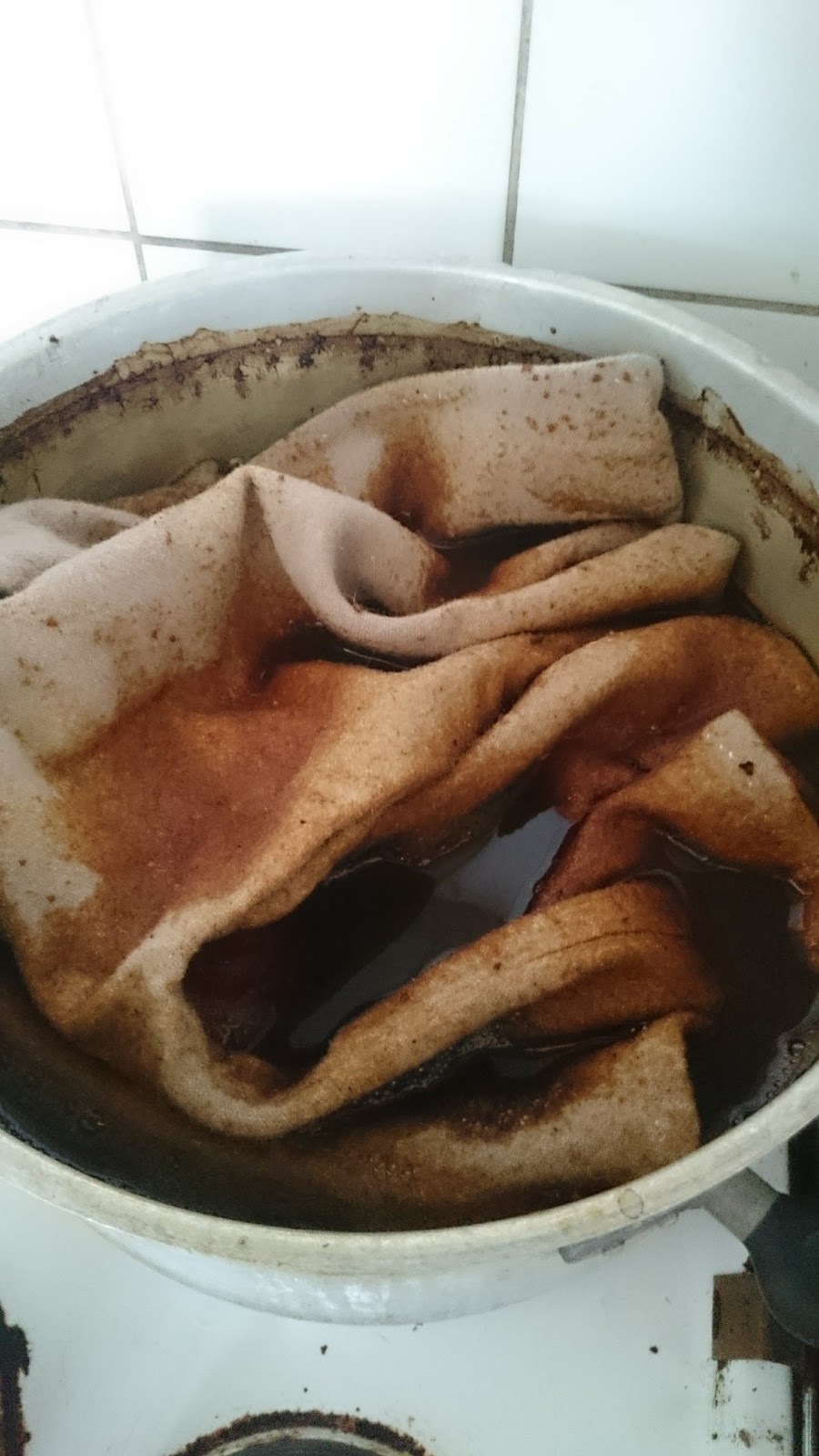
Sinne meni, tosi tumma liemi ja aavistus uudesta väristä jo pinnalle loiskahtaneena. ~~~There it went, really dark liquid already partially splashed to the hood

On sanottava että komea lopputulos siis tuli, runsas väriaineen määrä selvästi kannatti koska hupusta tuli suorastaan pronssinruskea. Ja tasainenkin vielä, mikä ei aina kangasta värjätessä ole ihan itsestään selvää. Huppu siis edusti vastavärjättynä keskiaikaisessa muotinäytöksessä ja hyvin edustikin muun Bockstenin-miehen vaatetuksen kanssa!

And I've got to say it ended up as quite handsome, plenty of dyestuff was definitely worth the shot because it ended up as bronze in colour! And very even dye, which is not always self-evident when dyeing fabric. The newly dyed hood was represented in the Turku medieval fashion show, and it indeed looked fabulous with the other Bocksten man gear!
Tällainen tuli. Illan myötä vastavärjätty huppu vaihtui chaperoniksi... ~~~ This was the result. As the night came, the newly dyed hood became a chaperon....

Monday, 10 July 2017

Taas Ruotsiin ja Tanskaan, osa 1: Luostareita ja vähän muutakin ~~~ Return to Sweden and Denmark, part 1: Cloisters and some more


Jo toista kertaa suuntana oli Tanska ja Middelaldercentret, mutta Suomen ja Middelaldercentretin väliin mahtui automatkalla monennäköistä -eli otettiin matkanteosta kunnolla ilo irti, ajan kanssa. Kuten autolautalla tapahtuvalle meren ylitykselle tyypillistä on, olimme taas Tukholmassa aivan laittoman aikaisin, mutta tällä kertaa jätettiin Tukholman lähiseudun nähtävyydet katsomatta ja suunnattiin suoraan parin tunnin ajomatkan päähän, päivän kohteena Vätternin rannan tienoot.

For the second time, we were heading off to Denmark and Middelaldercentret. There is a lot to see between Finland and Middelaldercentret, though, so we took the most out of it and went sightseeing big time, since we were driving anyway and were not in that much of a hurry. We were in Stockholm way too early for my taste which tends to happen when the arriving with a ferry, but this time we skipped the sights in and near Stockholm and drove for a couple of hours to the shores of lake Vättern.

Linköping

Linköpingin kohteita ei ollut sen kummemmin katsottavien kohteiden listalla tällä kertaa, joten piipahdus kaupungissa rajoittui antikvariaattiin -olin jo hyvissä ajoin löytänyt ruotsalaisesta nettiantikasta tiedon että linköpingiläisessä antikvariaatista löytyisi Birgittareliker -kirjanen, jota Suomesta on käytännössä mahdoton löytää (itselleni se oli hyvinkin tarpeen koska tekeillä oli 1300-luvun alun tyylin mekko hyödyntäen p. Birgitan viitan/mekon kaavaa ja tässä 1970-luvun kirjasessa siitä oli edelleen kaikkein parhaimmat saatavissa olevat infot, ja onpahan muutenkin kiva kirjanen). Mutta eipä siitä joutunut tuolla edes köyhtymään paljoa, ja mukaan tarttui myös Det Medeltida Östegötland-kirja -tuota maakunta-sarjaa ei oikein voi suositella edes riittävästi jos tällaisia road tripejä on tekeillä. Vasta jälkeenpäin tuli mieleen, että antikan pitäjä saattoi jäädä puheitten perustella siihen uskoon, että olisimme tulleet Suomesta ihan vartavasten tuota Birgittareliker -kirjan takia. No...

Linköping

We did not have any real sightseeing to do this time in Linköping, so what we stopped for was specifically because of books and an antiquarian bookshop. Well in advance I had spotted that in Linköping there is available a copy of the booklet Birgittareliker, which is next to impossible to find in Finland. I needed it for a sewing project, I was working on an early 14th century dress which utilizes the cutting pattern of the St. Birgitta's dress/mantle and this 1970s booklet has still the best information concerning the garment, and it's otherwise interesting too. And it was really a bargain, and I also took a copy of archaeological guidebook Det Medeltida Östergötland with me -one just simply cannot recommend the series enough if planning on a road trip like this. Only after the shopping it came to me that the bookshop owner might've unintentionally been left to the impression that we would've come all the way from Finland just because of these books. Oh, well...


Vretan luostari

Sitten alkoi tämä virallinen luostarikierros, ihan Linköpingin lähellä oli ensimmäinen kohde eli Vretan luostarin rauniot ja luostarikirkko. Kuningas Inge vanhempi ja kuningatar Helena perustivat Ruotsin alueen ensimmäisen nunnaluostarin noin vuonna 1100 ja se toimi aluksi benediktiiniläissäännön alla, mutta jo 1160 vaihtoi sistersiläisluostariksi. Luostarilla oli hyvinkin vahvat yhteydet kuninkaallisiin ja ylhäisaatelisiin muutenkin, useampi luostarin nunnista ja abbedissoista oli ylhäisaatelista ja jopa kuninkaallista sukua ja luostarin kirkossa on kuninkaallisia hautoja (ja vielä useampia kuninkaallisia hautamuistomerkkejä ilman varsinaista hautausta). Luostarin varsinaisista rakennuksista ainoastaan yksi eli viljavarasto oli edelleen pystyssä, muut olivat raunioituneet sen jälkeen, kun luostaritoiminta Vretassa lakkasi reformaation jälkeen. Huonetilojen jako on kuitenkin ihan selvästi nähtävillä edelleen, ja yllättävän paljon huoneiden käyttötarkoituksestakin ilmeisesti myös tiedetään.

Kirkossa oli pieni kahden huoneen museo alueen löydöistä ja Vretassa tedyistä tutkimuksista. Kirkossa oli varsin vähän keskiaikaista maalauksia -koristelemattomuus on sistersiläiskirkoille tyypillinen piirre, mutta ilahduttava poikkeus kirkossa oli Stenkilin kuninkaallinen hautakappeli joka oli tehty ja koristeltu 1100-luvun alussa eli ennen sistersiläisaikaa.

The Vreta cloister

After Linköping, the official slightly cloister-themed tour was about to begin with the ruins of Vreta cloister and the cloister church. King Inge the elder and queen Helena established the first nunnery in Sweden around 1100, and at first it functioned under the Benedictine rule but already in 1160 it was transformed as a Cictercian cloister. The cloister was well connected to the royals and high nobility even later on. Several of the abbesses and nuns were from the mightiest families in Sweden and the cloister church has royal graves (and even more memorial stones without actual burials). Only one of the actual cloister buildings still stands, the granary, the others fell to ruins after the reformation and closing of cloisters. The layout of rooms is still well visible, though, and quite a lot is apparently known of the uses of different rooms.

In the church there was a little two-room- museum concerning the finds and research of Vreta. The church was for the most part lacking medieval paintings (which is very typical for the Cistercian order), but delightfully there is an exception in the form of the Stenkil royal burial chapel, built and decorated in the beginning of the 1100s, before the Cistercian times.
Ristikäytävä oli melkein ennallistettu köynnöskasveilla. ~~~ The cross-vaulted gallery was almost reconstructed using vines.
Kirkko itse, luostarin alue kirkon takana. ~~~ The church itself, the cloister area is behind the church.
Stenkilin hautakappeli, 1100-lukuiset seinämaalaukset ja 1500-lukuinen muistomerkki. ~~~ The Stenkil burial chapel, paintings 12th century, memorial stone 16th century.
Ainoa edelleen seisova luostarin rakennus, 1200-lukuinen viljavarasto. Kiinni oli... ~~~ The 13th century granary, only one of the cloister buildings still standing. It was closed...

Vadstena

Vretasta ei ollut kuin kivenheitto Vadstenaan. Vadstenassahan käytiin jo viime reissulla, mutta luostarimuseo ei ollut tuolloin auki joten jäipä sieltäkin sitten katsottavaa uudellekin kerralle. Nyt kun olimme sitten aivan ajoissa liikenteessä, niin aikaa oli runsaasti, ja on kyllä sanottava että Vadstenan luostarimuseoon ei ihan hätäisellä aikataululla kannatakaan lähteä, on se sen verran laaja ja kyllä jokaisen paikalla vietetyn minuutin arvoinenkin. Kyseessähän on alkujaan kuninkaallinen asumus 1200-luvun puolivälistä (ensimmäisiä maallisia tiilirakennuksia Ruotsissa!), joka testamentattiin luostarikäyttöön 1346 ja josta tuli birgittalaisluostari 1384.

Luostarikäytössä aiemmin komeasti koristeltu rakennus muutettiin huomattavasti yksinkertaistetummaksi, mutta onneksi vihjeitä aiemmastakin ulkoasusta on säilynyt. Luostarikäyttö loppui reformaation myötä, mutta rakennus säilyi käytössä ja toimi mm. sairaalana. Sairaalakäyttö loppui 1950-luvula ja sen jälkeen remonttia tehdessä yllätys olikin suuri kun esim. nunnien huoneiden jaot olivat edelleen löydettävissä. Luostarimuseo toimii aika pitkälti tämän rakennuksen toisessa kerroksessa ja kattoi hyvinkin perusteellisesti keskiaikaisen luostarielämän eri puolia. Ja tulipa hiukan valaistusta siihenkin mitkä olivat sääntökuntien erot käytännössä (ei ollut mitenkään erityisen tuttua se). Kaikkineen hieno museo siis.

Vadstena

From Vreta, Vadstena was only a stone's throw away. We did visit the town during our previous trip, but the cloister museum was not open then so something was left to check out for upcoming trips too. Now that we were in Vadstena early enough and we had good time to check out the museum, it has to be said that the cloister museum is indeed not a place to visit if one is in a hurry, it's so large and well worth spending some time in. The building itself is a former royal residence built in the mid-13th century (first secular brick building in Sweden!) which was bequethed in a will to be used as a cloister in 1346 and which became a bridgettine convent in 1384.

As a cloister, the formerly well-decorated building was transformed to something much more plain, but luckily there are traces of the former decorations still left. The cloister ceased to excist as the reformation came, and after that the building functioned for example as a hospital. The hospital was closed in the 1950s, and it was quite a surprise when the old cloister-era structures were found as the building was renovated after that. The museum is mostly located in the second floor of the bulding and is very thorough on the different aspects of the cloister life. And the visitors are also educated on what are the actual differences between different orders (not really something I was very well aware of before). All in all, a fine museum indeed.
Tiilirakennus kuvassa on entinen kuninkaankartano ja myöhempi nunnaluostarin puoli. ~~~The brick building, aka. former royal residence and later the nunnery building.
Seinämaalaukset huoneessa, jonka sanottiin olleen perustajan itsensä käytössä. ~~~Wall paintings in a room that's said to have been used by the convent founder herself.
Käytävä, jonka molemmin puolin sijaitsivat nunnien huoneet. ~~~ Hallway, nun's rooms on both sides.
Toinen uudelleensisustetuista keskiaikaisista nunnan huoneista. ~~~ Another one of the recreated nun's chambers.
Esillä olleiden keskiaikaisten kirkkotekstiilien määrä oli melko tavalla uskomaton. ~~~ Somewhat incredible amount of medieval church textiles on display.
Alakerran sali ~~~ A hall on the first floor of the building.


Alvastran paalutalo

Vadstenasta otettiin suunta etelään, ja täytyy sanoa että tämä seuraava kohde tuli todella yllätyksenä, sillä olimme matkalla Rökstenen'iä katsomaan (siitä enemmän seuraavaksi) ja nähtävyys-kyltti osui silmiin jonkin verran Rökstenen'iä ennen. Arvelinkin kyllä että kyseessä ei voi olla vielä Rökstenenin kyltti koska sinne piti olla vielä muutamia kilometrejä matkaa, mutta pitipä piipahtaa tieltä silti eikä yhtään turhaan -osuimme siis Skandinavian ainoaan neoliittisen ajan paalutaloon! Ilmeisesti kyseessä on ollut jonkinlainen suolle rakennettu kulttikeskus, sillä alueen löydöissä on ruokaan ja ruuanlaittoon viittaavia löydöksiä, muttei pysyvän asutuksen jäänteitä. Alue on ollut käytössä noin 3000 eaa useamman sadan vuoden ajan, myöhemmässä vaiheessaan hautausmaana.

Alvastra pile dwelling

From Vadstena we headed south, and this next target came by as a total surprise. We were driving to Rökstenen (more of that shortly) when we spotted sign saying there a sight nearby. I did suspect it wasn't the Rökstenen sign yet, since it should've been some kilometers away still, but we decided to check it out anyway and it was totally worth the visit -we stumbled upon the only neolithic pile dwelling in Scandinavia! Apparently it has been some kind of a religious centre built on a swamp, since the finds of the site have a lot of food and cooking-related items but not signs of actual permanent settlement. The site has been in use from around 3000 BC on for several hundred years, and it functioned as a burial site on the later stage of its use.

Edelleen kostean oloista maastoa, muttei oikein suota enää. ~~~ Still somewhat damp ground, but hardly a swamp anymore.


Rökstenen

No tännehän siis pyrittiin, vaikka Alvastraan osuttiinkin ensin ja onhan tämä kyllä melkoinen tapaus riimukivien joukossa. Kyseessä kun on maailman pisin riimuteksti ja sitä pidetään myös ruotsalaisen kirjallisuuden vanhimpana säilyneenä edustajana. Kivi on raapustettu 800-luvulla ja perinteiseen riimukivien tyyliin se kerrotaan pystytetyn vainajan muistolle, mutta sen lisäksi tekstiä on paljon enemmänkin (kiven viidellä pinnalla!). Runomuodossa siinä mainitaan mm. 400-500-lukujen vaihteessa elänyt ostrogoottien kuningas Teoderik Suuri (tai ehkä todennäköisemmin Teoderikin ratsastajapatsas Saksan Aachenissa), mutta myös skandinaavimytologiaa sellaisiltakin osin joka muuten ei ole nykypäivään säilynyt. Lisäjännäksi tämän tekstin tekee se, että sen kirjoittaja on jostain syystä käyttänyt kuutta erilaista riimujärjestelmää kirjoittamiseen... Paikalla on myös oikein kiva opastuskeskus, jossa ainakin näin kesäaikaan oli ihan ihminenkin töissä mutta jonka opastaulut olivat myös kaikkien katseltavissa ulkoilmassa kellonajasta riippumatta.

Rökstenen

Well, this was what we actually headed for when stumbling across Alvastra neolithic site. This is indeed a curious case when it comes to runestones, it's the longest rune text in the world and it's also been considered as the first surviving example of Swedish prose. Rökstenen has been carved in the 9th century and it has been raised for a memory of a deceased person as is typical for runestones, but it has a lot more text than that (in five surfaces of the stone!). In poetic verse it mentions for example Theoderic the Great, 5th-6th century king of the Ostrogoths (or, more likely, the statue of him in Aachen, Germany), and also scandinavian mythology in such stories that are otherwise unknown today. What is extra curious is that the rune carver has used six different sets of runes in carving the stone... The site has small a guiding center with an actual person working in there during summertime, but there were very informative guiding plaques too that could be observed regardless the visiting time.


Alvastran luostari

Pienen sivupiipahduksen jälkeen palattiin Alvastraan ja luostarikierroksen viimeiselle etapille. Alvastran luostari oli aikoinaan munkkiluostari, sistersiläis-sääntökuntaa niinkuin Vretan nunnaluostarikin. Se perustettiin 1143, samaan aikaan kuin  Nydalan luostari noin 130 km:n päässä (siellä käytiin jo viime reissulla) ja sen ensimmäiset munkit tulivat Ranskasta. Alue oli sitä ennen kuninkaankartanon maita ja alueelta tunnetaan myös viikinkiaikaisen hallitalon jäänteet (varhaisemmasta historiasta sitten puhumattakaan, tämä edellä mainittu paalutalo oli käytännössä tien toisella puolella). Luostari voi hyvin neljänsadan vuoden ajan, ja kuninkaankartanoksi alue myös palasi reformaation jälkeen kun luostaritoiminta loppui 1529.

Täytyy sanoa että Alvastran rauniot ovat todella kuvaukselliset, kertakaikkista karkkia raunioromantiikan ystäville. Tämä oli jossain määrin raunioina paremmin säilynyt kuin Vreta, vaikka yhtään täysin ehjää rakennusta täällä ei ollutkaan enää -mutta muutamassa huoneessa oli edelleen katto päällä ja ehjät seinät. Luostarin puutarhan paikkaa markkeerasivat rivistöt kovin pörheää laventelia ja muutama satunnainen rohtoraunioyrttikasvusto (pisti miettimään voisivatko rohtoraunioyrtit oikeasti olla luostarin puutarhan kasvien jälkeläisiä..). Alvastra oli siitä kiva alue, että sekin oli aivan auki kellonajasta riippumatta ja kyltit olivat kovin informatiivisia, joten tänne piipahtamiseen ei ollut sen kummempia aikataulupaineita. Täältä ajeltiinkin sitten yöpaikkaan josta edelleen sitten etelämmäs kohti Tanskaa, mutta siitä sitten seuraavassa postauksessa.

Alvastra monastery

After a slight detour we returned to Alvastra and to the last point of our monastery-themed tour. The Alvastra monastery was a monastery for monks, and of Cistercian order just as the Vreta nunnery had been. It was established in 1143 and is therefore contemporary to the Nydala monastery, some 130 km south (we were there during our last visit). First monks of Alvastra came from France. The area belonged to the king before it was donated to the monastery, and there are also remains of a viking age longhouse nearby (not to even mention earlier history, the neolithic pile dwelling was practically on the other side of the road). The monastery flourished tor some 400 years, and after the reformation the land was returned to the crown in 1529.

In my opinion the monastery ruins were very pictoresque, a real treat for anyone who loves ruins. This site is somewhat better preserved than Vreta, although here none of the buildings had survived intact -but two of the rooms still had whole roofs and walls. In what used to be the monastery garden lavender grew happily with occasional bushes of comfrey (I couldn't help but think whether the comfrey was actually a decendant of the plants in the monastery garden). So indeed, Alvastra was a nice place to visit, no pressure schedule-wise because the open-air site is always accessible and the information plaques were, well, informative. From Alvastra we settled for the night and on the next day we headed south towards Denmark, but that's something for the next post :)


Linkkejä kohteista ~~~ links concerning the sites

Vadstena Klostermuseet
Alvastran pile rwelling research blog
Rökstenen, Ödeshög
Visit Östergötland: Alvastra Klosterruin

Thursday, 22 June 2017

Herjolfsnes 42 ja vähän säärtä! ~~~ Herjolfsnes 42 and some leg!

Herjolfsnes-haastetta, viime kesän Turun keskiaikaisia markkinoita ja sen muotinäytöstä varten tuli tehtyä Grönlannin skandinaaviasutuksen löytöihin perustuva Herjolfsnes-aiheinen asukokonaisuus sekä itselle että kanssaeläjälle. Kanssaeläjän pillerirasiapipo tulikin jo värjäyksineen esiteltyä (tekstissä  Herjolfsnesin pillerirasialakki), nyt sitten omaa mekkoa framille.

For the Herjolfsnes challenge, and the Medieval fashion show at Turku medieval market last year I made two sets of of clothing based on the Norse Greenland finds, both for me and the companion. The man's pillbox cap and the dyeing process were already introduced (on the blog post Herjolfsnes pillbox cap), now it's time to show off my dress!
 

Herjolfsnes 42-mekko, tunnettuna myös museonumerolla D10584, siis perustuu Grönlannin skandinaaviasutuksen Herjolfsnesin (nyk. Ikigaat) kirkkomaan löytöihin. Tästä nimenomaisesta vaatteesta ei ole radiohiiliajoituksia otettu, mutta yleisesti ottaen nämä Herjolfsnesin vaatteet ajoittuvat 1200-luvun puolivälistä 1400-luvun loppuun. Pääosa Herjolfsnesin vaatteista kaivettiin esille tutkimuksissa vuonna 1921, tutkijana toimi Poul Nørlund.¹

Noudatin tämän mekon teossa Nørlundin kaavaa teoksesta Buried Norsemen at Herjolfsnes (1924), sillä erolla että siinä missä alkuperäisessä on tarvittu pieniä jatko- tai korjauskappaleita (hihansuu ja olkapää) olen ne jättänyt pois ja tehnyt siis yhtenäisestä kankaasta. Tosin pieniä lisäpalasia tarvittiin silti, pieni pala helmaan... Taskuaukon paikka oli hupaisa, todellakin sivukiilan keskellä eikä, kuten käytännöllistä olisi, saumassa.

Herjolfsnes 42 -dress, also known by its museum number D10584, has been found, as the name says, in the Herjolfsnes (now Ikigaat) churchyard, Norse settlement of Greenland. No radiocarbon dating tests have been made to this specific dress, but in general these Herjolfsnes garments have been C14-dated from the mid-13th century to the late 15th century. The majority of the Herjolfsnes garments were found in the excavations in 1921, led by Poul Nørlund.¹

I followed the dress pattern from the Nørlund's book Buried Norsemen at Herjolfsnes (1924), with the exception that the original had small inserted patches and repair pieces (in shoulder and wrist) which I did not add to my dress. A small repair piece was needed, however, in the hem... I found the placement of the pocket slit a bit funny, in the middle of the side gore piece instead of, as it would be practical, in the seam.


Alkuperäinen vaatteen kangas oli kudottu mustaan loimeen ruskealla kuteella.² Oma mekkoni tehtiin Medeltidsmoden okranruskeasta toimikasvillasta, valmiiksi värjätystä siis, jossa väri ei ole aivan tasainen vaan pientä elävyyttä löytyy siitäkin.

Mekko näyttää kieltämättä hirveän lyhyeltä verrattuna yleisesti keskiaikaisissa kuvituksissa nähtyihin mekonpituuksiin, mutta tämä oli ihan tietoinen päätös. Ylänilkkaan-alasääreen ulottuva pituus on aika tarkalleen linjassa kun sitä vertaa Grönlannin skandinaavinaisten luurankolöytöjen keskipituuksiin ja löydettyjen mekkojen pituuksiin. Naisten keskipituus Grönlannin skandinaavialutuksen piiristä (itäinen ja läntinen asutus keskivertona) oli 152,3 cm³, (aikuisten) mekot joiden pituudesta voi jotain sanoa ovat pituudeltaan väliltä 118-128 cm, keskimäärin 123 cm4. Itse taas olen muutaman millin yli 10 cm keskiverto-grönlantilaisnaista pitempi, tämä oma mekkoni puolestaan on 7 cm keskivertomekkoa pidempi (olasta helmaan 130 cm). Ristin tämän helmanpituuden yltiökäytännöllisyytensä takia kieli poskella "tänään lapioidaan kakkaa"-pituudeksi -ja itse asiassa hihansuun halkio on myös aivan paikallaan kun on kyse hommista joissa täytyy kääriä hihat. Alkuperäisessä halkion pituus oli 12 cm5, tässä omassani pituus on sentin enemmän.

The original dress was woven to a black warp with a brown weft.² My dress was made of ochre brown twill wool supplied by Medeltidsmode, and it was readily dyed but the dye isn't uniformly even, so it has a bit of life in it.

The dress indeed looks terribly short when compared to the dress lengths usually seen in in medieval illustrations, but this was a deliberate decision. The upper ankle/lower shin-length is very comparable with the female skeleton average heights and dress lengths known from Greenland. The average height of a woman in Norse Greenland (eastern and western settlements both) was 152,3 cm³, and (adult) dress lengths vary between 116-128cm, being 123 cm4 on average. I am slightly over 10 cm taller than the average Greenland lady and this dress is 7 cm longer than the Herjolfsnes dress average (130 cm from shoulder to hem). For its extreme practicality, I decided to name this dress length not-so-seriously "I'm shoveling poo today"-length -and actually the slits in the wrist just add to the practicality when it comes to rolling up your sleeves and getting to work. In the original dress the slit is measured 12 cm5, in my dress it's one centimeter more.


Alusmekko vaan ei tuon ensimmäisen mekkokuvan ottamisen aikana oikein ollut linjassa päälimekon kanssa, tuollaisesta helman vilkkumisesta olisi ehkä saattanut saada jo heman pahoja katseita -ainakin jos on uskominen 1300-luvun lopun ranskalaista käytös- ja kodinhoito-opasta Ménagier de Paris'ia jossa varoiteltiin eri mekkokerrosten näkymisestä kaula-aukostakin -sitäkin moitittiin kovin epäsiistiksi...6 Jäi vahingossa huomioimatta se, miten paljon vyön lisääminen lopulta lyhentääkään mekkoa (tämähän ei täyspitkissä useinkaan realisoidu mitenkään niin, että sillä olisi sen enempää käytännön merkitystä). Ilman vyötä tämä laskeutuu kyllä kauniisti, mutta malli ei varsinaisesti mitenkään imartele allekirjoittaneen vartalotyyppiä. Taskuaukoista päätellen tällä on tosin saattanut olla käyttötarkoitus nimenomaan toisen mekon päällä, joten siksi pieni väljyys on kyllä aivan tarpeen.

On the first pic the underdress isn't really in line with the woolen dress, underdress hem showing like that would've perhaps caused some disapproving looks -at least if one believes the late 14th century French book of conduct Le Ménagier de Paris, which states that wearing one's clothing so that the layers of dress are not in neat order and shift collar is showing, is most unsightly 6. Actually I just didn't take into account how much wearing a belt actually shortens the dress length, because with usual, longer dress lengths the belt usually doesn't have that much effect. Without a belt it does drape nicely, but it just isn't very flattering at all to my body type. Although it crossed my mind that because of the pocket slits, it might be intended to be worn as the topmost layer of clothing, over another woolen dress.

Kaula-aukko: kiinniommeltu reunanauha ja käänteen reunaa suojaava täytelanka. ~~~ Neckline: the sewn-on braided cord and the filler thread.

Reunojen vahvistuksena hihoissa, kaula-aukossa ja taskuaukoissa käytin hyvin ohutta letitettyä nauhaa joka sitten ommeltiin reunaan erikseen kiinni. Tämä ratkaisu oli myös alkuperäisessä vaatteessa kaula-aukossa ja taskuaukoissa, vaikkakaan nauha ei ollut samanlaista kolmen säikeen lettiä kuin mitä itse käytin.7 En oikein saanut kuvasta selkoa että minkätyyppinen nauha sitten lopulta olikaan kyseessä, mutta no, "braided cord", tekee todistetusti tehtävänsä kyllä.

Kaula-aukossa oli vielä Herjolfsnesin vaatteille yleiseen tapaan suojaava ylimääräinen lanka käänteen reunassa, mutta taskuaukkoihin ja hihansuihin en tätä laittanut (tämä ominaisuus muuten ilmeisesti puuttuu alkuperäisestä 42:sta kokonaan)8. Helmassa vahvistukseksi kudoin lautanauhan, mutta se menee vielä uusiksi -yleensä kun olen tehnyt nämä lautanauhahuolittelut hyvin ohuella langalla, mutta nyt sopivan väristä ja riittävän ohutta ei ollut saatavilla joten käytin sitten sopivan väristä ja jonkin verran paksumpaa lankaa periaatteella "no ei se nyt niin tarkkaa voi olla ja paksullakin langalla tulee nättejä lautanauhoja" (itse asiassa samaa jolla nuo reunan ohuet nauhat laitoin), mutta kyllä se vain sittenkin oli aivan liian paksua huolitteluun, uusiksi menee jahka saan värjättyä sopivaa.

Mutta siis kaikkineen, olen kyllä kovin ihastunut tähän mekkoon ja ennen kaikkea thän pituuteen. Pitkien, jopa ylipitkien helmojen kanssa elää ja työskentelee kyllä eli en koe niiden kanssa olemista mitenkään vaikeaksi, mutta tämä on mukavuudessaan kuitenkin ihan omaa luokkaansa!

To strengthen the edges, a thin braided cord was sewn to the neckline, wrists and pocket slits. This feature was also in the original 42 in neckline and pocket slits (but not in sleeves), although the cord I used was unlike the one in the original.7 I used a 3-strand braid, I couldn't quite figure out what type of cord it was that was in the photo of the original. But hey, "braided cord", it'll be guaranteed to do its job.

Also to the neckline (but not wrists nor pocket slits) I added a filler thread to the edge of the seam allowance, this technique was fairly typical for the Herjolfsnes garments but it seems it's totally absent from the original 42.8 To finish the hemline I added a tablet-woven edging but I'll replace that sometime soon, I'm not happy with it at all. Usually my tablet-woven edgings have been woven with a very thin yarn, but this time I did not have yarn thin enough in a colour that would fit the dress. I decided to use much thicker yarn, thinking "it'll surely not be that significant and bands made of thicker yarns can be quite nice too" (actually it was the same yarn which was used for the braided cords). Well, it was significant, I'll redo the tablet woven edgings once I have dyed yarn to a colour that fits the dress.

In general, I'm quite keen on this dress, and most of all, this length. I mean, I do not find more common medieval dress lengths, even a bit overly long dresses difficult to live and work in at all, but this is so comfortable it's almost unbelievable!

¹ - ² Else Östergaard: Woven into the earth
³ Niels Lynerup: The Greenland Norse: A biological-ahropological study s. 72
4-5 Else Östergaard: Woven into the earth  
6 A good wife's guide/Le Ménagier de Paris, s. 57
7-8 Else Östergaard: Woven into the earth 

Thursday, 15 June 2017

Kangassukat Islannin tyyliin ~~~ Fabric socks Iceland-style


Inspiraatio tähän lähti siitä, kun kesken matkan Tanskan Middelaldercentretiin herra matkaseuralainen huomasi että neulakinnassukkia ei tullutkaan matkaan mukaan ja säätiedotus ennusti runsaasti sadetta. Uusien neulakinnassukkien tekeminen ei sirossa 45:n koossa olisi onnistunut mitenkään siihen hätään, joten ei sitten muuta kuin tempaisemaan suunnitelma B, hätävarasukat. Nopeista ratkaisuista heti tuli mieleen Islannin kansallismuseossa syksyllä nähdyt kangassukat, joten sellaiset sitten otettiin työn alle -tosin taustatyötä hieman häiritsi se, että mallin tarkastelu piti tehdä puhelimen ruudulta verkosta jo löytyvien kuvien avulla, ja nämä omat kuvat olivat tietysti, no, kotona kun niitä tarvittiin.

The inspiration for this project came when we were on our way to Middelaldercentret in Denmark, and the Companion noticed that he didn't have extra socks with him -and weather forecast showed signs of upcoming heavy rain. New nalbinded socks were not exactly an option with that schedule, but there was plan B. Concerning quick solutions I immediately thought of the fabric socks which I saw on display in the Icelandic national museum last autumn, so that was what I went for. Doing the background work was slightly difficult because  I had to do the photo research with a phone, using the photos that were already online -these photos were, well, at home when they were needed...

Kuva/Photo M. Pulla
Kuva/Photo M. Pulla
Kuva/Photo M. Pulla

Alkuperäinen sukka Islannin kansallismuseosta. Löytöpaikkana Snóksdalur, läntinen Islanti, ajoitus myöhäiskeskiaika. Vitriinin tekstin mukaan kangassukat olivat ilmeisen yleisiä keskiajalla, mutta onkohan tämä islantilainen erikoisuus? Suoranaisia matalia kangassukkia kun en ole oikein muualla museoissa tai kuvituksissakaan tavannut, jos nyt housusukkia ei lasketa mukaan... Ideahan on kyllä sinänsä aivan hieno ja toimiva, kangassukat eivät kangasta vaadi paljoakaan ja ompeleminenkin vie paljon vähemmän aikaa kuin vaikkapa neulakinnassukkien tekeminen -vaikka tosin kuluvatkin varmasti puhki huomattavasti nopeammin.

So this is the original sock from the Icelandic national museum. The find is from Snóksdalur, western Iceland, dating is "late medieval". According to the text by the display case fabric slippers were fairly common during that time, but I wonder if that's an Icelandic speciality? I haven't really come across socks like this in the museums nor even in illustrations, actual hose not being counted in here... But the idea is simply clever, socks like these take very little fabric and are really a lot quicker to make than nalbinded socks -although they also wear out quicker.


Tällaisista kappaleista sukka sitten tehtiin! Keskellä jalkapohja, oikealla varpaat ja vasemmalla oleva ameeba on siis kantapää. Nämä mallattiin jalkaan ja se tuotti tuon hämärän muodon, jota vielä hiukan nätimmäksi trimmattiin ompelun yhteydessä mutta aika omituiseksihan se jäi. Kangas oli sopivasti leikkuujätettä, saksanpähkinän kuorella värjättyä Medeltidsmoden raakakangasta jota itse hiukakseltaan vanutin ennen käyttöönottoa ja värjäämistä. Tästähän jo kyllä näkee että katsoin alkuperäisen kantakappaleen muodon väärin, todellinen kantakappaleen sauma taitaa olla kuitenkin takana ja etuosa menee jalkapöydän päältä yhteen. Tein myös pienen käänteen nilkkaan vaikka alkuperäisessä ei sellaista ole. Ehkä ensi kerralla sitten...

The sock was constructed of pieces like this! In the middle the foot sole, toe part on the right and the amoeba on the left is the heel part. These were pinned in shape to the foot and cut after that, and slightly neatened when sewing but yeap, they seem a bit odd none the less. The fabric is cutting waste, raw weave from Medeltidsmode, slightly fulled before dyeing with walnut. And it's fairly obvious when one looks at these pieces that I mistook the construction of the original, the real heel part seam seems to be vertically in the heel since there is an unbroken piece of fabric going across the instep. I also turned the edge around the ankle, a feature which the original doesn't have. Well, maybe next time, then. 

Kasassa, vielä toistaiseksi saumat ulospäin. ~~~ Pieced together, seams outside.
Tuosta islantilaisesta sukasta eivät käytetyt ompelupistot oikein kuvasta selviä, mutta vähän olosuhteidenkin ohjaamana menin linjalla "nopeasti valmista". Yhdistävät saumat siis pellavalankaa käyttäen takapistolla,  lievästä vanuttamisesta huolimatta edelleen rispaantumisherkät reunat ensin yliluotellen yhteen ja sitten etupistolla alas kiinni. Aivan suoraan tälle kombinaatiolle ei lähdettä ole, myönnän auliisti sen, mutta pistot ovat sinänsä aivan tyypillisiä keskiajan ompelupistoja.

The sewing stitches used in the original sock are not really clear, but as I was in a bit of a hurry I went by the "finish quickly" -method. So the seams that keep the pieces together have been sewn with backstitch using linen thread, and since the raw edges were despite the light fulling prone to fraying I whipstitched them together before sewing them down with running stitch. And I confess that I haven't found a source for a stitch combination like that, but well, they're all very typical medieval sewing stitches anyway.


Ja niinhän siinä sitten kävi, että hartaasti luvattua rankkasadetta ei sitten lopulta tullutkaan, epämääräisiä kuuroja vain. Mutta ovatpahan sitten sukat valmiina, kyllä sellainen vielä joskus saattaa niskaan ropsahtaa. Tai muuten vaan tulee tarve pitää varpaat lämpimänä.

And by the way, the heavy rain that was promised, it eventually never came, we only had some showers. But I assume there will be times in the future when some extra warmth will be needed, or when dry socks are more than welcome, and then the socks will be ready :)

Wednesday, 14 June 2017

Reissu Riikaan, osa 3 - Metzendorffin talo ja Aldariksen olutmuseo ~~~ Trip to Riga, part 3 - the Metzendorff house and Aldaris beer museum


Kolmas Riian-matkan päivä ja vielä oli museoita käytäväksi! Päivän ensimmäinen museo sijaitsi hyvinkin vanhankaupungin ulkopuolella, joten samalla pääsi tutustumaan myös paikalliseen ratikkaliikenteeseen. Välillä melkein hirvitti vaunuun kuuluvan kitinän ja vinkunan määrä, mutta hyvinkin pääsimme perille Aldariksen panimolle ja panimon olutmuseoon! Pysäkiltä museolle kävellessä tuli tutustuttua myös paikalliseen lähiöelämään, sitähän ei vanhassakaupungissa nähnyt ja olipa melko erinäköistä maisemaa siellä. Ihan mielenkiintoista nähdä niitäkin.

Third day of our trip to Riga, and a lot of museums to see! The first museum of our last day was situated well outside the Old Town, and so we got a chance to familiarize ourselves with the local trams. Despite of creaking and squeaking sounds, we were safely transported to the Aldaris brewery and brewery's own beer museum! On our way from the tram stop to the brewery we also got a glimpse of local suburb neighborhood -very different from the Old Town, and also quite interesting to see that side of the town too.

Panimon vanhaa osaa ~~~ Old part of the brewery

Alkuperäiset 30-luvun sammiot ~~~ Original brewing equipment from the 1930s

Siellä käy. ~~~ Some beer on its way.

Aldariksen panimo perustettiin 1865. Museo puolestaan on kovin tuore, se perustettiin vuonna 2015, ja nyt näytteillä on oluenpanovälineistöä 1800-luvulta alkaen (isoimpina 1930-luvun pronssisammiot!) ja rutkasti tietoa oluenpanoprosessista ja panimon historiasta. Mutta ei pelkästään historiaa, ikkunan läpi pääsi katselemaan myös parasta aikaa käytössä olevaa välineistöä. Museon pääsymaksun hintaan kuului opastus ja myös pieni oluenmaistelu kierroksen jälkeen :)

Aldaris brewery was established already in 1865. The museum, then again, is almost brand new, from 2015. The exhibition has brewing equipment starting from the 19th century and a lot of information concerning the brewing process and the history of the brewery. But not just history, the tour in the museum also takes the visitors to see equipment that is currently in use. The entrance fee also includes a small beer tasting after the tour :)

Olutmuseon jälkeen oli vielä hyvää aikaa ennen lähtöä kotiin, joten ehdimme katsastaa vielä Metzendorffin talon.

After the beer museum, there was still quite a lot of time for us to check out the Metzendorff House.


Metzendorffin talo oli huoneesta riippuen 1600-luvun lopusta 1900-luvun ensimmäisien vuosien asuun sisustettu kauppiaan kotimuseo 1600-luvun talossa. Talo oli saanut nimensä viimeiseltä yksityisomistajaltaan, August Metzendorffilta, joka tiettävästi myi Riian parasta kahvia. Pääasiassa talon näyttelyt menevät aikajärjestyksessä niin, että vanhin osa on alempana ja yläkerroksia kohti aikakausi nuortuu. Viimeisessä asuinkerroksessa käsiteltiin myös kauppias Metzendorffin elämää ja talon päätymistä museoksi.

The Metzendorff house is situated in a 17th century house and, depending on the room, furnished in the styles ranging from the late 17th century to the early 20th century. The house has gotten its name from its last private owner, August Metzendorff, who reputedly sold the best coffee in Riga. The rooms were mainly arranged in a chronological order so that the oldest rooms were downstairs and they got gradually younger in upper floors. In the topmost habitable floor there was a also a small exhibition on the life of merchant Metzendorff  and how the house ended up as a museum.


Kellarikerroksessa oli vielä lasitaiteen näyttely, melko modernia esineistöä ja sinänsä hienoja ihan ehdottomasti, mutta yhteys muuhun museoon oli ehkä hiukan hakusessa (mutta ihan kiva tilahan se kellari oli ja ihan mukavaa että oli julkisessa käytössä). Muutenkin vähän ihmettelin aika luovaa yhdistelemistä, ensimmäisessä eli vanhimmaksi sisustetussa kerroksessa oli kauppiaskoti-teeman mukaisen vanhan esineistön lisäksi esillä flamenco-aiheisia maalauksia jotka olivat kyllä oikein hienoja nekin mutta todella pahasti väärässä kontekstissa tässä. Tuo näyttely taisi tosin olla tilapäinen (tai ainakin oli kovasti sen näköinen), joten ehkä tuleville vierailijoille se ei aiheuta yhtä pahaa hämmennystä...

In the basement floor there was an exhibition of glass art, rather modern pieces and fine by themselves but I sort of couldn't figure out the connection to the rest of the museum (but the old basement was a nice place to show to the visitors, I'm glad it was open anyway). Combining *very* different stuff to one museum was a bit eyebrow-raising in other parts of the museum too, in the first aka. the oldest floor also featured flamenco-themed paintings among the 17th century furniture -the paintings were indeed pretty but in such a wrong context. It seemed as, though, that the paintings-exhibition was a temporary one, so perhaps it might not cause as much confusion among future visitors...

Historianelävöittäjille vielä shoppailuvinkki, aivan Metzendorffin talon lähistöllä oli erilaisia historiallisia korureplikoita myyvä putiikki Museum of Ancient Baltic Jewellery, jossa on takahuoneessa nimensä mukaisesti pieni museokin. Kovin vähän tuli reissusta ostettua (eipä varsinaisesti sitä varten tuolla oltukaan) mutta tuolta tuli vähän blingiä mukaan...

And also, some shopping tips for living history nuts! Right beside the Metzendorff house there is a shop which sells replicas of historical jewellery, Museum of Ancient Baltic Jewellery, which, as the name says, hosts a small museum too. Not much shopping was done during this trip (it wasn't really my aim to do that, either) but some small bling might've followed me home from this place...


Sitten alkoikin olla aika kiire lähteä hakemaan matkatavarat hotellilta, mutta odottamaton ja yllättävä piipahdus sotamuseoon saatiin aikaiseksi silti. Itse asiassa ajatus oli, että päästään piipahtamaan kaupunginmuurin Ruutitornissa, mutta koska se oli sotamuseon näyttelytilana ja museossa ilmainen sisäänpääsy, tehtiin siis museovierailu. En oikein ole mitenkään päin katsottuna erityisen militariasuuntautunut ihminen ja tähän museoon käytettävissä oleva aika oli ehdottoman minimaalinen ennen museon sulkeutumista niin en edes käynyt jokaisessa näyttelyhuoneessa. Mutta se oli todettava että tornia ei pyöreän muotonsa lisäksi olisi oikein sisätiloista tunnistanut samaksi rakennukseksi, vanhat piirteet oli sisätiloista aika hyvin hävitetty (tosin ilmeisesti irtoseinillä), ja tätäkin museota vaivasi sama ongelma kuin historiallista museota eli näyttelytekstit olivat englanniksi vain suurimmilta pääpiirteiltään. Näyttelyhuoneita ja näytteillä olevaa esineistöä oli silti paljon ja voin kyllä uskoa että militariasuuuntaunut ihminen saattaisi hyvinkin tykätäkin.

After that, we were in a bit of a hurry for having to get to our hotel and pick up our luggage, but instead we got a surprise museum visit! Actually the thought was to get a peek inside the town wall's Powder tower, but as it is a part of the War museum and works as exhibition halls (and the entry to the museum was free of charge) we end up going to the museum. I am by no means a very military-oriented person and our schedule before the museum closed was very tight, so the visit was very quick and superficial. But I just have to say that the insides of the tower were barely recognizable as being the same building, old features were almost completely erased (although, apparently by inserting separate walls instead of modifying the existing ones). And this museum too shared the common feature with the history museum, almost all the museum texts were in Latvian and only a summary was in English. There was, though, several exhibition rooms in several floors and a lot of items on display, so I can imagine that a military-oriented person would like this place.


Museon vanhinta historiaa, rautakautta. ~~~ The museum covered also iron age warfare.
Keskiaikaista osaa, aseistusta ja suojausta. ~~~ Medieval part of the museum, weapons and protection.