Thursday, 27 September 2018

Kesäreissu 2018: Hedebyn museo ~~~ Summer trip 2018: Hedeby museum

Reissu jatkuu! Göteborgista päädyttiin Saksaan ja Kieliin, josta tarkoitus oli tutustua muutamaan Saksan puolen nähtävyyteen ja sieltä ajaa sitten Tanskaan. Ensimmäinen kohde Saksan puolella oli Hedeby.

Tänä vuonna UNESCOn maailmanperintökohteeksikin nostettu Hedeby tai Haithabu on perinteisesti yhdistetty Tanskan viikinkiaikaan, mutta sijaitsee nykyisin Saksan puolella (on sijainnut 1800-luvulta puolivälistä lähtien). 700-luvulla perustettu Hedeby oli aikoinaan Tanskan merkittävimpiä viikinkiaikaisia kaupunkeja ja huomattava kauppakeskus jota kautta kulki tavaraa idästä ja lännestä. Hedebyn kukoistus päättyi vuonna 1066 kun kaupunki hyökkäyksessä poltettiin. Kaupungin jäännökset jätettiin sikseen ja uusi keskus perustettiin lahden toiselle reunalle, siitä muotoutui nykyinen Schleswigin kaupunki.

Aluetta tutkittiin ensimmäisiä kertoja jo reippaasti 1800-luvun puolella mutta oman museon sen sai vasta 1980-luvulla. Nykyinen museo avattiin 2010. Museo keskittyi siis alueen viikinkiaikaan ja koostui useasta pienemmästä rakennuksesta joista näyttelyn myötä kuljettiin sisäkautta rakennuksesta toiseen.

The trip continues! From Göteborg, Sweden, we ended up in Kiel, Germany, and we planned on familiarizing ourselves with some German sights before driving to Denmark. Our first target in Germany was Hedeby.

This year Hedeby or Haithabu was added to the list of UNESCO world heritage sites. It has traditionally been associated with the Danish viking age, but nowadays it is in German ground (has been since the mid-1800s). Hedeby was established in the 8th century, and on its heyday it was one if the most important towns in Denmark, a remarkable trading center with goods and people coming and going from east and west alike. Hedeby finally collapsed when it was burned in an attack in 1066. It was never rebuilt, a new town was established on the other side of the bay (modern day Schleswig), thus the remains of viking Hedeby were left untouched for centuries.

The area was excavated first time in the 19th century, but it had a museum of its own only in 1985. The museum we now visited was opened in 2010. Quite obviously it focused on the viking age of Hedeby and it consists of several one-room buildings, each with their own theme.

Mutta, itse museoon! Ensimmäinen huone käsitteli alueen rakennushistorian vaiheita ja kehitystä. Erityisen havainnollinen oli alueen pienoismalli johon eri tavoin kuvioita ja valoja heijastamalla käytiin läpi alle kymmenessä minuutissa alueen koko asutushistorian kehitys -minkä tyyppistä asutusta ja toimintaa oli missäkin päin kaupunkia missäkin vaiheessa ja miten esim. hautaukset olivat kaupunkiin sijoittuneet.

But, off to the museum itself! The first room was about the building history and development of Hedeby. I especially liked the scale model, to which lights and patterns were reflected thus showing what was situated and where, and how it changed over time -for example what areas functioned as burial grounds. 
Kaupunkia suojaanvan vallin  muotoja eri ajankohdilta ~~~ City wall and its different phases. Kuva/photo M. Pulla

Toisessa huoneessa päästiinkin sitten oikein kunnolla löytöjen pariin! Huone oli omistettu Hedebyn alueen käsityöläisille ja heidän tuotteilleen, ja valikoimaa olikin. Esillä olevien esineiden säilynyt kunto  oli todella huikea, melkoinen määrä puisia astioita ja muita puuesineitä -soittimiakin! Kokonainen seinä oli omistettu lasihelmille, ja esimerkiksi pronssinvalua oli havainnollistettu elävöitetyllä videoklipillä. Luojan kiitos täällä oli viitattu kintaalla kaikenlaiselle minimalismille mitä tulee esillepanoon, vahvasti esinesuuntautunut kävijä oli hyvinkin onnesta soikeana!

On the second room we got to go in depth to the finds! The theme of the room was the crafts and craftspeople of the town -and the items were plenty and seriously awesome. The state of preservation was astonishing, a lot of wooden items and even musical instruments! A whole wall was dedicated to glass beads alone, and for example bronze items were featured along with a video clip of viking age techniques of bronze casting. Thank goodness there were no signs of minimalism in here when it comes to objects on display, a heavily object-oriented visitor was as happy as one can be!

Kuva/ photo M. Pulla
Kolmas huone käsitteli alueen asukkaiden hautauksia sekä statuksen näkymistä erityisesti kuolemassa. Alueen hautauksien joukosta onkin löytynyt todella rikasta materiaalia, aina laivahautausta myöden.

The third room was about the burials of the area, and especially concerning the status of a person and how it is reflected in burials. Some of the graves in Hedeby showed signs of significant luxury, and there was even a boat burial.


Hedebyn tekstiililöydöt ovat melkoiset, mutta esillä niistä ei ollut juuri mitään (arkeologiset tekstiilifragmentit ovat ehkä muutenkin parhaimmillaan tekstissä kirjoitettuina ja valmiiksi analysoituna, ellei ihan wau-esineistä ole kyse -niitäkin Hedebystä olisi löytynyt mutta....). Tämä huovasta tehty eläinnaamio oli yksi niistä aivan harvoista tekstiileistä joita näytteillä oli ja ylipäätään hyvin harvinainen viikinkiaikainen huovutettu esine. Eläinnaamioita on Hedebystä toinenkin, mutta yhdessä ne ovat tietääkseni ainoat esimerkit viikinkiaikaisesta huovutuksesta (täydentäkää toki jos tiedätte jotain lisää!).

The textile finds from Hedeby are plenty, but almost none of them were on display. Archaeological textiles may be at their best when written down and analyzed, anyway, unless we're talking about very special wow-items (Hedeby would've had those, too, but...). This felt animal mask was among the very few textiles on display, and all in all a very rare example of felting in the viking age. There is another animal mask from Hedeby too, but together they are the only examples of felting that I know of (should you know more about this, please let me know!)
Kuva/photo M. Pulla

Neljäs huone käsitteli viikinkien kansainvälisiä yhteyksiä. Hedebyn kautta kulki jo aikalaisten tekstilähteidenkin perusteella runsaasti kansainvälistä kauppaa ja liikennettä muutenkin. Huone oli ryhmitelty eri tuontialueiden mukaan, mitä esineistöä tuotiin mistäkin.

The fourth room was about the international contacts in Hedeby. Not only there are exotic items that have been  found, there are even written eyewitness reports of international trade and traffic in the town. This room was arranged according to the areas of import, what was brought and from where.


Viidennessä huoneessa oli esitelty Hedebyn satamaa. Esillä oli laivan pienoismalleja ja rannasta löytynyt laivan runko (yksi pisimmistä tunnetuista!), kaikenlaista satamasta löytynyttä esineistöä sekä yksi Hedebyn julkkisesineistä -kokonainen, ilmeisesti rosvouksen uhriksi joutunut ja tyhjentämisen jälkeen silloiseen rantaveteen paiskottu arkku. Ei muuten lakkaa ihmetyttämästä miten museot tykkäävät laittaa pieniä esineitä lattiatasoon, tämänkin korkeus oli alle 30 cm (pituus puolisen metriä). Eli kun siitä yksityiskohtia tarkasteli, pyllistelyksihän se meni taas.

The fifth room was about Hedeby harbour. On display there was scale models of ships and even remains of a ship found in the harbour -one of the largest ever found, all kinds of other objects found in the shore and even one of the "celebrity items" of the museum, the Hedeby chest. A whole, almost intact chest was originally perhaps robbed and after being freed of its contents, it was thrown to the sea. And I just can't stop wondering how museums love to place tiny items on floor level, this one too is less than 30 cm in height (c. half a meter in length). And when observing details, yet again I was on my hands and knees on museum floor. It's becoming a habit!


Museo olikin melko lailla siinä, museokauppakin olisi ollut mutta sen anti jäi vähän pieneksi nyt -sitä vaivasi vähän sama kuin itse museota, kansainvälisiä tai muuten vain ei-niin-sujuvasti saksaa osaavia kävijöitä oli huomioitu vähän huonosti. Kirjoja, ilmeisen mielenkiintoisiakin, olisi ollut saatavilla mutta saksaksi kaikki. Näyttelyteksteistä selvisin sentään jotenkuten, tieteellistä kirjallisuutta en taida edes yrittää -vielä :P

Mutta eihän alueen anti tässä vielä ollut! Varsinainen Hedebyn kaupunki ja osin sinne ennallistettu viikinkikylä sijaitsi muutaman sadan metrin päässä museosta. Kylään päästäkseen oli kierrettävä metsäpolkua -ja ai että mikä metsä, tammivaltainen, valtavan isoja lehtipuita. Havumetsävyöhykkeen asukas oli aivan lääpällään!

That was pretty much it for the museum, there was a museum shop too but it seemed as if I was not a target group for its contents (this, by the way, applied to the museum itself too) -international visitors or others that are less than fluent in German language were not really taken into account. There would've been books, interesting ones even, but all in German. I sort of figured out the texts in exhibition (partly by guessing) but I'm not really up for scientific texts in German, at least not yet.

But that was not all for the area! The actual town of Hedeby and its reconstructed viking age buildings were situated a few hundred meters away from the museum. In order to reach the town, one had to walk through a forest -and what a forest, huge oaks and other leafy trees! As one living in an area mostly covered with evergreen trees, this was also very exotic (yeap, I love trees) :)


Hedebyn kaupungin vieriltä alkoi Danevirken vallitus (niin ikään UNESCO-kohde tältä vuodelta). Aluetta oli pitämässä siistinä lammaskatras, pötköttelivät puun alla kaikessa rauhassa. 

Right next to the Hedeby town started the Danevirke earthwork fortification (also an UNESCO site). Keeping the landscape nice and open, there were sheep roaming around, they were seemingly happy having a nap under an oak. 


Kylässä oli seitsemän uudelleenrakennettua taloa, ja lisäksi työpajatarkoitukseen kevyempiä rakennelmia ja telttoja. Kylään oli ennallistettu rakennuksia alueen löytöjen mukaan, mukana oli yksi suomalais- tai balttilaistyyliin hirsistä nurkkasalvoksilla rakennettu talokin aivan kuten alueella oli alunperinkin ollut. Tämä rakennus oli nyt kalastajan majana ja esitteli viikinkiaikaisia kalastusvälineitä. Muita työpajaksi asti esiteltyjä ammatteja olivat kammantekijä, kutoja ja puuseppä. Alueen kanat kanailivat sitten ihan omia juttujaan vapaasti kylässä pyörien <3
Alueella oli muutamia käsityöläisiäkin esittelemässä viikinkiaikaisia taitoja. Piipahdushetkellä paikalla olivat jousentekijä, seppä ja koruntekijä, joka ilmeisesti mukanaan olevien materiaalien perusteella teki lasihelmiäkin mutta sillä hetkellä keskittyi pronssiketjuun.

Sisätilat rakennuksissa olivat varsin vähän sisustetut jos vertasi viimevuotiseen Fotevikeniin (esim. ei astioita tai tekstiilejä juurikaan) ja varsin monissa tapauksissa taloon ei kunnolla päässyt sisällekään vaan vastassa oli portti. Ehkä johtui siitä, että henkilökuntaa tai vapaaehtoisia oli paikalla varsin vähän, yleisön opastaminen ja valvonta siis hankalampaa? No, kovin nätisti tehdyt sisätilatkin, ei siinä mitään missään nimessä.

Selvästi alueesta huomasi, että turistikausi ei ollut täysin päällä piipahduksemme aikaan, olisi mahtavaa käydä tuolla uudelleen silloin kun kylä on täynnä elämää. Ilmeisesti tuolla järjestetään markkinoitakin vuosittain, heinäkuussa, tässä voisi olla joskus ajatusta... 

In the village there were seven reconstructed houses, and also for workshop- and market stall purposes some lighter buildings and tents. The buildings in the village were made according to the finds of the area, among them one small timber house with finnish-baltic style structure -just as there originally had been. This house functioned now as a fisherman's house and it had fishing equipment on display. Other workshops in the area included a combmaker's, weaver's and a carpenter's workshops. The chicken were up to their very own chicken business, wandering freely around the town <3

Not only workshops, there were some craftspeople showing their skills. When we were visiting, there was a bowyer, smith and a jewellery maker, who based on the equipment he had with him, also made glass beads but at that moment he was focusing on making a bronze chain.

The insides of the house were scarcily furnished, when one compared that to Foteviken last year (no real signs of living, for example bowls or other dishes or textiles), and in several cases the insides of the houses were restricted in access by a gate. Perhaps because there was a limited amount of personnel or volunteers, guiding and observing the visitors was more difficult? Well, not that the insides of the houses would've been anything other than neatly made and attractive, they indeed were.

One could tell that the tourist season was not at its peak during our visit, I would love to visit the place again when it's full of life. It seems that there is an annual market arranged in there, in July, perhaps that would be an idea...


Ja ei ilman pientä shoppailua päästy, mukaan lähti luinen värttinänkehrä. Kohtuullisen kevyenä olettaisin että sillä on mainio kehrätä ohutta lankaa -ja ennen kaikkea onhan se ihan hirmuisen nätti!

And also, some shopping happened (but very little). I got me a bone spindle whorl! As it is quite light in weight I assume it's nice in spinning lightweight yarns -and most of all, it is tremendously pretty!

Seuraava pysähdys olikin sitten Gottorfin linnassa lahden toisella puolella! Siitä seuraavassa postauksessa!

The next stop for us was the Gottorf castle, on the other side of the bay! More about that on next post!

Friday, 17 August 2018

Kesäreissu 2018: Varbergin linna ~~~ Summer trip 2018: Varberg castle

Tämän vuoden kesäreissu koostui useamman maan kiertomatkasta, Ruotsista pohjoisen Saksan kautta Tanskaan ja sieltä Ruotsin läpi kotiin. Ja koska reissussa oli kaksi historianörttiä, matkan varrelle saatiin mahdutettua hirveästi nähtävää, eli todella mainio reissu! Mutta tässä siis kohde kerrallaan, alkaen ensimmäisestä etapista!

Reissun ensimmäisenä kohteena oli Hallands kulturhistoriska museum Varbergin linnassa. Kohtuullisen lähellä Göteborgia ja Saksan-lautan lähköpistettä kun oli, se oli "lähestulkoon" matkan varrella eli pieni sivupiipahdus oli enemmän kuin paikallaan -tunti sinne tai tänne :D Tännehän olin hinkunut jo vuosikausia, mutta tämä oli ollut sen verran sivussa  aiemmista reiteistä että ensimmäistä kertaa pääsin tänne vasta nyt. Eikä muuten ollut epäselvyyttä minne mennä kun lähistölle päästiin, linna erottui maisemasta aika hyvin.

This year's summer trip was a tour of several countries, from Sweden to northern Germany, from there to Denmark and back to Sweden and then home. And because two history geeks were the ones doing the travelling, we managed to see quite a lot of wonderful sights -a really neat trip indeed! But starting here, one target at the time, starting from the trip's first target!

So, our first target was Hallands Kulturhistoriska museum, located in Varberg castle. Being situated quite near Göteborg where the ferries to Germany left, it was "almost"  en route  -one hour here or there... I had been longing to visit this place for years and years, but during previous trips this had not been really within a practical distance for dropping by, so this was the first time I got to visit this place.  And once we were nearby, there was absolutely no question on where should we be heading to, the castle really stood out on the landscape!


Ja ensimmäinen ilahduttava löytö tapahtui jo ennen kun päästiin linnan pihallekaan. Rannalla linnan edustalla kasvoi merikaalia! Ensimmäinen oikeasti livenä näkemäni esiintymä! Ja kyllä, pitihän sitä kipaista maistamaan, jännä juttu että maistui hyvinkin paljon lehtikaalilta -siltähän se näyttääkin. Kaikkien aistien elämysmatkailua...

And the first delightful find was even before we arrived to the castle. In the beach right by the castle there was sea kale growing happily! I had never really seen those before in the wild, and of course I had to taste it a little, and unsurprisingly it tasted almost identical to kale -it even looks very much alike. Something for every sense, right?

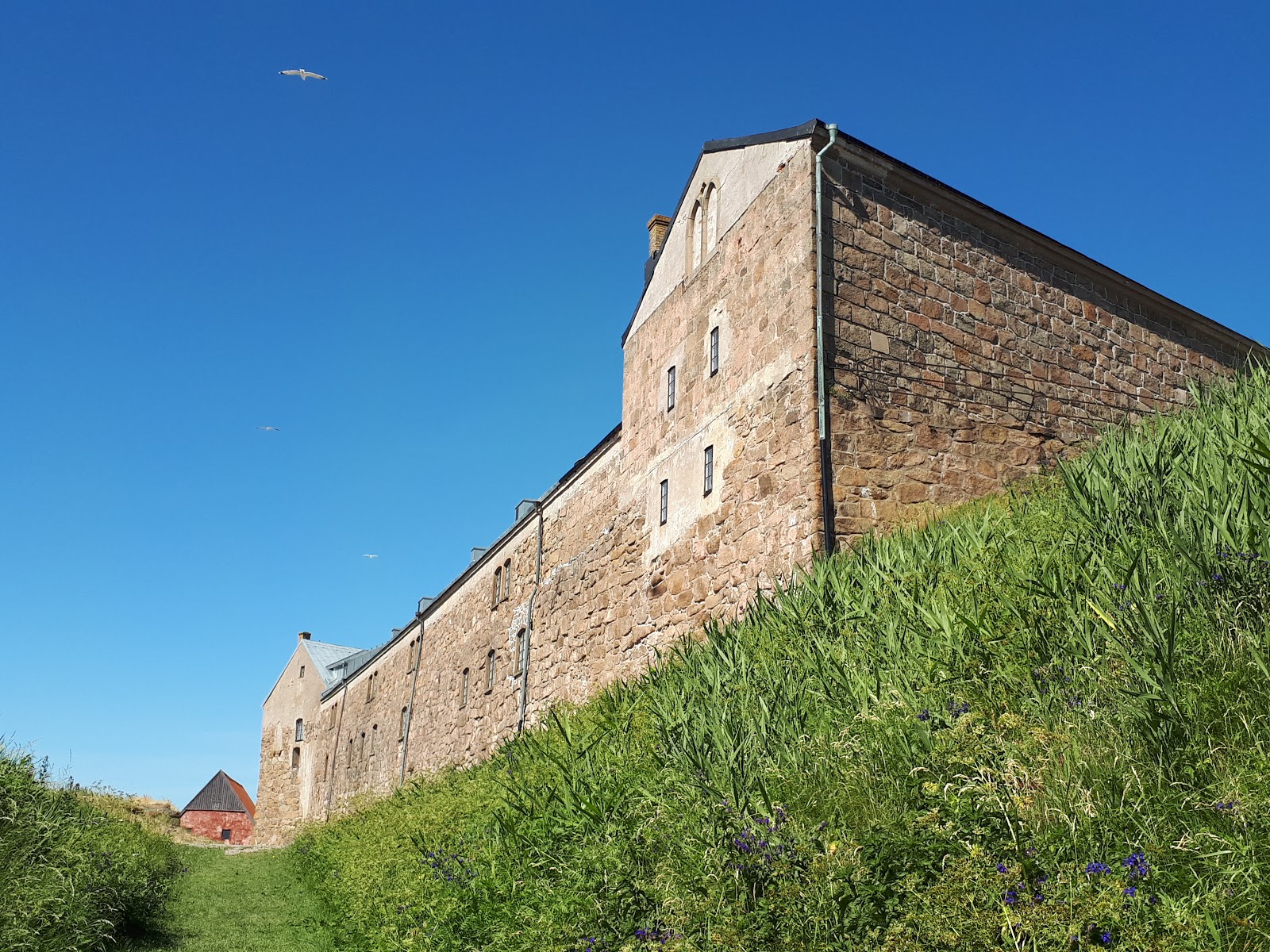
Sitten itse linnaan! Linnan ensimmäiset vaiheet olivat vuosilta 1270-1300, mutta nykymuoto edusti aika tavalla 1600-lukua. Meren puoleista laitaa reunustivat hirmuisen jämäkän näköiset muurit, varsinainen sisäänkäynti oli toiselta puolelta.

But off to the castle! Its first building phase was between 1270-1300, but its present appearance is pretty much 17th century. On the sea side the castle is surrounded by tremendously thick and sturdy fortifications, the actual entrance is on the other side.


Sisäpiha oli vähemmän torjuvan näköinen, oikeastaan hyvin sympaattinen. Hallannin kulttuurihistoriallisen museon lisäksi linnoituksessa toimii muutamia ravintoloita, taidenäyttely sekä retkeilymajakin.

The courtyard is less "rejecting", actually it's quite sympathetic. In addition to the Halland cultural history museum there are a few restaurants and cafés, art gallery and a hostel located in the castle grounds.
Varsinaiseen museoon! Ensimmäinen sali koostui yleisestä Hallannin historian näyttelystä, kivikaudesta alkaen. Näyttävimmät esineet, esimerkiksi pronssikauden kilpi, oli paikalla kopiona  alkuperäisen ollessa sijoitettuna Tukholmaan Historiskaan.

But, the actual museum itself! The first hall consisted of Hallands history in general, starting from the stone age. Some of the most impressing items, such as a bronze age shield, were presented as replicas, the original ones being located in Historiska Museet, Stockholm.
Viikinkiaikakin oli toki näyttelyssä edustettuna, kaikkineen tosin vain parilla vitriinillä -yleinen Hallannin läänin historian näyttely oli varsin kompakti kaikkineen.

Of course the viking age was presented in here too, although the exhibition was somewhat limited (only a few glass cases). All in all, the exhibition concerning the history of Halland was quite compact.
Astiamaanikkoa ihastutti, keramiikkaa keskiajalta ja uudemmalta ajalta. Hirmuisen nätti tuoppi ja sievä kolmijalkapata!

A pottery maniac was delighted, ceramics from the medieval era and early modern. Awfully pretty jug and a cute tripod!
Uudemmalta ajalta komeat kirkkomaalaukset 1700-luvun alkupuolelta, Unnarydin kirkosta.

Early modern pretties, church paintings from Unnaryd church, early 18th century.
Uudempaa historiaa, kansanomaisia tekstiileitä. Nätit kuviot erityisesti noissa neuleissa!

Newer history, traditional textiles. I especially like the knitted items!
Mutta siis, ettei totuus unohtuisi, seuraavaa huonetta ja Bockstenin miestähän tänne oikeasti tultiin katsomaan. Muu oli bonusta ja plussaa, tänne oltaisiin kyllä tultu vaikka muuta näyttelyä ei olisi ollutkaan. 1300-luvun puolivälissä maallisen taaperruksensa henkirikoksen uhrina päättänyt ja 1936 löytynyt herrahan on sikäli ihan ainutlaatuinen, että herran vaatetus on Euroopan ainoa kokonaisena säilynyt saman henkilön vaatekokonaisuus, ja vielä niin että ruumista ei ole puettu varta vasten hautajaisia varten vaan kyse on arkipäivän vaatetuksesta. Luukin on säilynyt valtavan hyvin, ja materiaalin perusteella on saatu testattua perusteellisesti, ja herran elämästä ja elämäntavoista on näin saatu paljon uutta tietoa.

But who are we kidding, in real we were here to see the next hall and the Bocksten man. Anything else was all nice and all but extra -we would've come here even if the other exhibitions would not have been around. This man, found in 1936 and originating from the mid-14th century, is an unique case especially when it comes to his clothes -a whole set of same person's clothes, the only one of its kind in medieval Europe. And as as he was a homicide victim, his clothes were not special grave clothes but a set meant for everyday use. Also his bones were in super good condition, and a lot of new information has been gained by examining them.

Herran vaatetus oli sijoitettu yhteen isoon vitriiniin jota kivasti pääsi tarkastelemaan kolmelta puolelta. Paita oli asetettu lasilevylle, joten myös alapuolen tutkaileminen onnistui (ja kyllä, taas pyllisteltiin).

The clothing of Bocksten man has been placed on one large glass case, and one could observe the garments from three directions. His shirt had been placed on a sheet glass, so one could also look at the underside (and once again I was on my hands and knees on museum floor).

Paidassa oikeastaan yllätti se, miten pieni se lopulta olikaan. Ja siis miksi ei olisi ollut, olihan herralla pituutta jotakuinkin 170 cm ja ruumiinrakenne ei mitenkään viitannut ruumiillisen työn tekijään -mutta itse tekstiilin näkeminen siinä edes oli aika wau. 

What actually took me by surprise was how small the shirt was. To think of it, why wouldn't it be, the Bocksten man was only about 170 cm tall and his body structure was far from someone who had been accustomed in doing physical work -but seeing the actual textile was really a wow -moment.
Kuva/photo M. Pulla
Kuva/Photo M. Pulla
Nahkaesineitäkin oli varustuksessa, perustarvikkeiden eli vyön, kenkien ja puukontupen lisäksi  pussukka ja sekalaisia nauhoja.

Bocksten man also had leather objects with him, the basics ie. shoes, belt and knife sheath and in addition a pouch and some leather strings.
 
Debattia herättänyt huppu ja erityisesti hupun pieni koristekaitale. Nykyisin ovat sitä mieltä jopa linnassa että se on konservoitaessa sijoitettu väärään paikkaan, oikeasti sen paikka olisi viitassa.

The hood and especially the small decorative piece, which had been causing some debate. The modern conclusion seems to be that during conservation work the piece had been placed in a wrong garment, and it should be in the cloak.
Kuva/Photo M. Pulla
Sukat ja sukkien eksoottinen kiinnitysviritys. Tämän toimintaperiaatetta ei ilmeisesti ole oikein saatu ratkaistua, tuollaisenaan se ei pysy ylhäällä.

The socks, also something that has been debated. The method of suspending them is somewhat exotic and it is unclear how it works, apparently at least not like that.
Kuva/photo M. Pulla
Paitsi itse Bockstenin miehen esineistöä, näytelyssä oli myös tieteellistä tietoa miehelle tehdyistä tutkimuksista mm. tutkijoiden videohaastattelujen muodossa sekä muutakin videomateriaalia. Miehen vaatetuskokonaisuutta esiteltiin myös klipillä jossa aiheena oli herran viimeinen aamu -miten mies herää kotona, pukee vaatteensa päälleen ja lähtee ulos. Ja tokihan paikalla oli myös kasvorekonstruktio ja nukella päällään myös rekonstruktiot vaatteista. Lievästi yrmeä ilme aiheutti sen, että oli ihan pakko ottaa "setä paheksuu" -selfie :D

In addition to the objects owned by the Bocksten man, in the exhibition there was scientific information on the research made about him in video format, interviews of the scientists. And other video material too, a clip with the theme of "Bocksten man's last morning", how he wakes up at home and gets dressed and eventually leaves the house (obviously meant for showing the clothing layers). Also present was a facial reconstruction, and along with it reconstructions of Bocksten garments. The slightly grim look was almost too tempting, I just had to take a "man disapproves" -selfie :D
Kasvo- ja vaaterekonstruktio ilman ylimääräisiä lasin heijastuksia ~~ Facial and textile reconstruction without glass case reflections, kuva/photo Hallands Kulturhistoriska Museum


Kolmas halli Borgen, linnan vanhin osa, oli ehkä enemmän lapsille ja perheille suunnattu, "sovita keskiaikaisia vaatteita" -piste, valtaistuimella kuvauttamisen mahdollisuus ja keskiaikaisia pelejä. Lautapeleistä mukana oli ainakin mylly ja alquerque, lisäksi ketteryyttä ja tasapainoa vaativia pelejä. Lautapelit ovat aina viihdyttäviä!

Taidenäyttelyä ei käyty katsomassa, mutta pienelle piipahdukselle linnan valleille oli kyllä aikaa ennen kun piti lähteä Varbergistä (joka läpiajon perusteella näytti hyvin sympaattiselta kesäkaupungilta muutenkin). Mainiot näkymät!

The third hall Borgen, the oldest part of the castle, was perhaps more meant for children and families, there were possibilities to try on some medieval clothes, a chance to take a photo of oneself in a throne and also some medieval games. Nine men's morris and alquerque were featured, and also some games that require balance and agility. Board games are always fun!

We did not check out the art exhibition, but we did have some time to see the really impressing view from the fortress walls before we had to leave Varberg (which, by a quick glance, looks like a really cute town during summertime).  


Täältä olikin hyvä lähteä sitten kohti Göteborgia ja sieltä Saksan suuntaan, siitä sitten seuraavassa postauksessa!

From Varberg we headed off towards Göteborg and from there towards Germany, more about that in next post!

Wednesday, 8 August 2018

Hupppu ja huppukangas Skjoldehamn-tyyliin ~~~ Hood and hood fabric in Skjoldehamn style

Keväällä tuli kanssaeläjältä taas vähän kommenttia, että kaapissa tuppaa olemaan liian hienoja vaatteita. Kieltämättä asiassa oli jotain perääkin, esimerkikisi herran viikinki-vaatesetin huppu oli tosiaan prameasti sininen. Ei mitenkään soveltuva siis esimerkiksi halonhakkuuseen... No, kudontaprojektiahan tässä oltiinkin kieltämättä vailla, joten ei kun huppukangas tulille.

In the spring I received (again) some comments from my Companion, he mentioned he has too fancy clothes in his living history kit. And I must admit, he indeed had some truth to it, for example his viking hood was very posh blue... Not quite something to use when chopping firewood, for example! Well, I was in need of a weaving project anyway, so a hood fabric it was going to be!

Kaulan narut solmittuna, tiiviimpi vaikkapa tuulisella säällä. ~~~ Neck strings tied, better for for bad weather

Löydöt viikinkiaikaisista hupuista ovat varsin vähäiset, mutta yksi lähes-kokonainen kuitenkin löytyy muun saman henkilön vaatekerran kera Norjasta Skjoldehamnista joten sillä mentiin (tosin tästä löytökokonaisuudesta on ollut hieman keskustelua että onko sen kantaja ollut mies vai nainen, mahdollisesti saamelainen jne.) Kaava on kuitenkin nerokas, käytännöllinen tyystin ilman leikkuujätettä joten siksikin olen kovin ihastunut siihen. Alkuperäinen norjalainen löytö oli ajoitettu 900-1000-luvun vaihteeseen.

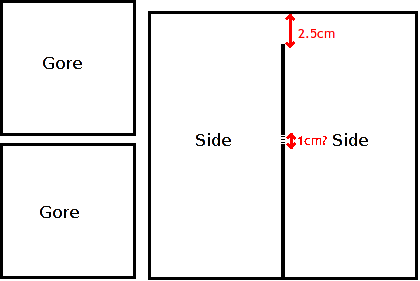
Hupun alkuperäinen kangas oli kudottu 4-vartisella toimikkaalla. Alkuperäisessä loimen tiheys on vaihtelevasti 9 ja 10 langan nurkilla/cm, kudelankaa n. 7 lankaa/cm (Nye tanker om Skjoldehamnfundet). Alkuperäisen kude oli hieman paksumpaa kuin loimi. 4-vartista toimikasta päätin laittaa tähän omaan huppuprojektiini myös, siinä kun saa kuteelle ja loimelle yhtä paljon näkyvyyttä ja molemmat puolet kankaasta ovat samanlaiset. Kaavan suhteen tein ihan aavistuksen verran alkuperäisestä eroavan kaavaratkaisun, alkuperäinen kun on kankaaltaan enemmänkin "lyhyt ja leveä" kun taas tämän omani laitoin kudontateknisistä syistä yhden sauman lisäyksellä pitkästä ja kapeahkosta kankaankappaleesta -ts. sivukappaleet eivät ole tässä versiossa vierekkäin vaan peräkkäin.

The finds of viking age hoods are very few, but there is one example that is preserved almost whole, along with the rest of the same person's clothing kit. The find is from Norway, Skjoldehamn, and although there has been some debate concerning the person's gender or ethnicity (man or woman, perhaps sápmi -or not?) I do think the pattern is brilliant, very practical with zero cutting waste, that's why I chose it. The original find has been dated to the turn of 10th-11th century.

The original fabric was a 4-shaft twill. In the original find there are 9-10 warp threads per cm, and approx. 7 weft threads per cm (Nye tanker om Skjoldehamnfundet), weft slightly thicker than the warp. I went for 4-shaft twill in my weaving too, both sides of the fabric are alike and warp and weft are equally visible. As for the pattern, I decided to alter the pattern very slightly with one extra seam, the original fabric was more like wide and short but for weaving reasons I decided to make the side pieces consecutive instead of contiguous, ie. one narrow and long fabric.

Alkuperäisen kaava ~~~ pattern of the original hood. Kuva/drawing Medieval baltic
Alkuperäinen huppu ~~~ Original hood, kuva/photo Náttmál

Mitä lankoihin tulee, käytin loimeen islantilaista yksisäikeistä Alafoss Einband -lankaa luonnonmustana -muutamia valkoisia karvoja oli joukossakin! Kudelankana toimi ruotsalainen Svarta Fåret'in Ullgarn 1 tråd tummanruskeana. Alkuperäisenkin väriä arvellaan ruskeaksi tai harmaaksi, sisäpinta Løvlidin mukaan on tummempi kuin ulkopinta ja kudelanka on mahdollisesti ollut hieman vaaleampaa kuin loimi. Toisin kuin alkuperäisessä, tässä loimi oli hieman paksumpaa kuin kude, mutta ero on varsin pieni. Kudelankaa projektiin kului 136 g, loimilankaa 189 g. Varsin vähän siis! Kudottaessa kankaan tiheys oli 7 l/cm (pirralla 3,5 l/cm, 2 lankaa yhdessä välissä), loimen leveys 38 cm. Kankaan pituus oli lopulta 236 cm.

When it comes to threads, I used Icelandic undyed black single-ply Alafoss Einband as warp (it even featured some white hair along the black ones!). Dark brown Swedish Svarta Fåret Ullgarn 1 tråd was used as weft. The original colour has been said to be brown or grey, Løvlid mentions its inside is darker than the outside, weft thread has possibly been lighter than warp. Unlike the original, my weft thread was slightly thicker than my warp thread, but not that great difference. The project used up 136 grams of yarn for weft and 189 grams for warp. Not much at all! When weaving, the density was 7 threads/cm (using a 3,5 threads/cm heddle, threaded double), weaving width 38 cm. Eventually the fabric reached the length of 236 cm.


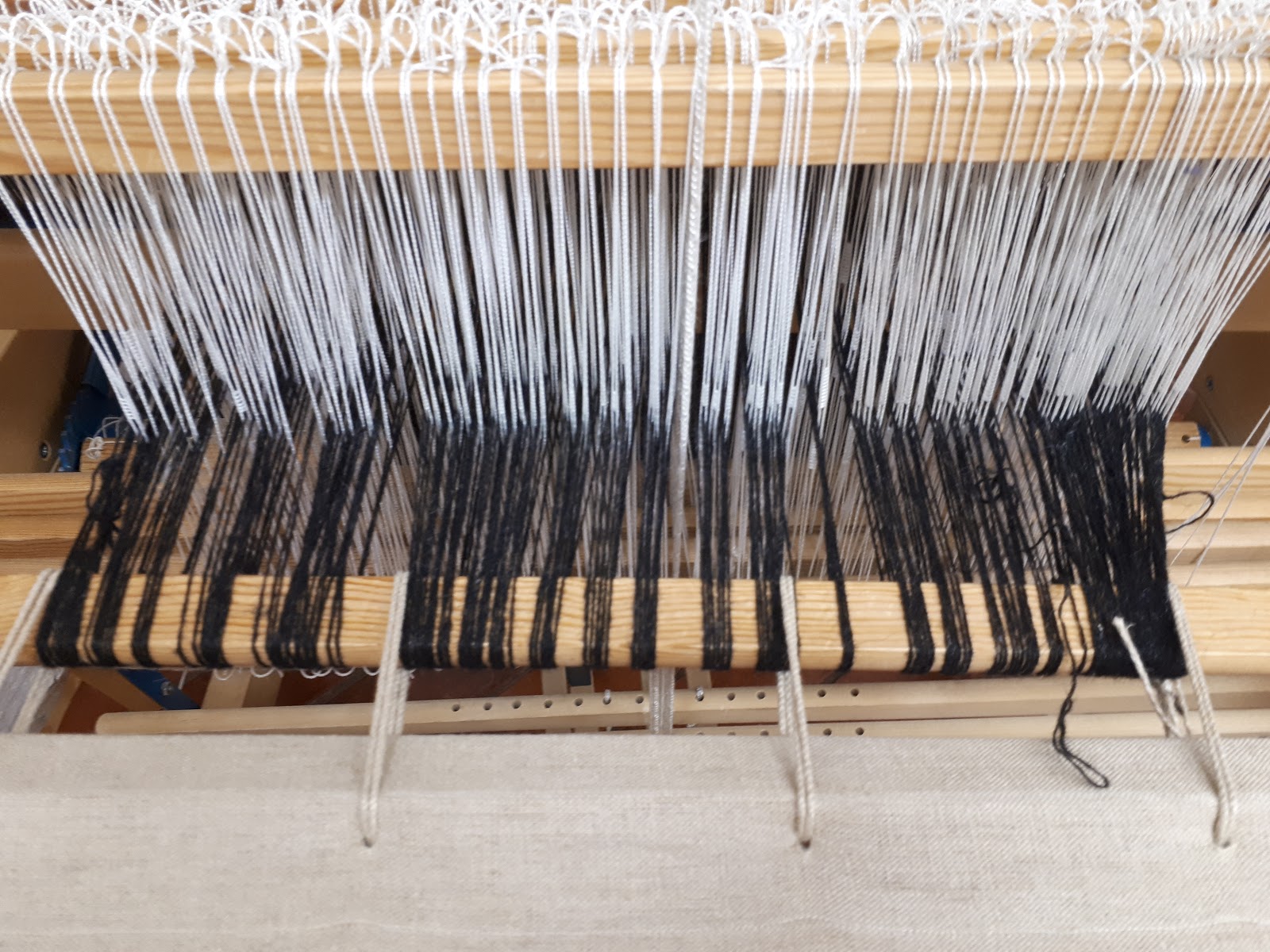
Kankaanrakentamisen vaihe hommassa tuntuu olevan se kaikkein aikaavievin ja turhauttavin  osuus -jahka kutomaan pääsee, tuntuu että homma menee siitä eteenpäin melkein itsestään. Tosin tämä tunnelma varmaan muuttuu kun itse saa sellaisen tuntuman kankaanrakentamiseen ettei joka vaihetta tarvitse erikseen tuskailla... Sitä odotellessa. Kuvasta voikin jo päätellä että tämä kutominen tapahtui moderneilla kangaspuilla alkuperäiseen sopivampien pystypuiden sijaan. Sellaisia en vielä ole päässyt varsinaisesti käyttämään pientä testaamista lukuunottamatta -taas jotain mitä odotella.

What I find the most vexing part of weaving is the dressing of the loom, even somewhat frustrating- once I get to weaving, it seems that the fabric just comes by itself! I bet this is because I have done the dressing of the loom only a few times, and I have absolutely no routine in doing it -and therefore I have to pay special attention to every single stage of the process. Waiting for that to change... One can easily spot in the photo that the weaving  was done in modern horizontal loom instead of a more period-appropriate warp-weighted loom. I haven't really gotten a chance to use a warp-weighted loom unless brief testing is taken into account -yet again, that's something to look forward to.

Ja siitähän sitä kangasta sitten alkoi syntyä kun itse kutomiseen pääsi, reunatkin muotoutuivat yllättävän siistiksi. Reunaratkaisuksi laitoin palttinareunan kaksinkertaisilla reunalangoilla.

And there, we have fabric. Even the selvedges are surprisingly nice! As for selvedges, I went for double threads and tabby structure. 

Loimi tuli kudottua varsin loppuun... Tuosta ei enää loimen viriö auennut niin että olisi saanut sukkulaa läpi! Yllättäen kuitenkin yksisäikeinen lanka kesti loimessa suorastaan mainiosti, vain muutaman jatkon joutui tekemään. Huomattavasti paremmin kuin odotin!

I wove to the point when I could absolutely not continue, I couldn't pass the shuttle through the warp! Unexpectedly the single ply yarn was quite durable, only a few broken threads were spotted. Much better than I expected!

Kankaalle tuli valmista pituutta 236 cm, joskin se hiukan tiivistyi puista otettaessa. Yritin tiivistää sitä vielä hiukan lisää pesemällä sen vähän kovakouraisestikin, hupun kun on ihan hyvä olla säänkestävä ja alkuperäisenkin sanottiin olevan vanutettu. Hiukan niin kävikin joten luulisin että tiheys on tätä nykyä suunnilleen 8 lankaa/cm. 

As I mentioned before, the finished length of the fabric was 236 cm, although it might've shrunken slightly when I took it off from the loom. I tried to shrink it a bit more by washing it not-so-gently, as hoods are best when they are weatherproof -and the original has been said to be fulled too. And I think I succeeded in that, I assume the warp density is nowadays along the lines of 8 threads/cm. 


Ompeluun käytin kudonnan ylijäämiä eli loimen tutkaimia. Mukavasti noin puolen metrin pätkissä Einband kesti myös ompelussa, pidemmässä pätkässä tosin varmaan olisi kestänytkään -kyseessä kun ei tosiaan ole ompelulanka. Kummasti kankaan oma lanka maastoutui ompelussa erinomaisen hyvin eikä pistoja juurikaan näy ellei erikseen hae vaikka ompelinkin aika "huolettomasti". Kiinnittävät saumat ompelin takapistolla, yliluottelin saumavarat kiinni toiselle puolelle ja vielä laitoin rivin "stab stitchin" ja etupiston välimuotoa (jonkinlaista tiheätä etupistoa) saumavaraa pitkin. Hätävarjelun liioittelua ehkä, mutta kangas vaikutti hyvin innokkaalta purkaantumaan joten siksi tällainen ratkaisu -nyt luultavasti pysyy paikoillaan. Alkuperäinenkin oli ommeltu moneen kertaan, joten ehkä tämä ratkaisu on siksikin perusteltu.

For sewing I used the warp leftovers. Nicely in about 50 cm lengths, Einband was suitable for sewing too -for longer lengths I expect it would not have been that successful... After all, it's far from being a sewing thread. When using the same thread as the fabric itself, the individual stitches were almost invisible even though I was kinda carefree with my sewing. I used backstitch for attaching the pieces together, whipstitched them to the side and added a row of some blend of stab stitch and running stitch to secure the seam allowances in place. That might've been a slight exaggeration,but since the fabric was very keen on fraying I thought that it's better to be safe than sorry.Also the original has been sewn several times so perhaps that also justifies this action.